

Introduction to Outsourcing for Focus
Running a business is not easy. Every day, leaders face the pressure of managing teams, keeping clients happy, watching costs, and at the same time, trying to grow. At some point, most business owners ask themselves a simple but important question: Are we spending our time on the right things?
That question is exactly where outsourcing becomes a powerful answer.
Table of Contents
The Core Problem: Doing Too Much at Once

When a company tries to handle everything in-house, something almost always suffers. It might be the quality of the core product, or the speed of delivery, or the motivation of the team. Peter Drucker, one of the most respected management thinkers of the 20th century, famously said, “Do what you do best and outsource the rest.“ This single idea captures why outsourcing is not just a cost-saving tactic; it is a strategic choice about where a company’s energy truly belongs.
Many growing businesses in Nepal and across South Asia are discovering this reality firsthand. When founders and managers are buried in HR paperwork, payroll calculations, IT troubleshooting, and administrative tasks, there is very little time and mental energy left for strategy, innovation, and client relationships.
What Outsourcing Really Means for Business Focus
Outsourcing is not about giving up control. It is about making a deliberate decision to trust specialists with functions that are not your company’s primary strength, so your own team can concentrate on what actually drives your business forward.
Gary Hamel and C.K. Prahalad, in their landmark work on core competencies, introduced the idea that companies should identify what they do uniquely well and build everything else around that. Every function that does not directly strengthen your core competency is a candidate for outsourcing.
For example, if you run a software company, your core competency is building great software, not managing payroll systems or recruiting administration. If you run a marketing agency, your strength is creative strategy, not IT infrastructure. Outsourcing the supporting functions frees your team to go deeper into what actually creates value for your clients.
The Hidden Cost of Divided Attention
There is strong evidence from organizational psychology that divided attention is expensive. Cal Newport, author of Deep Work, argues that the ability to focus without distraction on cognitively demanding tasks is one of the most valuable skills in today’s economy, and also one of the rarest. When employees are constantly pulled away from meaningful work to handle administrative or operational tasks, their ability to do their best work decreases significantly.
This is not just theory. A Gallup study on employee engagement found that employees who are able to focus on their strengths are significantly more productive, more engaged, and more likely to stay with their organization. Outsourcing non-core tasks is one practical way companies create the conditions for their people to do exactly that.
Why Growing Companies in Nepal Are Embracing Outsourcing
Nepal’s business environment is evolving rapidly. Start-ups, mid-sized firms, and even established companies are beginning to recognize that lean, focused teams often outperform larger, generalist ones. The rise of Business Process Outsourcing (BPO) and HR outsourcing services has made it easier than ever for Nepali companies to delegate functions like:
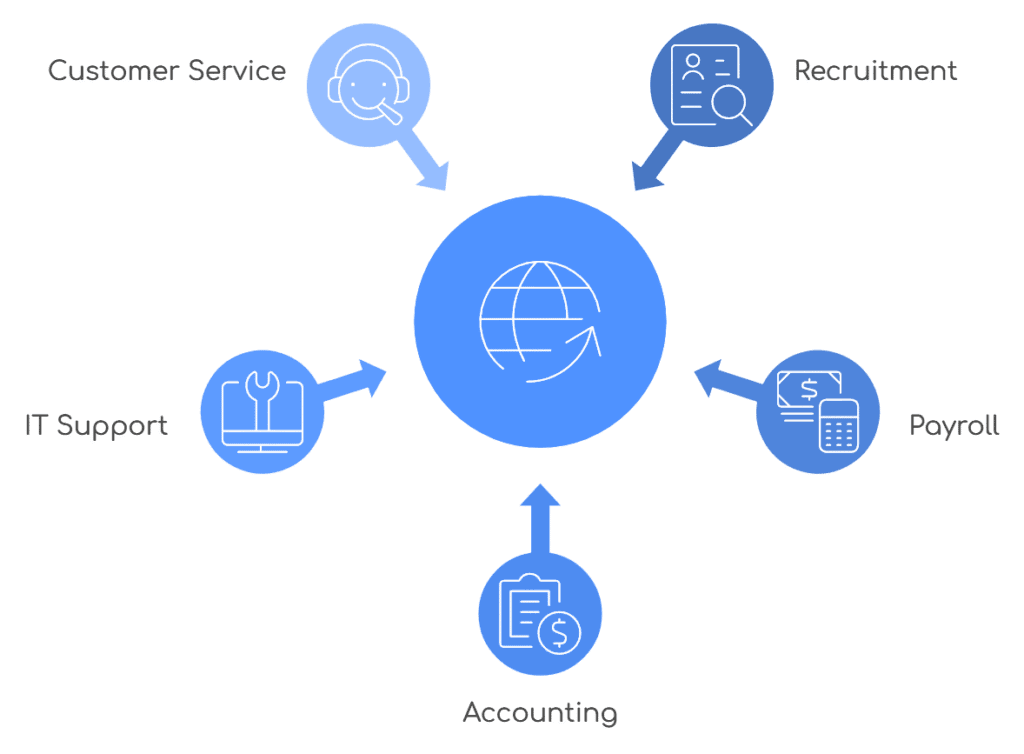
- Recruitment and talent acquisition
- Payroll processing and compliance
- Accounting and bookkeeping
- IT support and infrastructure management
- Customer service and back-office support
By working with trusted outsourcing partners, companies can access professional expertise without the long-term commitment and overhead of building large internal departments.
Focus Leads to Better Decision-Making
One of the most underrated benefits of outsourcing is what it does to leadership clarity. When senior leaders are not bogged down in day-to-day operational details, they are in a much better position to see the bigger picture, identify opportunities, and make smarter decisions.

Stephen R. Covey, in The 7 Habits of Highly Effective People, wrote about the importance of focusing on what is truly important rather than just what feels urgent. Most operational and administrative tasks are urgent but not particularly important to long-term business growth. Outsourcing creates the space for leaders to shift from being reactive to being genuinely strategic.
Outsourcing and Team Morale
There is also a direct connection between outsourcing and employee satisfaction. When skilled professionals are asked to perform repetitive or administrative tasks that fall outside their area of expertise, frustration builds over time. People who were hired to do meaningful work and find themselves buried in operational details often become disengaged.
SHRM, the Society for Human Resource Management, consistently notes that one of the top reasons employees leave organizations is the feeling that their talents are not being used well. Outsourcing the work that does not require specialized internal skills helps ensure that your team is spending their time on work that is motivating and aligned with their strengths.
A Common Concern: Does Outsourcing Reduce Quality?

This is one of the most frequent questions companies ask before outsourcing. The honest answer is: it depends entirely on who you choose to work with.
When outsourcing is done thoughtfully, with the right partner and clear communication, quality tends to improve rather than decline. This is because specialists, by definition, are better at their specific function than a generalist internal team trying to manage it as a secondary responsibility. A dedicated HR outsourcing firm, for instance, stays current with labor laws, compliance requirements, and best practices in a way that a small internal HR team simply cannot match when stretched across multiple functions.
The key is selecting outsourcing partners who understand your business context, communicate clearly, and are genuinely accountable for outcomes.
Outsourcing Is Not Just for Large Corporations
There is a common misconception that outsourcing is only for large multinational companies. In reality, small and medium-sized businesses often benefit the most from outsourcing, because they typically have the fewest internal resources and the greatest need to stay focused.
For a 20-person company in Kathmandu trying to scale, managing payroll, recruitment, compliance, and IT in-house stretches the team thin. Outsourcing even one or two of these functions can make a significant difference in how focused and productive the core team can be.
How to Start Thinking About Outsourcing
If you are considering outsourcing, the best place to start is with a simple audit. Ask yourself:
What tasks are consuming our team’s time that are not directly connected to serving our clients or building our product?
Make a list. Then assess each item: Is this something a specialist external partner could do better, faster, or more cost-effectively? If the answer is yes, it deserves serious consideration.
From there, the process is about finding the right partner, setting clear expectations, and building a working relationship built on transparency and accountability. Done well, outsourcing is not a loss of control. It is one of the smartest ways a growing company can protect its focus and invest in what truly matters.
Final Thought
The most successful companies we work with share one thing in common: they are very clear about what they do and they protect that focus fiercely. Outsourcing is one of the most practical tools available to achieve that clarity. It allows your team to stop spreading themselves thin and start channeling their energy into the work that genuinely sets your business apart.
32 views