
Introduction Talent Assessment
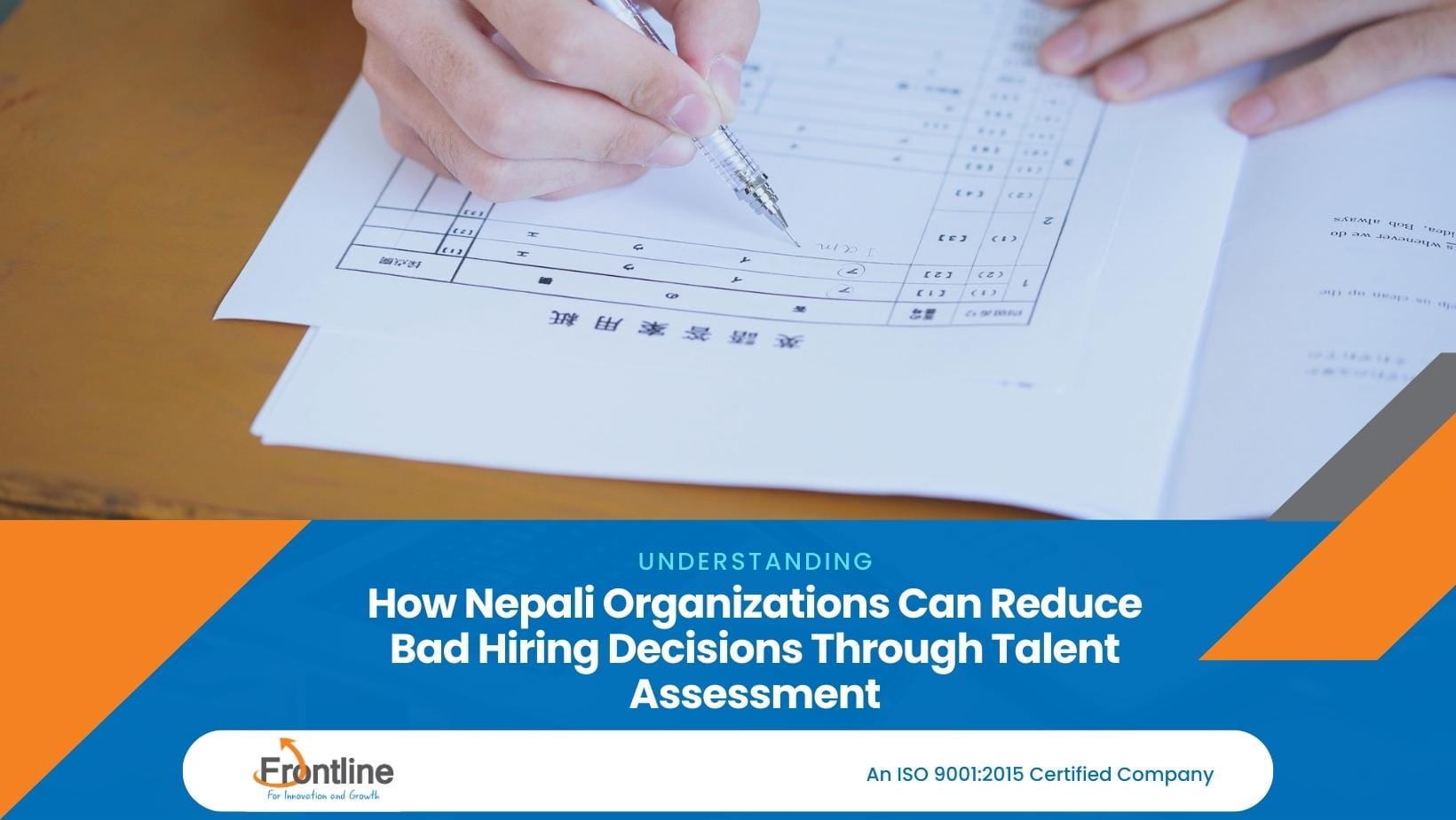
Hiring mistakes cost Nepali organizations far more than most leaders realize. Beyond salary and onboarding expenses, poor hiring decisions affect productivity, team morale, customer satisfaction, and long-term growth. In a competitive labor market where skills, adaptability, and cultural alignment matter more than ever, relying only on CV screening and unstructured interviews is no longer enough.
We believe that talent assessment is the most reliable way for Nepali organizations to reduce hiring risks, improve workforce quality, and build teams that consistently perform. This article explains how structured, data-backed assessment practices help organizations in Nepal make smarter hiring decisions, without guesswork or bias.
The True Cost of Bad Hiring Decisions in Nepal
Bad hiring decisions have direct consequences. Where many organizations operate with lean teams, one wrong hire can disrupt an entire department.
Key impacts include:
- Increased employee turnover, especially within the first year
- Lower team productivity due to skill gaps and poor role fit
- Management time wasted on performance correction and conflict handling
- Damage to employer reputation, making future hiring harder
When we examine failed hires closely, the root cause is rarely a lack of academic qualification. Instead, it is a mismatch in competency, behavior, and job readiness. These are precisely the areas traditional hiring methods fail to measure accurately.
Why CVs and Interviews Are Not Enough
CVs tell us where a candidate has worked, not how they perform. Interviews assess communication, not consistency or problem-solving under pressure.
In the Nepali context, hiring challenges are often intensified by:
- Overstated resumes
- Limited reference verification
- Cultural hesitation to ask probing interview questions
- Bias toward academic degrees over applied skills
Without objective tools, hiring decisions become subjective. This is where structured talent assessment creates a measurable advantage.
What Talent Assessment Really Measures
Talent assessment goes beyond surface-level evaluation. It focuses on predicting future job performance, not just reviewing past experience.
Effective talent assessments measure:
- Cognitive ability such as logical reasoning and learning agility
- Job-specific skills aligned with actual role requirements
- Behavioral traits including accountability, adaptability, and teamwork
- Workplace attitude and motivation
- Leadership and managerial potential, when relevant
By combining these dimensions, organizations gain a clear picture of whether a candidate can perform, grow, and align with company culture.
How Talent Assessment Reduces Hiring Errors
Objective Decision-Making
When assessments are standardized, every candidate is evaluated against the same criteria. This removes personal bias and ensures decisions are based on evidence rather than impressions.
Better Job Fit
Assessments align candidates with roles that match their strengths. This improves performance and reduces early attrition.
Predictable Performance Outcomes
Data-backed assessments correlate strongly with on-the-job success. This allows organizations to hire with confidence, even for critical roles.
Faster and More Accurate Shortlisting
Assessment tools help filter candidates efficiently, saving time for HR teams and hiring managers.
Types of Talent Assessments Suitable for Nepali Organizations
Pre-Employment Skill Assessments
These tests evaluate practical skills relevant to the role, such as accounting accuracy, data handling, sales judgment, or technical problem-solving.
Behavioral and Personality Assessments
Behavioral assessments help predict how a candidate will respond to workplace challenges, feedback, and collaboration.
Cognitive Ability Assessments
These measure learning speed, reasoning, and decision-making ability. They are especially valuable for roles requiring adaptability.
Assessment and Development Centers
For leadership and management roles, assessment centers simulate real workplace scenarios. Candidates are evaluated through group tasks, role plays, and case discussions.
Using Talent Assessment Across the Employee Lifecycle
Talent assessment is not limited to hiring. Leading Nepali organizations apply assessments at multiple stages.
Recruitment and Selection
Assessments identify candidates with the highest probability of success before making an offer.
Promotion and Internal Mobility
Objective assessment reduces favoritism and ensures the right people move into leadership roles.
Training and Development Planning
Assessment results highlight skill gaps, allowing targeted development instead of generic training.
Succession Planning
Leadership potential assessments help organizations prepare future leaders systematically.
Addressing Common Concerns About Talent Assessment
Cost Considerations
Many organizations assume assessments are expensive. In reality, the cost of one bad hire often exceeds the cost of implementing a structured assessment process.
Candidate Experience
Well-designed assessments improve candidate perception by creating a fair and transparent hiring process.
Local Relevance
Modern assessment tools can be customized for Nepali industries, job roles, and cultural context, ensuring practical relevance.
Building an Assessment-Driven Hiring Culture in Nepal
To fully benefit from talent assessment, organizations must embed it into their hiring philosophy.
Key steps include:
- Defining role-specific competencies clearly
- Training hiring managers to interpret assessment data
- Integrating assessments with interviews rather than replacing them
- Reviewing hiring outcomes regularly to improve accuracy
When assessment data guides decisions, hiring becomes consistent, defendable, and scalable.
The Strategic Advantage for Nepali Organizations
Organizations that adopt talent assessment gain a long-term edge. They build stronger teams, reduce turnover, and develop leaders internally.
In a market where skilled talent is limited and competition is growing, assessment-led hiring separates high-performing organizations from those constantly reacting to hiring failures.
We see talent assessment not as an HR tool, but as a business risk management strategy that directly supports growth, stability, and performance.
Conclusion
Reducing bad hiring decisions is not about hiring faster or interviewing harder. It is about hiring smarter.
For Nepali organizations aiming to improve workforce quality, lower turnover, and strengthen performance, talent assessment provides clarity where intuition falls short. By focusing on competencies, behavior, and potential, organizations can make hiring decisions that are accurate, fair, and future-ready.
The organizations that succeed tomorrow are those that measure talent properly today.
72 views