
Performance Management System Automation
Performance management is becoming increasingly dependent on the quality, availability, and timing of performance data. As organizations manage larger teams, multiple departments, changing business priorities, and more frequent performance conversations, relying on spreadsheets, manually compiled reports, and annual review forms can make it difficult to maintain a consistent view of performance.
A modern Performance Management System (PMS) can address this by connecting goals, KPIs, reviews, feedback, development activities, and performance records within a structured process. Automation adds another layer by reducing repetitive administrative work and making performance information available at the point when managers need to act.
The objective is not simply to digitize an appraisal form. A well-designed automated PMS creates a continuous flow of performance information from organizational objectives to individual goals, from goals to measurable outcomes, and from performance results to development and management decisions.
What Changes When Performance Management Becomes Automated?
Traditional performance management often operates as a sequence of disconnected activities. Employees receive goals at the beginning of a cycle, managers monitor progress independently, HR collects review forms later, and performance information is eventually consolidated for reporting.
Automation changes the structure of this process.
Instead of treating performance management as a periodic administrative exercise, organizations can establish a workflow in which:
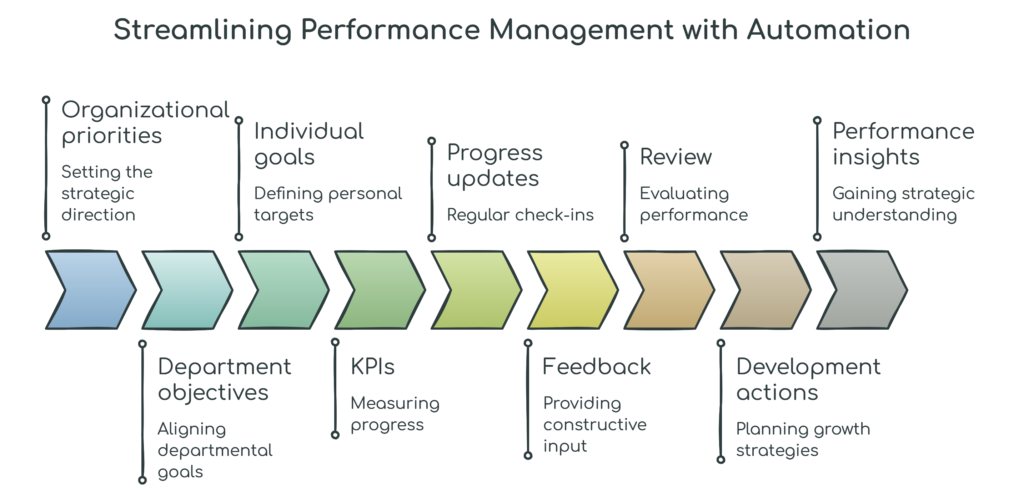
Each stage produces information that can support the next stage.
1. Start With the Performance Architecture, Not the Software
One of the most important considerations in PMS automation is that technology cannot compensate for an unclear performance framework.
Before automating a PMS, an organization needs to establish what performance actually means for different roles.
A robust performance architecture normally defines:
- Organizational objectives
- Department-level objectives
- Individual responsibilities
- Key Performance Indicators
- Target values
- Measurement frequency
- Weightage of different KPIs
- Competencies and behavioural expectations
- Review periods
- Feedback mechanisms
- Development requirements
Once these elements are clearly defined, automation can make the framework easier to operate and monitor.
2. Automate the Cascade From Business Goals to Individual KPIs
A data-driven PMS should establish a visible connection between what the organization wants to achieve and what employees are expected to deliver.
The objective can be translated into departmental targets and then into role-specific KPIs.
For example:
Organizational objective: Improve customer retention
Department objective: Increase customer renewal rate
Team KPI: Monthly renewal percentage
Individual KPI: Customer portfolio renewal rate
Supporting measure: Resolution time for customer issues
This cascading structure allows managers to examine performance at multiple levels rather than looking at individual scores in isolation.
3. Move KPI Tracking From Periodic Reporting to Continuous Data
KPI tracking is one of the strongest areas for PMS automation.
In a manual system, managers may need to collect figures from different departments before determining how an employee or team is performing. By the time the information is available, the opportunity to correct the performance gap may already have passed.
An automated PMS can establish defined measurement cycles.
Depending on the role, performance information may be reviewed:
- Daily
- Weekly
- Monthly
- Quarterly
- At defined project milestones
- At formal review periods
The appropriate frequency depends on the nature of the KPI.
The important point is that the PMS should record progress consistently rather than depending entirely on memory at the end of the review period.
Performance management software can track goals, KPIs, check-ins, feedback, development activities, and review outcomes in real time, creating a stronger foundation for workforce analytics.
4. Build Automated Workflows Around the Performance Cycle
Automation becomes particularly useful when it manages the administrative sequence surrounding performance management.
A typical automated workflow can include:
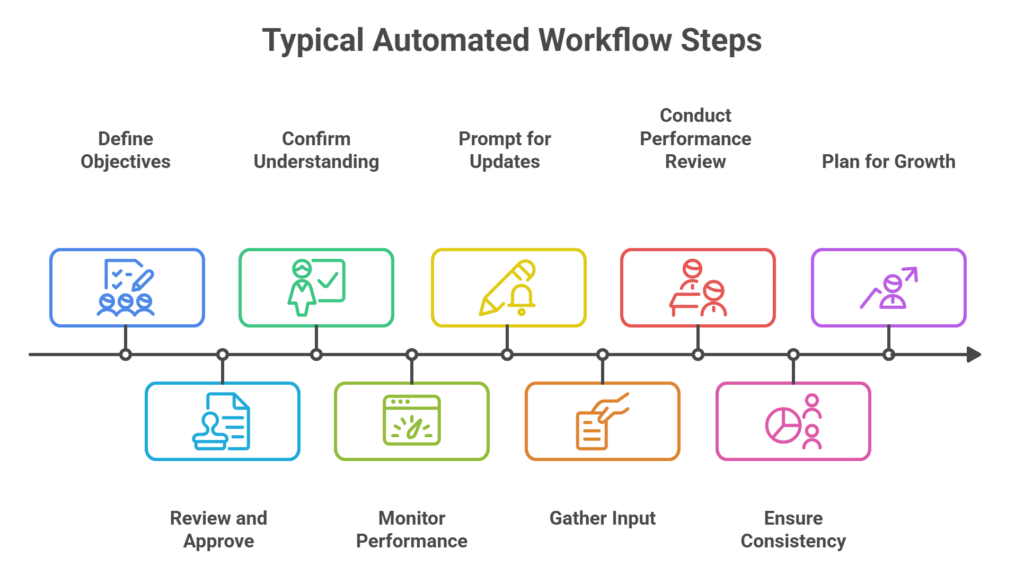
i.e. Goal setting → Manager approval → Employee acknowledgement → Progress tracking → Check-in reminder → Feedback collection → Formal review → Calibration → Development action
HR automation is particularly effective for repeatable, rules-based tasks such as routing performance review forms, sending notifications, and maintaining workflow records.
5. Replace the Annual Memory Test With a Performance Record
A major weakness of infrequent performance reviews is the amount of information managers are expected to reconstruct.
If an employee’s performance is formally assessed only once or twice a year, the review may depend heavily on recent events and the manager’s recollection of earlier work.
A more effective PMS maintains a performance record throughout the cycle.
This record can include:
- Agreed objectives
- KPI results
- Goal progress
- Manager feedback
- Employee self-assessments
- Recognition
- Development activities
- Coaching discussions
- Completed action items
- Review outcomes
- Changes to goals
This creates a more complete evidence base for formal performance discussions.
6. Automate Feedback Without Turning It Into a Form-Filling Exercise
Feedback is another area where automation needs to be designed carefully.
The purpose of automated feedback is not to increase the number of forms employees complete. It is to make relevant feedback easier to capture at appropriate points in the work cycle.
The system can connect the feedback with the relevant employee, competency, goal, or review cycle.
This produces a richer performance record than relying exclusively on an end-of-year assessment.
For organizations using 360-degree feedback, automation can further simplify the process by managing participant selection, feedback requests, submissions, aggregation, and reporting.
7. Use Dashboards to Identify Performance Patterns
A dashboard should do more than display employee scores.
The more important question is:
What does the performance data tell management about the organization?
A useful PMS dashboard can help identify patterns such as:
- Employees consistently exceeding targets
- KPIs that are frequently missed
- Departments with recurring performance gaps
- Goals that are poorly defined
- Managers with low review completion rates
- Teams requiring specific development interventions
- Competencies that are consistently weak
- Performance improvements following training
- Employees whose responsibilities have changed but whose goals have not been updated
A data-driven PMS therefore needs to support interpretation, not simply measurement.
HR technology can connect performance information with workforce analytics, allowing organizations to examine relationships between performance, development, engagement, and other workforce indicators.
8. Separate Performance Measurement From Performance Diagnosis
A score tells you what happened.
It does not necessarily explain why it happened.
This is one of the most important principles in building a useful automated PMS.
Consider an employee whose KPI achievement falls from 92% to 68%.
The system can identify the change immediately. However, management still needs to investigate the reason.
Possible factors could include:
- A change in workload
- A change in role responsibilities
- Lack of required skills
- Inadequate resources
- Process inefficiencies
- Unrealistic targets
- Changes in market conditions
- Poor coordination between teams
- Insufficient managerial support
The automated PMS should therefore support investigation through related information rather than treating the KPI score as the complete explanation.
This is where performance management becomes more valuable to management. The system identifies where attention is required, while managers determine what action is appropriate.
9. Connect Performance Data With Employee Development
A performance gap should not automatically lead to a low rating.
It should also trigger a question about capability development.
If several employees demonstrate difficulty with the same competency, the organization may have a broader training requirement.
If one employee consistently struggles with a specific responsibility, an individual development plan may be more appropriate.
A PMS can therefore connect performance outcomes with:
- Training requirements
- Coaching
- Mentoring
- Development plans
- Skill assessments
- Career development
- Leadership development
This creates a direct relationship between performance measurement and employee development instead of keeping them as separate HR activities.
10. Use Automation to Keep Goals Current
Business priorities change.
A goal that was appropriate at the beginning of a performance cycle may become less relevant after a major business change, new project, organizational restructuring, or change in customer demand.
A rigid PMS can create an unusual situation where employees are assessed against objectives that no longer reflect the work they are actually expected to perform.
An automated system should therefore allow appropriate goal modification while preserving an audit trail.
A good goal management process should distinguish between:
Original target → Approved change → Reason for change → Revised target → New measurement period
This maintains accountability without forcing employees to pursue outdated objectives.
Modern performance management platforms increasingly support changing goals and more frequent check-ins because organizational priorities can evolve during the performance cycle.
11. Design the PMS Around Data Quality
Automation can make bad data move faster.
This is why data quality needs to be treated as part of PMS design.
An organization should establish rules for:
KPI definition
Every KPI should have a clear meaning, measurement method, owner, target, and review frequency.
Data source
The organization should identify where the underlying information comes from and who is responsible for maintaining it.
Measurement consistency
The same KPI should not be calculated differently by different departments unless there is a defined reason.
Goal ownership
Every goal should have a responsible employee or team and an accountable manager.
Review history
Changes to targets, ratings, and other important performance information should be traceable.
Access control
Performance information is sensitive and should only be accessible to authorized users.
Without these controls, dashboards may create an appearance of precision while the underlying information remains inconsistent.
12. What a Data-Driven PMS Should Measure
Not every available employee metric belongs in a performance management system.
A useful PMS should prioritize measures that have a clear relationship with role expectations and organizational outcomes.
These can include four broad categories.
Business results
Revenue, productivity, customer retention, project completion, quality, cost control, operational output, or other role-specific outcomes.
Goal achievement
Progress against individual, team, departmental, or organizational objectives.
Competencies
Technical capabilities, leadership, communication, problem-solving, collaboration, customer orientation, or other competencies relevant to the role.
Development
Training completion, skill development, coaching actions, improvement plans, and progress against development objectives.
The objective is to create a balanced performance picture rather than reduce performance to a single number.
13. Automation Should Reduce Administrative Work, Not Managerial Responsibility
There is a clear boundary between what a system should automate and what managers should continue to own.
Suitable for automation
- Reminders
- Review schedules
- Goal submission workflows
- Approval routing
- Data collection
- KPI calculations
- Progress notifications
- Feedback requests
- Review form distribution
- Report generation
- Dashboard updates
- Record maintenance
Requires managerial judgement
- Setting meaningful expectations
- Understanding performance context
- Giving constructive feedback
- Coaching employees
- Diagnosing performance barriers
- Assessing behavioural competencies
- Discussing career development
- Deciding appropriate interventions
The strongest PMS models use automation to give managers better information and more time for these higher-value activities.
14. A Practical PMS Automation Framework
Organizations planning to automate performance management can approach implementation through the following sequence:
Step 1: Map organizational objectives
Identify the outcomes the organization needs to achieve.
Step 2: Define role expectations
Translate organizational and departmental objectives into responsibilities for individual roles.
Step 3: Establish KPIs and competencies
Define measurable indicators and behavioural or functional competencies appropriate to each role.
Step 4: Establish the review architecture
Determine goal-setting, check-in, feedback, review, calibration, and development cycles.
Step 5: Identify data sources
Determine where KPI and performance information will originate and how it will be validated.
Step 6: Automate repeatable workflows
Automate reminders, approvals, data collection, review routing, and reporting.
Step 7: Create performance dashboards
Give managers and HR access to relevant performance information at the appropriate level.
Step 8: Connect performance with development
Use performance evidence to identify training, coaching, mentoring, and development requirements.
Step 9: Establish governance
Define access permissions, data quality standards, review rules, documentation requirements, and responsibilities.
Step 10: Review the system itself
A PMS should also be evaluated. If managers consistently bypass a workflow, employees do not understand a KPI, or a particular measure produces poor-quality information, the performance framework may need to be redesigned.
The Future of PMS Is Not More Data. It Is Better Use of Data.
Automating a Performance Management System does not mean collecting every available employee metric.
The more important objective is to create a reliable connection between business objectives, employee expectations, measurable performance, feedback, development, and management action.
A mature PMS should allow leaders to move through a simple chain of questions:
What are we trying to achieve?
Who is responsible for it?
How will success be measured?
What does the current data show?
Where are the gaps?
Why are those gaps occurring?
What action should follow?
Did that action improve performance?
When these questions can be answered through a structured performance process, PMS becomes more than an appraisal mechanism. It becomes a management system supported by timely information and consistent decision-making.
For organizations in Nepal, the move toward a data-driven PMS also requires consideration of organizational structure, role clarity, KPI design, evaluation methods, review cycles, employee development, and the practical realities of implementation. A technology layer should support these elements rather than operate independently from them.
Building a Performance Management System That Fits the Organization
Automation should begin with the organization’s performance requirements, not with a list of software features.
Different organizations need different approaches to goal setting, KPI measurement, review frequency, feedback, competency assessment, and performance development. The right PMS therefore needs to reflect the organization’s structure, business objectives, roles, and management practices.
Frontline Consult provides Performance Management System development and implementation support in Nepal, including approaches built around KPIs, OKRs, scorecards, review mechanisms, feedback, and data-driven performance assessment. Its PMS service can be explored here:
A well-designed PMS gives organizations more than performance scores. With the right automation and data structure, it can provide management with a clearer view of progress, identify areas requiring attention, connect performance with employee development, and create a more consistent basis for organizational decision-making.
11 views