
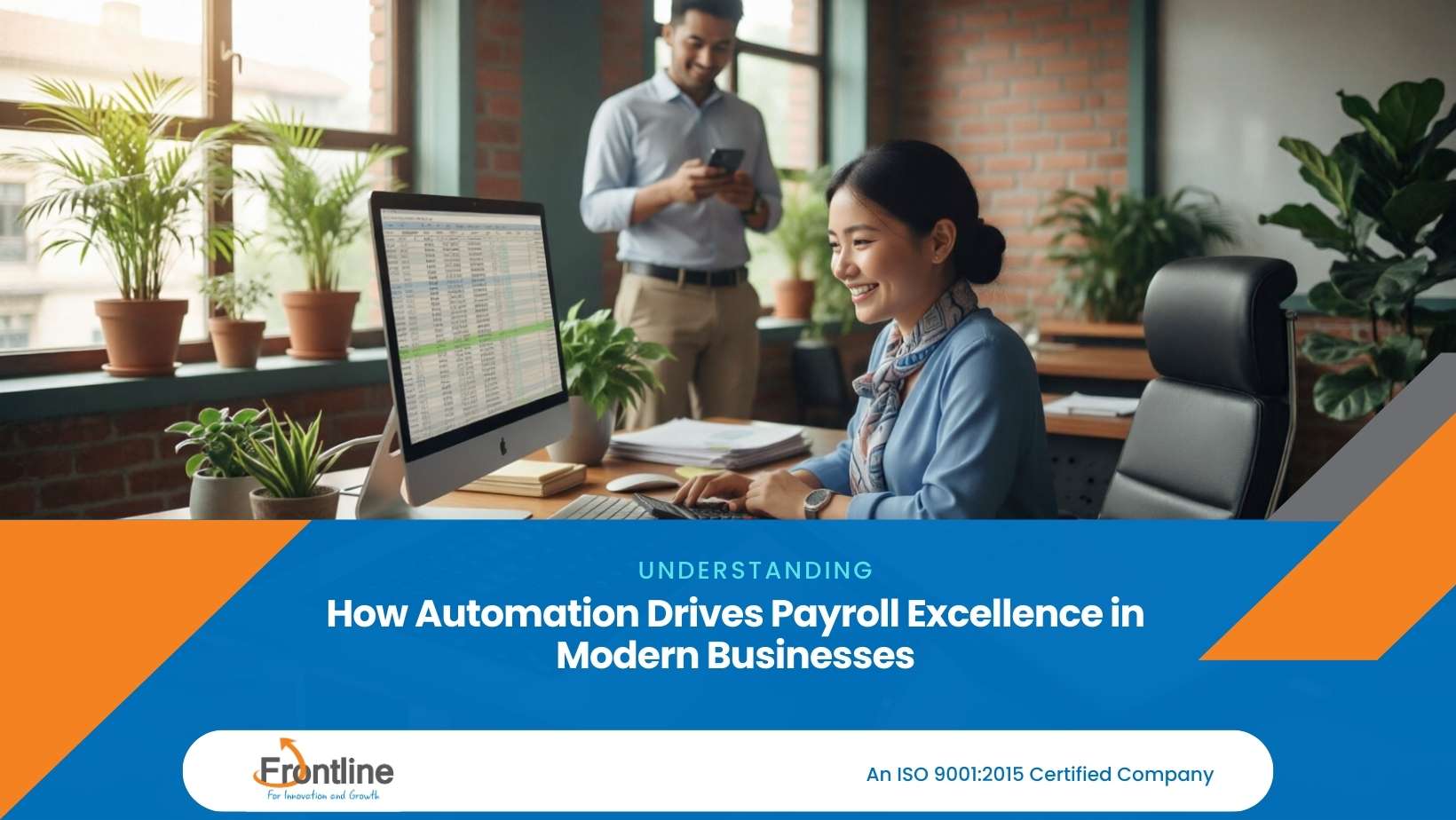
Automation for Payroll Excellence
Running payroll sounds simple on paper. But anyone who has done it manually knows the truth. It is stressful, time-consuming, and one small mistake can affect the trust of an entire team.
For many businesses in Nepal and across South Asia, payroll is still handled through spreadsheets, paper records, or basic accounting tools. This works, until it does not. As a company grows, the complexity grows with it. More employees, more deductions, more compliance requirements, and more chances for error.
This is where automation quietly changes everything.
Table of Contents
The Real Cost of Manual Payroll
Before talking about automation, it helps to understand what manual payroll actually costs a business. Not just in time, but in human energy.
The Society for Human Resource Management (SHRM) has long pointed out that HR teams spend a significant portion of their week on repetitive administrative work. Payroll sits at the top of that list. When HR professionals are buried in data entry and tax calculations, they have less time to focus on the things that actually build a great workplace: hiring the right people, supporting employee growth, and creating a culture worth staying for.
This is not a small problem. It is a strategic one.
“HR should be every company’s killer app. What could possibly be more important than who gets hired?“
Jack Welch, Former CEO, General Electric
Welch was talking about people decisions broadly, but the principle applies here too. When HR teams are too busy with manual payroll, the real work of human resources suffers.
What Payroll Automation Actually Does
Payroll automation does not replace people. It removes the tedious parts so people can do more meaningful work. At its core, an automated payroll system handles the calculations, tax deductions, leave tracking, and payment processing that used to take hours every month. It does this accurately, every single time.
Here is what that looks like in practice:
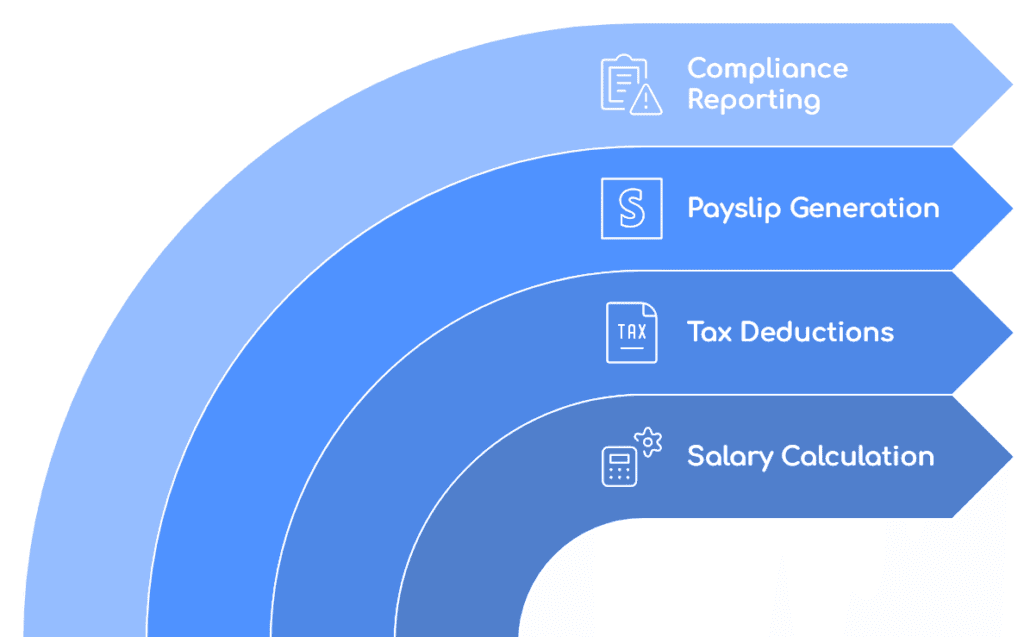
- Salaries are calculated automatically based on attendance and leave data
- Tax deductions follow the latest government rules without manual updates
- Payslips are generated and sent to employees without anyone printing or emailing them one by one
- Compliance reports are ready when needed, not scrambled together at the last minute
For a business in Nepal dealing with provident fund contributions, CIT deductions, and various allowances, this kind of accuracy is not a luxury. It is a necessity!
Trust Is Built Through Consistency
One thing that does not get talked about enough is the relationship between payroll and employee trust. Getting paid correctly and on time, every month, is one of the most basic ways a company shows its employees that it respects them.
Josh Bersin, one of the most respected voices in HR research, has written extensively about how employee experience is shaped by the small, everyday interactions a person has with their workplace. Payroll is one of those interactions. It happens every month. And when it goes wrong, the damage to morale can be significant and lasting.
Think about it this way: if an employee notices a wrong deduction on their payslip, they do not just feel frustrated about the money. They start to wonder whether the company is paying attention to them at all. Automation removes that doubt entirely.
Freeing HR to Do HR

Dave Ulrich, widely regarded as the father of modern HR, introduced the idea of HR as a strategic business partner rather than just an administrative function. His work transformed how companies think about what HR departments are actually for.
But here is the gap: many HR teams want to be strategic. They want to focus on workforce planning, learning and development, and employee wellbeing. The problem is they are too deep in spreadsheets to get there.
Payroll automation closes that gap. When the routine work is handled by a system, HR professionals get back their most valuable resource: time.
“The most important thing about HR is not what HR does but what HR delivers.“
Dave Ulrich, HR Thought Leader & Author
Delivering value means having the bandwidth to think, plan, and engage with people. Automation makes that possible.
Accuracy Is Not Optional

Payroll errors are not just inconvenient. In many countries, including Nepal, they can lead to compliance issues with tax authorities or labour laws. Deloitte’s Global Human Capital Trends research has repeatedly highlighted that compliance complexity is growing faster than most HR teams can keep up with manually.
Automated payroll systems are built to stay current with regulations. When rules change, the system updates. No one needs to remember to check the tax tables or recalculate PF contributions. It simply happens.
This kind of quiet reliability is what makes payroll automation such a smart investment for growing businesses.
A Note on Human Judgment
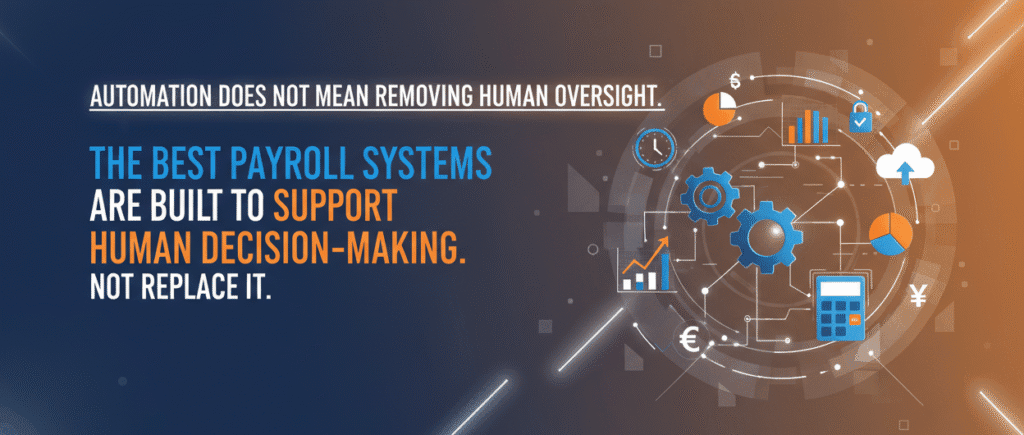
Someone still needs to review the reports, approve the runs, and handle exceptions like long-term leave or disputed deductions.
What changes is that the person doing that review is looking at clean, accurate data instead of trying to find errors in a spreadsheet at midnight before payday.
Harvard Business Review has often written about how the best use of technology in business is not to automate everything, but to automate what is repetitive so that people can focus on what requires judgment, creativity, and empathy. Payroll is a perfect example of this principle in action.
Where to Start
For businesses thinking about making this shift, the starting point does not need to be complicated. Begin by mapping out where your current payroll process breaks down. Is it in the calculations? In communicating with employees? In staying compliant with local tax rules?
Once you understand the pain points, look for a payroll system that addresses those specific needs. For Nepal-based businesses, that means something that understands local compliance requirements, works in Nepali rupees, and can handle the specifics of SSF, CIT, and provident fund contributions.
The bottom line is simple. Payroll automation is not about technology for technology’s sake. It is about giving your people, both your HR team and your employees, a more reliable, respectful, and efficient experience. And in a world where talent is increasingly hard to hold on to, that kind of consistency matters more than most businesses realise.
73 views