
Turning Performance Reviews into Growth Plans
Assessment for Development | A Practical Perspective
Most people dread performance review season. Managers feel awkward. Employees feel judged. And when it is all over, very little actually changes. But what if we flipped the whole thing around and used reviews as a real starting point for growth?
That is what assessment for development is really about. Instead of using reviews just to rate performance, we use them to understand people better and help them move forward. It is a small shift in thinking, but it makes a huge difference in practice.
Table of Contents
The Problem with Traditional Reviews
For decades, performance reviews were built around one question: “How well did this person do?” That sounds reasonable. But in reality, it puts people on the defensive. Nobody wants to sit across from their manager and hear a list of things they did wrong.
Marcus Buckingham, one of the world’s most respected voices in people development, has spent years studying what actually helps employees thrive at work. His research found something striking: when people get to use their strengths regularly at work, they are far more engaged and productive. Yet most performance systems focus almost entirely on fixing weaknesses.
“People leave managers, not companies.”Gallup Workplace Research
This famous finding from Gallup tells us something important. When people feel unsupported or misunderstood by their manager, no amount of salary or perks keeps them around. And a review that only judges without guiding is one of the fastest ways to damage that trust.
What “Assessment for Development” Actually Means
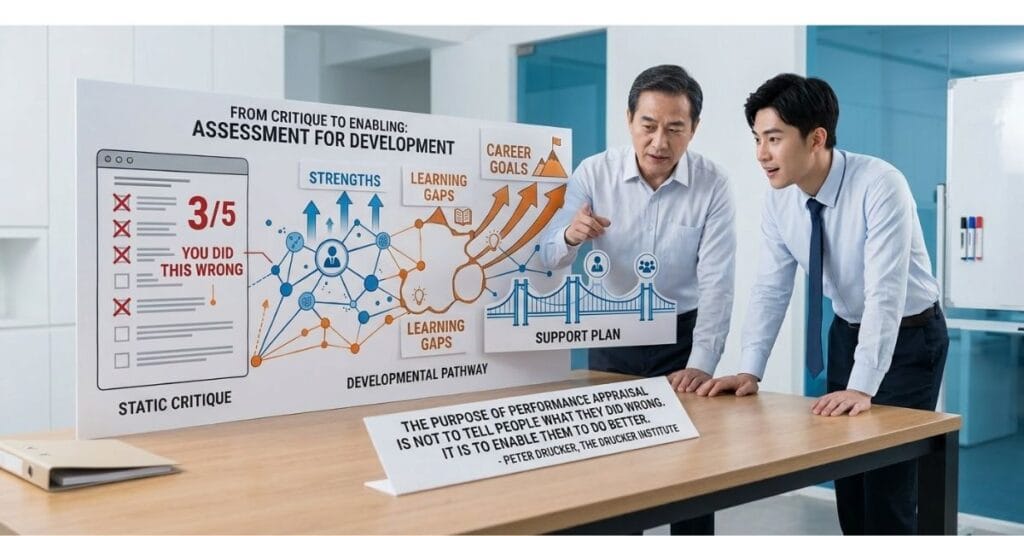
Assessment for development means using the review process to understand a person’s strengths, learning gaps, and career goals, and then building a plan around those things. It is not about lowering standards. It is about raising the conversation from “you scored a 3 out of 5” to “here is where you are strong, here is where you can grow, and here is how we will support you.”
Peter Drucker, widely considered the father of modern management, put it simply and well. He believed the job of a manager is to make people capable of joint performance. A review that does not lead to growth simply does not fulfill that purpose.
“The purpose of performance appraisal is not to tell people what they did wrong. It is to enable them to do better.”Peter Drucker, The Drucker Institute
Strengths First, Always
One of the most important things research tells us is that people grow faster when they build on what they are already good at. This does not mean ignoring problems. It means starting the conversation from a place of confidence rather than shame.
Buckingham’s work at the ADP Research Institute showed that teams where managers know their people’s strengths are significantly more engaged. Engaged teams do better work, stay longer, and support each other more. It is not just a “nice to have.” It is good management.
So in a growth-focused review, the first question should be: what is this person genuinely good at? Not what the role requires in general, but what this specific person brings to the table that is real and valuable.
Turning the Review into a Growth Plan
Once you understand someone’s strengths and areas for growth, the next step is building a plan together. Not a plan handed down from above, but something the employee genuinely owns. This is where many organizations miss the mark. They write a plan, file it, and forget it until the next review cycle.
David Ulrich, one of the most cited HR thinkers in the world, often talks about HR’s role in building human capability, not just managing processes. A growth plan is a capability-building tool. It should answer three simple questions.
Three Questions Every Growth Plan Should Answer
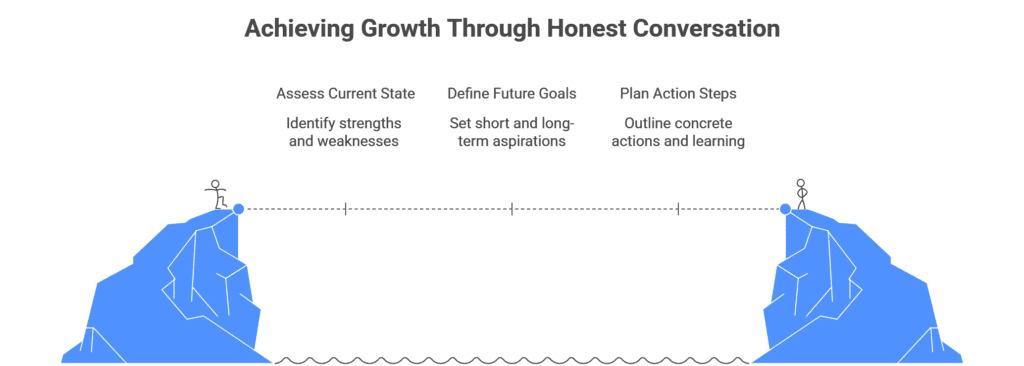
- Where are you now? An honest look at current strengths, skills, and areas that need more work.
- Where do you want to go? Short-term goals tied to the role, and longer-term career aspirations that matter to the person.
- How will you get there? Concrete actions, learning opportunities, and support from the manager or team.
These questions do not require a complicated system. They require honest conversation and genuine care for the person sitting across from you.
The Manager’s Role in All of This

None of this works without managers who actually care about people’s growth. And that takes both skill and intention.
Liz Wiseman, author of Multipliers, found that the best leaders amplify the intelligence and capability of the people around them. They ask more questions than they give answers. They create space for people to figure things out. In a review context, this means listening more and judging less.
A manager who uses a review to genuinely understand their team member, and then actively helps them grow, is doing something far more valuable than filling out a form. They are building loyalty, capability, and trust all at once.
Making It Work in Practice
You do not need a big system overhaul to start doing this. Even within existing review frameworks, you can shift the tone and focus. Before the review, ask the employee to reflect on their own growth, not just their performance. During the review, spend at least half the time talking about the future. After the review, check in regularly rather than waiting another year.
Gallup’s ongoing State of the Global Workplace research consistently shows that employees who feel their manager cares about their development are more productive and more committed to their organization. That is not a surprising finding. It is something most people know intuitively. What matters is actually acting on it.
Performance reviews do not have to be something people dread. When done with the right intention, they can be one of the most meaningful conversations a manager and employee have all year. The goal is not a perfect score. The goal is a person who leaves that conversation feeling seen, supported, and ready to grow.Written for HR practitioners and people managers.
33 views