
Table of Contents
What Is an EOR in Nepal?
An Employer of Record (EOR) in Nepal is a third-party organization that legally employs workers on behalf of a foreign or domestic company. The EOR acts as the official employer for legal, tax, and HR compliance purposes while the client company retains full control over the employee’s day-to-day tasks, deliverables, and performance.
This model is designed for companies that want to hire employees in Nepal without going through the time-consuming and expensive process of registering a local legal entity, such as a Private Limited Company (Pvt. Ltd.) under the Companies Act 2006. In 2026, EOR adoption in Nepal has accelerated sharply as global companies prioritize agile workforce strategies.
Here is how responsibilities are divided between the EOR and the client company:
| Responsibility | EOR Provider | Client Company |
| Employment contract | Yes | No |
| Payroll processing | Yes | No |
| Tax withholding (TDS) | Yes | No |
| Daily work direction | No | Yes |
| Project management | No | Yes |
| Performance reviews | Shared | Yes |
Why Hire in Nepal in 2026?
Nepal is one of South Asia’s most compelling talent destinations in 2026, especially for technology, IT services, and business process outsourcing (BPO). Here are the key reasons global companies are turning to Nepal EOR services to tap into this market.
Strong IT & Tech Talent Pool
Nepal produces more than 10,000 IT graduates annually from institutions such as Tribhuvan University and Kathmandu University. English proficiency is high among professionals, and Nepal consistently ranks favorably in global outsourcing indexes for software development, QA testing, and digital marketing talent.
Competitive Labor Costs
The average salary for a software developer in Nepal ranges from NPR 50,000 to NPR 200,000 per month (approximately USD 375–1,500 as of 2026), making it significantly more cost-effective than comparable skill sets in India, the Philippines, or Eastern Europe.
Time Zone Advantage
Nepal Standard Time (NPT, UTC+5:45) offers an effective overlap window with both European and North American teams.
Government Support for Foreign Investment
The Foreign Investment and Technology Transfer Act (FITTA) 2019 and the Industrial Enterprises Act 2020 demonstrate Nepal’s active push to attract foreign businesses. Digital infrastructure has continued to expand, with internet penetration exceeding 75% as of early 2026, according to the Nepal Telecommunications Authority.
How EOR Nepal Works
Using an Employer of Record in Nepal is a straightforward process that typically follows these steps:
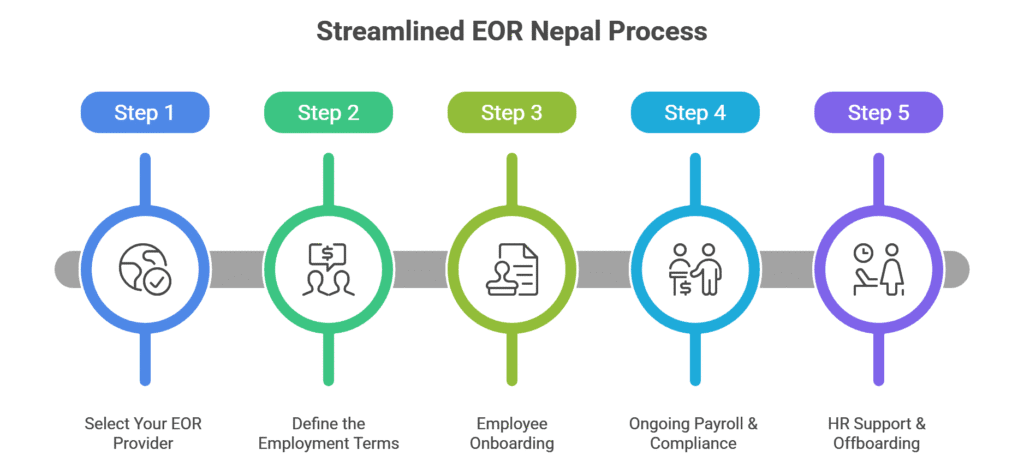
Step 1 — Select Your EOR Provider: Choose a Nepal EOR provider with a verified legal presence and a track record of compliance with the Labor Act 2017 and related regulations.
Step 2 — Define the Employment Terms: Work with your EOR to define salary, job title, work hours, benefits, and any probationary period. All of this is encoded in a compliant employment contract.
Step 3 — Employee Onboarding: The EOR issues the employment contract in the employee’s name, registers them with the Employees’ Provident Fund (EPF) or Social Security Fund (SSF), and sets up payroll.
Step 4 — Ongoing Payroll & Compliance: Every month, the EOR processes salary, withholds income tax (TDS) at the applicable slab rate, remits social security contributions, and provides payslips to the employee.
Step 5 — HR Support & Offboarding: When needed, the EOR handles leave management, contract renewals, statutory benefits, and when employment ends, compliant termination and gratuity calculations.
The entire process from signing an EOR agreement to an employee receiving their first paycheck can take as few as 3 to 7 business days, compared to 3–6 months for entity incorporation.
Nepal Employment Law: What You Must Know
A reputable Nepal EOR provider will manage all statutory requirements on your behalf. However, understanding the legal landscape helps you make informed decisions.
Labor Act 2017 (Shramik Ain)
This is the cornerstone of employment law in Nepal. Key provisions include:
- Written employment contracts are mandatory for all employees.
- Probation period may not exceed 6 months.
- Working hours: Standard is 8 hours per day and 48 hours per week.
- Overtime pay: 1.5x the regular hourly rate.
- Annual leave: 1 day of paid leave for every 20 working days.
- Sick leave: 12 days of paid sick leave per year (after 1 year of service).
- Maternity leave: 98 days (60 days fully paid by employer; balance covered by the Social Security Fund).
- Paternity leave: 15 days of paid paternity leave.
Social Security Fund (SSF)
Nepal’s Social Security Fund (SSF), established under the Social Security Act 2017, is mandatory for formal sector employees. Contribution rates are:
- Employee contribution: 11% of basic salary
- Employer contribution: 20% of basic salary
These contributions cover medical, accident, dependent, and old-age protection schemes.
Employees’ Provident Fund (EPF)
For companies not enrolled in the SSF, EPF contributions apply at 10% from the employee and 10% from the employer, both calculated on basic salary.
Gratuity
Employees who complete 3 years of continuous service are entitled to gratuity upon separation. The standard rate is 8.33% of the basic salary per year of service.
Income Tax (TDS) — Fiscal Year 2025/26
Nepal uses a progressive personal income tax structure. The applicable tax slabs for fiscal year 2025/26 are:
| Annual Income (NPR) | Tax Rate |
| Up to 600,000 | 1% |
| 600,001 – 800,000 | 10% |
| 800,001 – 1,100,000 | 20% |
| 1,100,001 – 2,000,000 | 30% |
| Above 2,000,000 | 36% |
An EOR in Nepal handles all TDS calculations, withholdings, and remittances to the Inland Revenue Department (IRD) on behalf of both the employee and the client company.
EOR vs. Setting Up a Legal Entity in Nepal
Many companies considering Nepal expansion ask: Should I use an EOR or register my own company? Here is a detailed comparison:
| Factor | EOR Nepal | Own Legal Entity |
| Setup time | 3–7 days (approx) | 3–6 months |
| Setup cost | None (in EOR fee) | USD 3,000–10,000+ |
| Ongoing compliance | Managed by EOR | Your responsibility |
| Risk of misclassification | Low | High if self-managed |
| Scalability | High | Low (fixed overhead) |
| Best for | 1–50 employees | 50+ employees, long-term |
| Exit flexibility | High | Low (liquidation needed) |
Bottom line: If you are hiring fewer than 50 employees in Nepal, or testing the Nepal market, using an EOR in Nepal is almost always faster, cheaper, and lower-risk than entity setup.
Key EOR Services in Nepal
A full-service Nepal EOR provider typically offers the following:
- Employment contract drafting in Nepali and English, compliant with Labor Act 2017
- Payroll processing in Nepali Rupees (NPR) with monthly payslips
- Tax withholding (TDS) and filings with the Inland Revenue Department
- SSF/EPF enrollment and monthly statutory contributions
- Gratuity calculation and provisioning
- Leave management (annual, sick, maternity, paternity)
- HR helpdesk support for employee queries
- Background verification and onboarding support
- Termination management and severance calculation
- Visa and work permit assistance for expatriate hires
How to Choose the Right EOR Provider for Nepal
With a growing number of global and regional EOR platforms entering the Nepal market in 2026, selecting the right partner is critical. Evaluate providers on the following criteria:
Local Legal Presence
Verify that the EOR provider has a registered entity in Nepal and not just a reseller agreement with a local partner. This ensures they bear the legal employer-of-record liability.
Compliance Track Record
Ask for references from existing Nepal clients and check whether they have a dedicated in-country compliance team that monitors changes to Nepal’s Labor Act, Social Security Act, and IRD circulars.
Payroll Currency & Turnaround
Confirm that the EOR processes salaries in NPR and can meet Nepal’s payroll calendar; most formal sector employees expect salary credit between the 25th and the end of the month.
Data Privacy Compliance
Since Nepal enacted the Individual Privacy Act 2018, employee personal data must be handled carefully. Confirm the EOR’s data protection protocols and whether they align with your company’s data governance standards.
Top Industries Using EOR in Nepal
The following sectors are the primary drivers of EOR adoption in Nepal as of 2026:
| Industry | Common Roles | Why Nepal? |
| IT & Software Development | Developers, QA Engineers, DevOps | 10,000+ IT graduates/year; competitive salaries |
| BPO & Customer Support | Customer Service, Data Entry | Strong English skills; lower costs than India |
| Digital Marketing & Content | SEO Specialists, Content Writers | High English literacy; growing digital economy |
| Finance & Accounting | ACCA/CFA Professionals, Analysts | Quality professional qualifications |
| E-commerce Support | Catalog Mgmt, Logistics Coordination | Time zone overlap with AU/UK markets |
Conclusion
EOR Nepal is the fastest, most compliant way for foreign companies to access Nepal’s growing talent pool in 2026 — without the complexity and cost of entity registration. Whether you are hiring your first Nepali developer, building a remote BPO team, or piloting a market entry strategy, an Employer of Record in Nepal gives you the legal cover, payroll infrastructure, and HR support to move quickly and confidently.
Nepal’s Labor Act 2017 is clear, its Social Security framework is maturing, and the talent pool; particularly in IT, finance, and digital services continues to expand. The companies that move now will have a significant head start in securing top-tier Nepali professionals.
Ready to hire in Nepal? Partner with a verified EOR provider and onboard your first Nepal-based employee within the week.
25 views