
Table of Contents
Introduction to Skill Auditing
Most organisations talk about talent. Fewer actually understand it. The gap between knowing you have good people and knowing what those people can actually do is where most HR strategies quietly fall apart. That is where skill auditing steps in, not as a trendy concept, but as a practical, grounded approach to understanding your workforce from the inside out.
We believe that building a data-driven talent strategy starts with one honest question: do we actually know what skills exist in our organisation right now?
Why Intuition Alone Is No Longer Enough
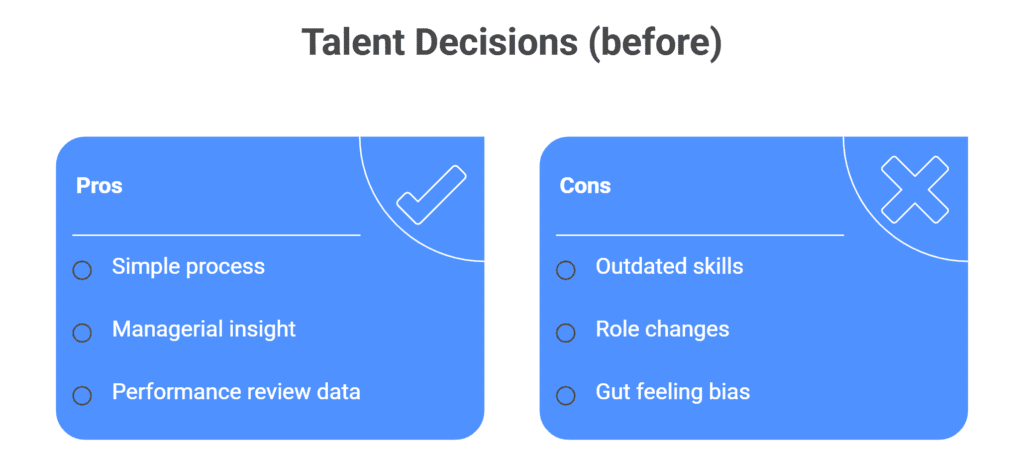
For decades, talent decisions were made on gut feeling, manager recommendations, and annual performance reviews. That approach worked when workplaces were simpler. Today, roles change faster than job descriptions can keep up with, and the skills needed tomorrow often do not match what was hired for yesterday.
Josh Bersin, one of the most respected voices in global HR research, has consistently pointed out that organisations are shifting from job-based structures to skills-based organisations. In his research, he notes that companies focusing on skills rather than titles are more agile, more innovative, and better at retaining talent. You can explore his ongoing research at joshbersin.com.
This shift is not just philosophical. It is operational. And it begins with knowing what you have.
What a Skill Audit Actually Is
A skill audit is a structured process of identifying, mapping, and evaluating the skills your employees currently possess, and then comparing them against what the organisation needs now and in the future.
It is not a performance review. It is not a training needs assessment alone. It is a comprehensive internal inventory that gives HR leaders and business managers a clear, evidence-based picture of workforce capability.
When done well, a skill audit answers three core questions:
- What skills do our people currently have?
- Where are the critical gaps?
- How do we close those gaps strategically?
The Link Between Skill Auditing and Strategic HR
Dave Ulrich, widely regarded as the father of modern HR, has long argued that HR must earn a seat at the strategic table by delivering business value, not just managing processes. His HR Business Partner model calls for HR to align talent decisions with organisational goals. A skill audit is one of the most direct ways to do exactly that.
When HR can walk into a leadership meeting and say “we have identified a gap in data analytics capability across three departments, and here is a mapped plan to address it,” that is strategy. That is not administration. Ulrich’s foundational work is well documented at rbl.net.
We see skill auditing as the foundation of that kind of credibility.
How to Conduct a Meaningful Skill Audit
There is no single template that works for every organisation, but there is a clear process that we recommend following.
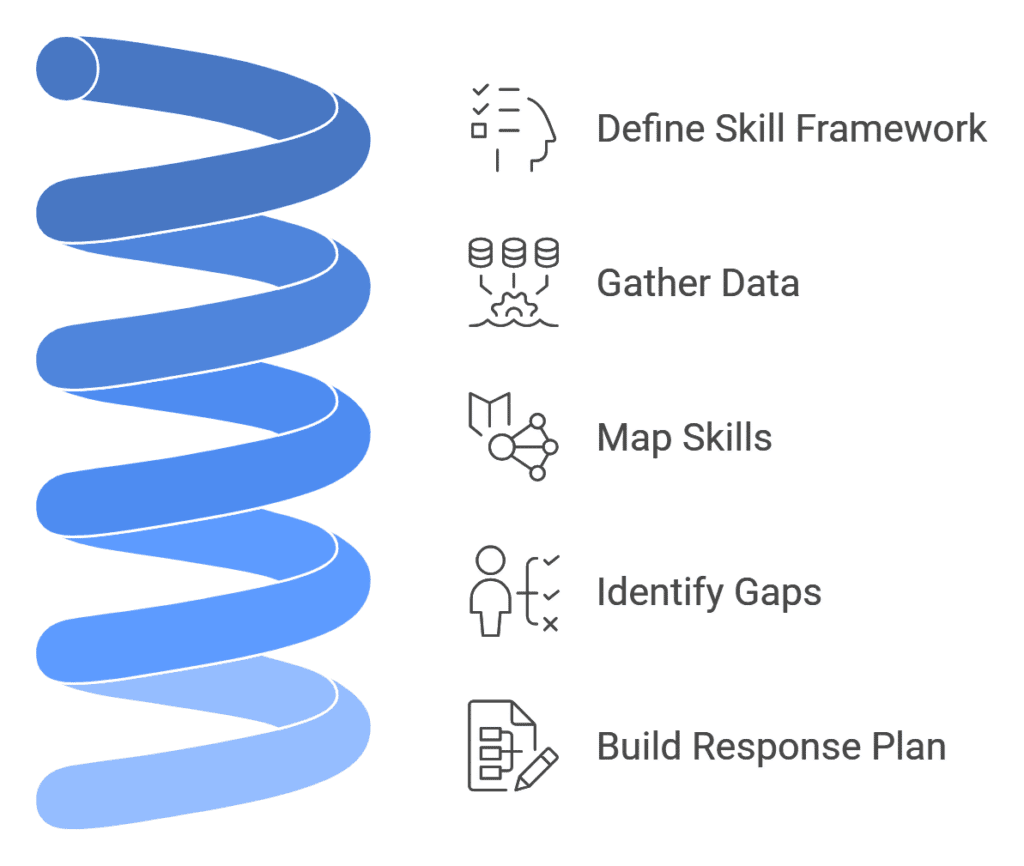
Step 1: Define the Skill Framework
Before you can measure skills, you need to agree on what skills matter. Work with department heads to build a competency framework that reflects both current needs and future direction. This includes technical skills, behavioural competencies, and leadership capabilities.
Step 2: Gather Data Through Multiple Sources
Relying on self-assessments alone creates blind spots. A strong skill audit triangulates data from self-assessments, manager evaluations, and observed performance. Tools like 360-degree feedback, structured interviews, and skills mapping software all contribute to a more complete picture.
The Society for Human Resource Management (SHRM) provides extensive guidance on competency-based assessments and how organisations can structure these effectively. Their resources are available at shrm.org.
Step 3: Map Skills Against Business Needs
Once data is collected, it must be interpreted in the context of where the business is going. A skill that is abundant today may be irrelevant in three years. A skill that barely exists in your workforce may become critical. This forward-looking analysis is what separates a true data-driven talent strategy from a simple HR exercise.
Step 4: Identify Gaps and Prioritise Action
Not all gaps are equal. Some are urgent and mission-critical. Others are developmental over time. Prioritise based on business impact, not just volume of absence.
Step 5: Build a Response Plan
Gap identification without action is just documentation. The response plan should include a combination of upskilling existing employees, targeted hiring, internal mobility, and in some cases, restructuring roles entirely.
Skill Auditing and Employee Engagement
Here is something that often gets overlooked: employees benefit from skill audits too.
When people understand where their strengths lie and what growth areas exist, they feel more invested in their own development. Research from Gallup consistently shows that employees who feel their manager takes interest in their development are more likely to be engaged and stay with the organisation. Gallup’s workplace research is publicly accessible at gallup.com.
In the Nepali context, where talent retention is a genuine challenge and many skilled professionals consider opportunities abroad, giving employees a clear picture of their growth path within your organisation is not just good HR practice. It is a retention strategy.
Turning Audit Data Into Real Talent Decisions
Data without action is noise. The real value of a skill audit materialises when organisations use findings to make better decisions across the entire talent lifecycle.
In Recruitment: Knowing exactly what skills are missing means you can hire with precision rather than broad job descriptions that attract the wrong candidates.
In Learning and Development: Training budgets are always limited. Skill audit data tells you exactly where to invest, so learning programmes are targeted and measurable rather than general and hopeful.
In Succession Planning: When leadership gaps appear, organisations with strong skill data can identify internal candidates with confidence. This is particularly important for organisations in Nepal that are building long-term leadership pipelines.
In Performance Management: When managers understand the skill profiles of their team members, performance conversations become more specific, more honest, and more developmental.
Common Mistakes Organisations Make
We have seen skill audits fail, and the reasons are usually the same.
The first mistake is treating it as a one-time exercise. Skills change. Business needs change. A skill audit conducted once and filed away becomes irrelevant within a year. It needs to be a living process, revisited regularly.
The second mistake is making it feel like a surveillance exercise. If employees perceive the audit as a way to identify underperformers, they will not engage honestly. Communication is everything. Frame it as a development tool, not an evaluation threat.
The third mistake is collecting data but failing to act on it. Nothing destroys employee trust in HR processes faster than participating in something that produces no visible outcome.
Technology as an Enabler
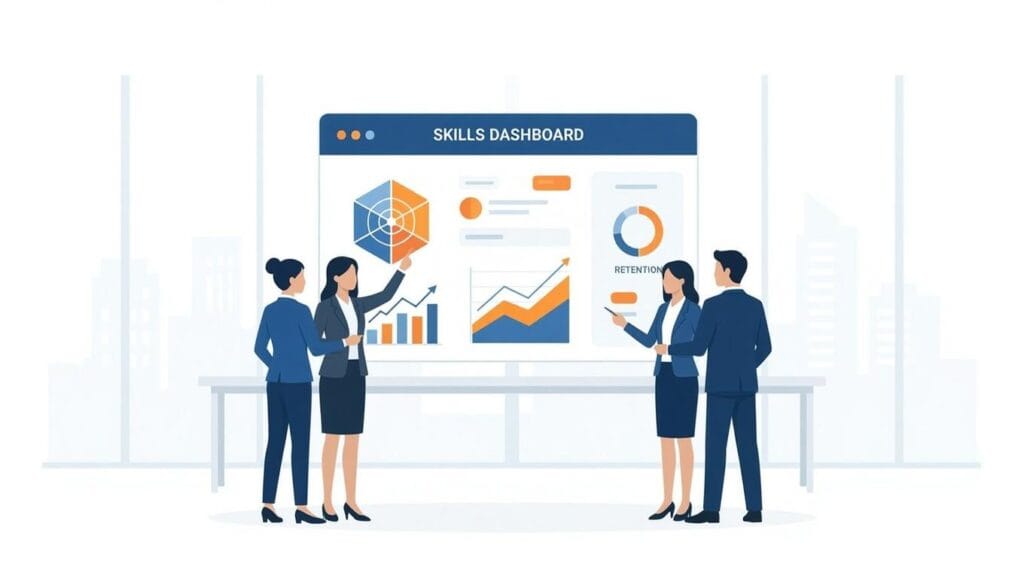
We are now in an era where HR technology can make skill auditing far more efficient and dynamic than it once was. Platforms built around skills intelligence allow organisations to map skills in real time, identify adjacencies, and model workforce scenarios for future planning.
Pioneers like LinkedIn have invested heavily in skills-based talent infrastructure. Their annual Workplace Learning Report tracks how organisations are shifting towards skills-first hiring and development. The report is available at learning.linkedin.com.
Even without enterprise-level software, organisations can build meaningful skill audits using structured spreadsheets, clear frameworks, and disciplined follow-through.
The Bigger Picture: Skills as Organisational Currency
We believe that skills are becoming the true currency of the modern workplace. Not job titles. Not years of experience. Not academic qualifications alone. What people can actually do, and how quickly they can learn to do new things, is what determines both individual and organisational success.

Lynda Gratton, Professor at London Business School and a globally recognised thinker on the future of work, has written extensively about how organisations that invest in understanding and developing human capability are better positioned for long-term resilience. Her work, including the widely read book The 100-Year Life, is referenced at lyndagratton.com.
For organisations in Nepal, this is a timely and urgent conversation. The workforce is young, capable, and hungry for development. The organisations that build systems to understand and grow that capability will be the ones that lead.
Where to Begin
If you are starting from scratch, do not let the scale of the task paralyse you. Begin with one department. Build a simple skill framework. Run a small audit. Learn from it. Then expand.
The goal is not a perfect system on day one. The goal is to replace guesswork with knowledge, and to make talent decisions that are grounded in reality.
That is what a data-driven talent strategy means in practice. And a skill audit is exactly where it starts.
52 views