

Table of Contents
Compensation Benchmarking
In today’s competitive talent landscape, paying people fairly is no longer just a moral responsibility. It is a business strategy. For HR professionals and business leaders across Nepal and South Asia, understanding how compensation benchmarking works and why it matters can be the difference between building a high-performing team and constantly losing your best people to competitors.
At its core, compensation benchmarking is the process of comparing your organisation’s pay structures against the broader market. It tells you where you stand, who you are losing ground to, and what adjustments you need to make to stay relevant as an employer.
Why Compensation Benchmarking is No Longer Optional

The world of work has changed dramatically. Employees today have access to more information than ever before. They talk to each other, they browse job platforms, and they know what the market is offering. If your pay structure is misaligned, your people will find out, and they will leave.
Dave Ulrich, one of the most influential HR thinkers of our time and a professor at the University of Michigan’s Ross School of Business, has long argued that HR must move beyond administrative functions and become a true strategic partner. His work, including the globally respected HR Competency Study, consistently highlights that organisations that align human capital decisions with business strategy outperform those that do not. Compensation benchmarking is one of the most direct ways to operationalise that alignment.
When we set pay without looking at the market, we are essentially making decisions in the dark.
What Market Intelligence Actually Means in Compensation
Market intelligence in the context of compensation means gathering, analysing, and acting on data about what other organisations are paying for similar roles, in similar industries, and within comparable geographies.
This is not simply about matching competitor salaries. It is about understanding the full picture: base pay, variable pay, benefits, career growth opportunities, and total rewards. According to research from the WorldatWork Total Rewards Association, organisations that take a holistic view of total rewards are significantly more successful at attracting and retaining top talent compared to those that focus on salary alone.
For Nepali organisations, this means collecting data from local job markets, benchmarking against regional competitors in South Asia, and, in the case of multinational companies operating here, also considering global pay norms for certain specialised roles.
The Real Cost of Getting Pay Wrong
Josh Bersin, a leading HR industry analyst and founder of the Josh Bersin Academy, has published extensively on the cost of employee turnover. His research indicates that replacing an employee can cost anywhere from a significant portion to several times their annual salary, once you factor in recruitment costs, lost productivity, onboarding time, and the cultural disruption that comes with high attrition.
In Nepal, where the talent market for skilled professionals in sectors like banking, technology, and hospitality is increasingly competitive, the cost of losing a valued employee is very real. Businesses that invest in regular compensation benchmarking are taking a proactive step to reduce this risk.
Underpaying people signals that the organisation does not value their contribution. Overpaying without a clear structure creates internal inequity and budget strain. Getting pay right requires data, and data requires benchmarking.
Compensation Benchmarking as a Tool for Pay Equity

One of the most important and often overlooked benefits of compensation benchmarking is its role in building pay equity within an organisation.
Pay equity does not mean everyone earns the same. It means that people doing equivalent work, with similar experience and performance, are compensated in a way that is fair and consistent regardless of gender, background, or personal relationships with management.
The SHRM (Society for Human Resource Management) has long championed pay equity as a foundation of a healthy workplace culture. Their research consistently shows that employees who perceive their pay as fair are more engaged, more productive, and more loyal to their employer.
When we anchor pay decisions to market data rather than subjective judgement or historical inertia, we create a more defensible, transparent, and equitable compensation structure. This builds trust, and trust is the foundation of a high-performance culture.
How Compensation Benchmarking Feeds Strategic HR Decisions
Beyond individual pay decisions, compensation benchmarking feeds into a much broader set of strategic choices that HR and leadership must make together.
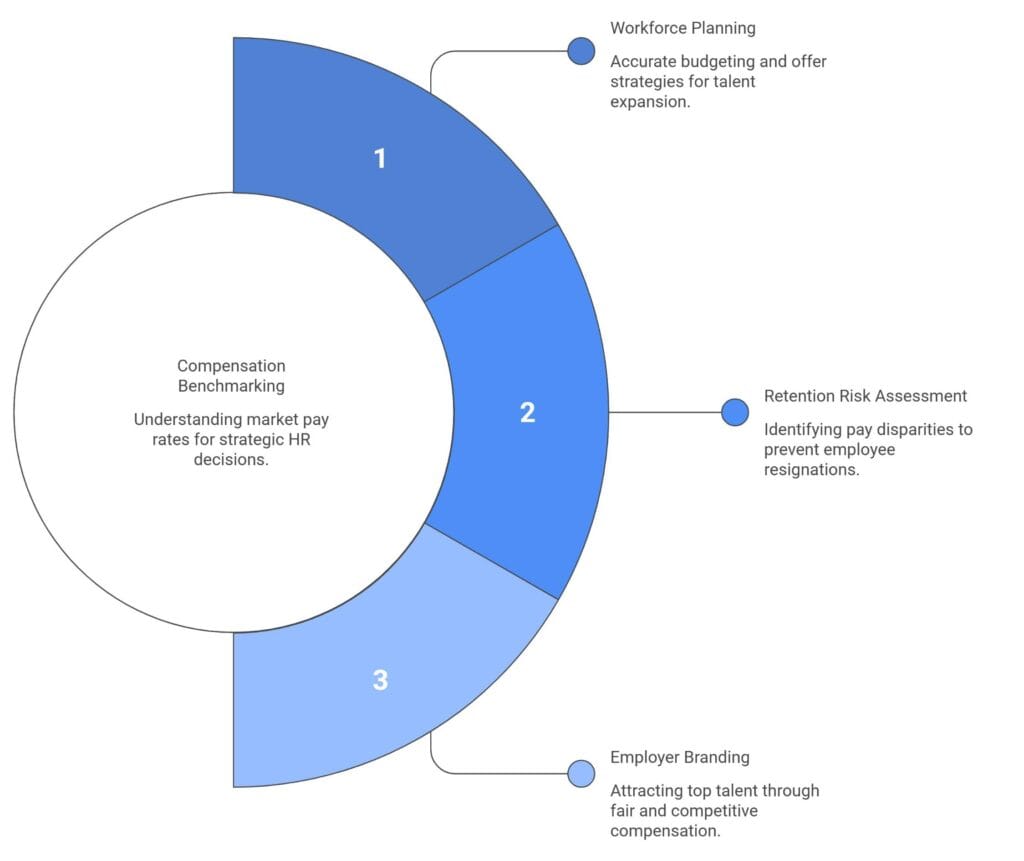
Workforce planning becomes more accurate when you understand the market cost of talent in different functions. If your organisation is planning to expand its technology team, knowing the going rate for software developers in Kathmandu versus Pokhara versus remote positions helps you build a realistic hiring budget and a competitive offer strategy.
Retention risk assessment becomes clearer when you map your current pay against the market. If a critical segment of your workforce is being paid significantly below the median for their role, you can identify that risk before it becomes a resignation letter.
Employer branding is also strengthened when pay is aligned with the market. Candidates talk. If your organisation is known for fair and competitive compensation, you attract better talent. If it is not, even your best recruitment marketing will struggle to convert.
Building a Compensation Benchmarking Process That Works
For organisations looking to build or improve their compensation benchmarking practice, here is a practical framework we recommend:
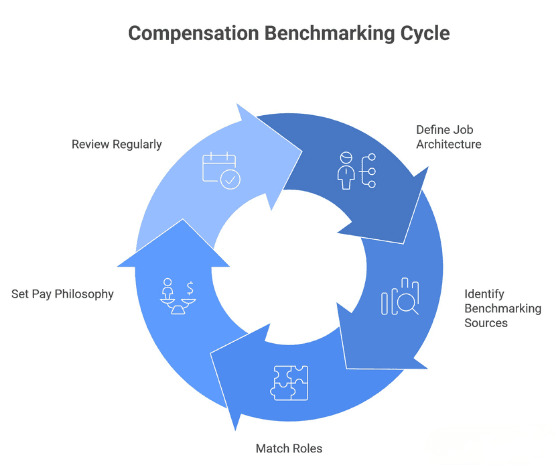
Step 1: Define Your Job Architecture
Before you can benchmark anything, you need clarity on what roles exist in your organisation, what they do, and how they relate to each other. A clean job architecture with well-written job descriptions is the starting point for any meaningful benchmarking exercise.
Step 2: Identify the Right Benchmarking Sources
There are multiple sources of compensation data available: salary surveys from HR consulting firms, data published by industry associations, government labour statistics, and online platforms. For Nepal, sources like the Employers’ Council of Nepal and regional HR consultancies provide useful local data. For broader benchmarking, international surveys from Mercer, Korn Ferry, and Hay Group are widely used by multinationals.
Step 3: Match Roles, Not Titles
One of the most common errors in benchmarking is matching job titles without considering actual job content. A “Manager” at one company may have a very different scope of responsibility than a “Manager” at another. Always benchmark on the basis of role content and level, not just the label.
Step 4: Set Your Pay Philosophy
Every organisation needs a clear position on where it wants to sit relative to the market. Do you want to lead the market, match it, or lag it strategically while compensating with other benefits? This is your pay positioning strategy, and it should be deliberate and aligned with your overall talent strategy.
Step 5: Review Regularly
Markets move. What was competitive eighteen months ago may not be competitive today, especially in fast-moving sectors. We recommend reviewing compensation benchmarking data at least once a year, and more frequently in roles where turnover risk is high.
Compensation Benchmarking in Nepal: A Growing Need
The Nepali HR landscape is evolving. More organisations are professionalising their people practices, and compensation transparency is becoming a topic of growing conversation, particularly among younger workers who are more willing to discuss and compare pay.
With the rise of remote work, Nepali professionals are also increasingly aware of regional and global pay standards. Organisations that fail to keep pace risk losing their talent not just to local competitors, but to international remote opportunities that may offer significantly more attractive packages.
The Nepal Rastra Bank, the Ministry of Labour, Employment and Social Security, and various sector-specific regulatory bodies have also been increasing their focus on fair employment practices. Compensation benchmarking is not just a competitive tool. Increasingly, it is becoming part of responsible governance.
Conclusion: Data-Driven Pay is a Leadership Choice
Compensation benchmarking is not a one-time exercise or a bureaucratic checkbox. It is an ongoing commitment to understanding your market, valuing your people, and making pay decisions with the rigour and intention that your workforce deserves.
As HR thought leader Peter Cappelli of the Wharton School of Business has noted in his research on talent management, organisations that treat their people as strategic assets rather than operational costs build more resilient, more adaptive, and ultimately more successful businesses.
We believe that every organisation in Nepal, from growing startups to established corporates, can benefit from a more disciplined, data-informed approach to compensation. It starts with benchmarking, and it grows into a culture where people feel genuinely valued.
If you are ready to take your compensation strategy to the next level, explore how structured benchmarking can transform your organisation’s ability to attract, retain, and reward exceptional talent.
49 views