
Table of Contents
Compliance Service in Nepal
For organisations operating in Nepal, HR compliance is closely tied to how employment, payroll, employee records, workplace policies, and statutory responsibilities are managed every month. A well-designed compliance framework brings these functions into one structured system, giving management a clear view of what needs to be maintained, reviewed, documented, and updated.
The practical challenge is not simply knowing the provisions of Nepal’s labour and employment framework. It is translating those requirements into everyday HR processes.
An organisation needs to know how a new employee is documented, how working hours and leave are recorded, how payroll information connects with statutory requirements, how employee changes are documented, how grievances are handled, and how employment records are maintained from joining through separation.
This makes compliance service in Nepal closely connected with the design and operation of the wider HR function.
1. Start With an HR Compliance Map, Not a Checklist
A compliance checklist can tell an organisation what documents it has. A compliance map shows how those documents and processes connect.
A practical HR compliance map should cover the complete employee lifecycle:
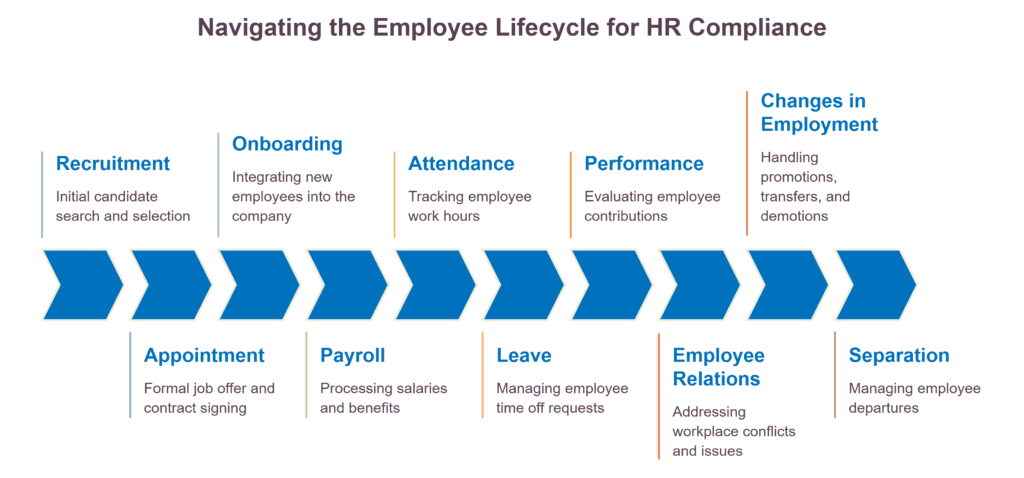
This approach turns compliance into an operating system rather than a collection of documents.
2. Align Employment Contracts With Actual HR Practices
Employment documentation should accurately reflect the employment relationship and the organisation’s established HR practices.
The review should cover areas such as:
- Position and responsibilities
- Employment terms
- Working arrangements
- Compensation
- Working hours
- Leave provisions
- Probation
- Benefits
- Confidentiality
- Workplace obligations
- Separation provisions
The important point is consistency.
If an organisation’s written employment terms differ significantly from how employees are actually managed, the HR system needs to be reviewed.
A compliance review should therefore compare the employment contract against actual payroll, attendance, leave, reporting structures, and workplace practices.
3. Connect Payroll With HR Records
Payroll compliance cannot be reviewed independently from HR data.
Every month, employee changes need to flow correctly into payroll.
A useful payroll-HR reconciliation process can check:
| HR Information | Payroll Impact |
|---|---|
| New employee | Salary and statutory setup |
| Promotion | Revised compensation |
| Salary revision | Updated payroll calculation |
| Leave | Applicable payroll adjustment |
| Overtime | Applicable payment |
| Allowances | Payroll treatment |
| Resignation | Final settlement |
| Employee transfer | Department and cost allocation |
This connection becomes increasingly important as the organisation grows.
Payroll, HR and finance should work from consistent employee information instead of maintaining disconnected records.
4. Build a Social Security Fund Process Into Monthly HR Operations
Social Security Fund administration should be incorporated into the organisation’s regular payroll and HR cycle.
The Social Security Fund provides formal-sector registration, contribution, and related services through its official system. The organisation should therefore establish clear responsibility for employee registration, contribution processing, reconciliation, documentation, and employee communication.
A practical monthly process can include:
- Review employee changes
- Verify contribution-related payroll data
- Process applicable contributions
- Reconcile records
- Maintain supporting documentation
- Resolve discrepancies
- Communicate relevant information to employees
5. Treat Attendance and Leave as Compliance Data
Attendance records are not simply used to determine who came to work.
They can form part of the organisation’s broader employment records.
A structured attendance and leave system should establish:
- Working schedules
- Attendance recording
- Leave requests
- Leave approval
- Leave balances
- Overtime records
- Exceptions
- Manager responsibilities
- Record retention
For organisations using flexible, remote, hybrid, or shift-based working arrangements, these processes should be adapted to the actual working model.
The same system should also feed relevant information into payroll.
6. Review HR Policies Against Actual Workplace Practice
An organisation may have policies covering leave, attendance, discipline, grievance handling, workplace conduct, remote work, or other HR matters.
The more useful question is how those policies are implemented.
A policy review should therefore examine:
Policy: What does the document say?
Process: How is the policy implemented?
Practice: What actually happens?
Records: Can the organisation demonstrate that the process was followed?
7. Create a Clear Employee Relations Process
Employee relations require particular attention because individual cases can involve employment records, policies, management decisions, and procedural consistency.
A structured process should define how the organisation handles:
- Employee grievances
- Workplace complaints
- Misconduct
- Disciplinary action
- Investigations
- Management responses
- Documentation
- Appeals or review mechanisms
Managers should also understand their role in the process.
HR compliance is stronger when employee relations matters follow a documented procedure rather than being handled differently by individual managers.
8. Review Compliance at Key Employee Events
A useful way to manage HR compliance is to create mandatory review points whenever an employee’s status changes.
At hiring
Check employment documentation, employee information, payroll setup, and statutory registration requirements.
At promotion
Update position, compensation, reporting structure, job description, and employee records.
At transfer
Review department, location, reporting relationship, responsibilities, and payroll information.
At salary revision
Ensure HR records, payroll, employment documentation, and relevant approvals are aligned.
At extended leave
Review attendance, leave records, payroll treatment, and relevant documentation.
At separation
Complete resignation or termination documentation, final settlement, company property return, statutory processes, and employee records.
This creates a series of compliance checkpoints throughout the employee lifecycle.
9. Build a Compliance Calendar
Instead of asking HR teams to remember every recurring requirement, organisations can create a compliance calendar.
A basic structure can include:
| Frequency | Review Area |
|---|---|
| Monthly | Payroll, statutory contributions, employee changes |
| Monthly | Attendance and leave records |
| Quarterly | Employee documentation review |
| Quarterly | HR policy implementation review |
| Half-yearly | HR compliance audit |
| Annually | Policy and employment document review |
| As required | Regulatory and procedural updates |
The exact calendar should reflect the organisation’s workforce, employment arrangements, and applicable requirements.
10. Use an HR Compliance Audit to Find System-Level Gaps
An effective HR compliance audit should not simply ask, “Do we have this document?”
It should examine whether the organisation’s systems work together.
For example:
Employee contract → HRIS → Payroll → Attendance → Leave → Statutory records
If information changes in one system but not another, the organisation has a process gap.
An audit can therefore review:
- Employee master data
- Employment contracts
- Payroll
- Attendance
- Leave
- Social Security Fund records
- Tax-related payroll information
- HR policies
- Employee files
- Performance documentation
- Employee relations records
- Separation documentation
The output should be an actionable gap report showing the issue, relevant process, responsible function, priority, and recommended corrective action.
11. Compliance Becomes More Important When the Organisation Expands
HR systems that work for a small team can become difficult to control as the organisation adds employees, departments, branches, or locations.
Expansion is therefore a useful point to review:
- Employment documentation
- Salary structures
- HR policies
- Payroll processes
- Reporting structures
- Employee records
- Attendance systems
- Leave administration
- Statutory processes
- Manager responsibilities
For organisations entering Nepal for the first time, the review should begin before employees are hired so that the employment and HR framework is established from the beginning.
12. Remote and Hybrid Employment Requires Clear Rules
Remote and hybrid work should be incorporated into the HR framework rather than managed informally.
The organisation should define:
- Working hours
- Availability
- Attendance
- Leave
- Communication
- Performance expectations
- Equipment
- Confidentiality
- Data access
- Workplace responsibilities
The HR system should also clarify how these arrangements interact with payroll, attendance, leave, and employee records.
For international organisations employing people in Nepal, local employment and statutory requirements should be considered alongside the company’s global HR policies.
13. Assign Responsibility for Every Compliance Process
One of the simplest ways to improve compliance is to define ownership.
A responsibility matrix can look like this:
| Process | HR | Finance | Management | Employee |
|---|---|---|---|---|
| Employee records | Responsible | Consulted | Informed | Provides information |
| Payroll | Consulted | Responsible | Approves | Reviews |
| Leave | Responsible | Consulted | Approves | Requests |
| Attendance | Responsible | Consulted | Monitors | Records |
| Statutory processes | Responsible | Responsible | Oversight | Provides information |
| Policy implementation | Responsible | Consulted | Responsible | Follows |
| Employee separation | Responsible | Responsible | Approves | Completes process |
The exact allocation will differ by organisation, but every recurring compliance activity should have an identifiable owner.
14. When External HR Compliance Support Makes Sense
Internal HR teams may have strong operational capabilities but limited time for detailed compliance reviews, policy development, documentation audits, or system redesign.
External HR consulting can provide an independent assessment of the organisation’s existing framework and help management establish a more structured system.
This can include:
- HR compliance audits
- Policy review and development
- Employment documentation review
- Payroll and statutory process review
- Employee file audits
- HR process development
- Compliance calendars
- HR manuals and procedures
- Employee lifecycle documentation
- Ongoing HR advisory support
The objective is to integrate compliance into the organisation’s HR structure rather than create another disconnected administrative function.
Building a Sustainable HR Compliance Framework
A strong compliance framework in Nepal should be designed around the way the organisation actually operates.
It should connect employment documentation with payroll, payroll with statutory processes, attendance with leave, employee changes with HR records, and policies with actual workplace practices.
The framework should also have clear ownership and regular review points.
For growing organisations, this creates a more practical approach to compliance. Instead of reviewing individual documents in isolation, management can see how the complete HR system operates from hiring through separation.
Need Support With HR Compliance in Nepal?
Frontline Consult provides end-to-end HR consulting support covering HR systems, policies, compliance, employee documentation, payroll-related processes, and broader HR management requirements.
Learn more about Frontline Consult‘s End-to-End HR Consulting services.
14 views