
Introduction to Outsourcing HR and Payroll
Running a business in Nepal means wearing a lot of hats. You’re thinking about clients, cash flow, growth; and somewhere in the middle of all that, someone has to make sure salaries go out on time, taxes are filed correctly, and your team’s records are actually up to date.
For a lot of businesses, that “someone” ends up being whoever has a spare moment. And that’s where things start to fall apart.
HR and payroll aren’t side tasks. They’re complex, regulation-heavy functions that directly affect your employees’ trust and your legal standing. Handling them informally, or under-resourced is one of the quieter risks that businesses in Nepal carry without fully realising it.
That’s why more and more companies here are choosing to outsource these functions entirely. Not as a shortcut, but as a deliberate, strategic move.
Table of Contents
What “Outsourcing HR and Payroll” Actually Means
There’s a misconception that outsourcing HR means handing off a spreadsheet and hoping for the best. In reality, a proper HR and payroll outsourcing arrangement covers the full spectrum of workforce management:
- Payroll processing and salary disbursement — calculated correctly, paid on time, every month
- Tax computation and filing — in line with Nepal’s Income Tax Act
- Social Security Fund (SSF) contributions — properly deducted and submitted
- Leave and attendance management — tracked consistently across your team
- Employee record management — organised, secure, and audit-ready
- Onboarding and offboarding support — so new hires start right and exits are clean
- Statutory compliance and reporting — so you’re never caught off guard by a regulatory update
The Real Compliance Problem in Nepal
Nepal’s regulatory environment isn’t static. The Labor Act, Income Tax Act, SSF requirements — these frameworks evolve, and keeping up with them while also running a business is genuinely difficult.
Most payroll errors in Nepalese companies don’t happen because people are careless. They happen because someone’s managing payroll on the side, using outdated tax brackets, or missing a filing deadline simply because no one flagged it in time.
The consequences? Financial penalties, employee disputes, reputational damage with staff, and in some cases, legal exposure. None of which you want showing up during what should otherwise be a normal growth phase.
Outsourcing moves that compliance burden to specialists whose entire job is staying current with these regulations. You don’t have to track every amendment to the Labor Act — they do.
The Practical Benefits (Beyond the Obvious)
1. Your team gets paid correctly — and they know it
Payroll accuracy isn’t just a finance issue. It’s a trust issue. When employees receive payslips they can actually read and understand, with deductions that make sense, it removes a constant low-level source of friction. People notice when payroll is managed well. They notice even more when it isn’t.
2. You stop losing senior time to admin
In smaller companies especially, payroll and HR admin tends to get absorbed by people who have more important things to do i.e. founders, finance managers, operations leads. Outsourcing recovers that time for work that actually moves the business forward.
3. You get expertise you couldn’t otherwise afford to hire full-time
Bringing in a dedicated HR compliance expert as a full-time employee is expensive. Outsourcing gives you access to that level of expertise: legal, technical, and operational, at a fraction of the cost, and without the overhead of maintaining an internal team.
4. It scales with you
Hiring your first 10 employees looks completely different from managing a team of 80. Outsourcing arrangements flex with your headcount. You’re not rebuilding internal systems every time you grow; it just scales!
HR Outsourcing Is Bigger Than Payroll
A lot of businesses start with payroll outsourcing and then realise how much more is possible. Strategic HR, the kind that actually shapes how your company grows. It can also be part of the arrangement.
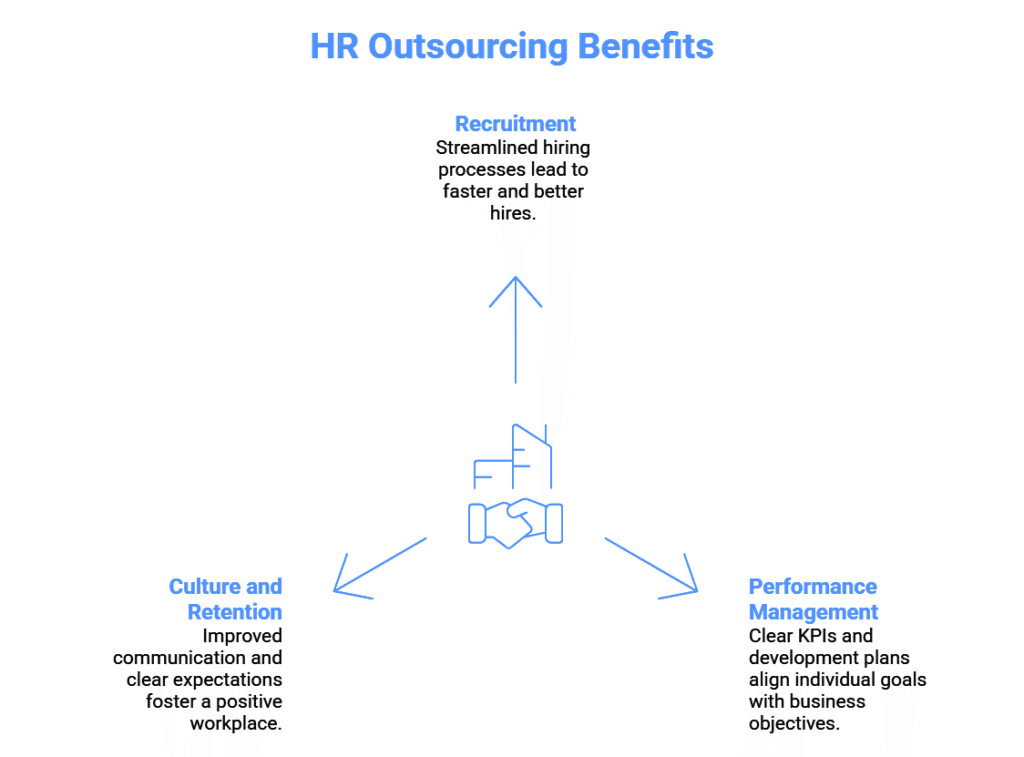
Recruitment and Hiring Structured hiring processes, candidate screening, and onboarding workflows mean less time-to-hire and fewer bad fits. Not just filling roles, but filling them with the right people.
Performance Management Clear KPIs, structured review cycles, and development plans that connect individual performance to business goals. The kind of framework that’s hard to build internally when you’re in growth mode.
Culture and Retention High turnover is expensive in Nepal as anywhere. A well-structured HR function improves internal communication, sets clear expectations, and creates the kind of workplace people actually want to stay in.
Who Benefits from This in Nepal?
The honest answer: almost any business that’s past the very early startup stage. Sectors where we see the strongest uptake include:
- IT and technology companies — where talent competition is intense and compliance often gets overlooked during rapid growth
- Hospitality and tourism businesses — with seasonal headcount fluctuations and complex leave management needs
- NGOs and INGOs — which often have strict reporting requirements and limited internal admin capacity
- Manufacturing and trading firms — where workforce size and shift-based attendance tracking make manual HR unworkable
- SMEs scaling up — who have outgrown informal HR practices but aren’t yet ready to build a full internal department
The common thread isn’t industry — it’s complexity outpacing internal capacity.
What to Look for in an Outsourcing Partner
Not all HR outsourcing firms are the same. Before signing anything, it’s worth asking:
Do they actually know Nepal’s regulatory landscape? This isn’t generic HR theory; it’s SSF filings, IRD compliance, and Labor Act specifics. Your partner needs to live and breathe these.
What technology do they use? Cloud-based payroll platforms with real-time dashboards, automated calculations, and secure employee portals aren’t a luxury anymore; they’re the baseline. If someone’s still running payroll on manual spreadsheets, that’s a red flag.
How do they handle data security? Employee salary data, tax records, and personal information are sensitive. You need clarity on how data is stored, who has access, and what their security protocols look like.
Can they scale with you? A partner that works for your current 30-person team should also be able to handle your 150-person team two years from now.
What’s their track record? Ask for references. Real ones. Talk to businesses they’ve actually worked with.
Where This Is All Heading
The direction of travel in Nepal is clear. More businesses are moving toward outsourced HR, and the services themselves are getting more sophisticated: AI-assisted payroll systems, predictive analytics for workforce planning, digital employee self-service portals.
But the core reason businesses outsource hasn’t changed: they want accuracy, compliance, and peace of mind. This comes without diverting their best people to administrative work that someone else can do better.
The Bottom Line
If your HR and payroll processes are currently held together by a combination of spreadsheets, manual follow-ups, and hoping nothing gets missed; that’s a risk worth addressing.
Outsourcing isn’t about losing control of your workforce management. It’s about putting it in the hands of people who do this every day, so you can focus on the parts of your business that actually need your attention.
Frontline Consult works with businesses across Nepal to deliver HR and payroll outsourcing that’s accurate, compliant, and built around your specific operational needs. If you’re ready to take the guesswork out of workforce management, we’d be glad to talk.
Reach out to Frontline Consult to explore how outsourced HR and payroll can work for your business.
189 views