
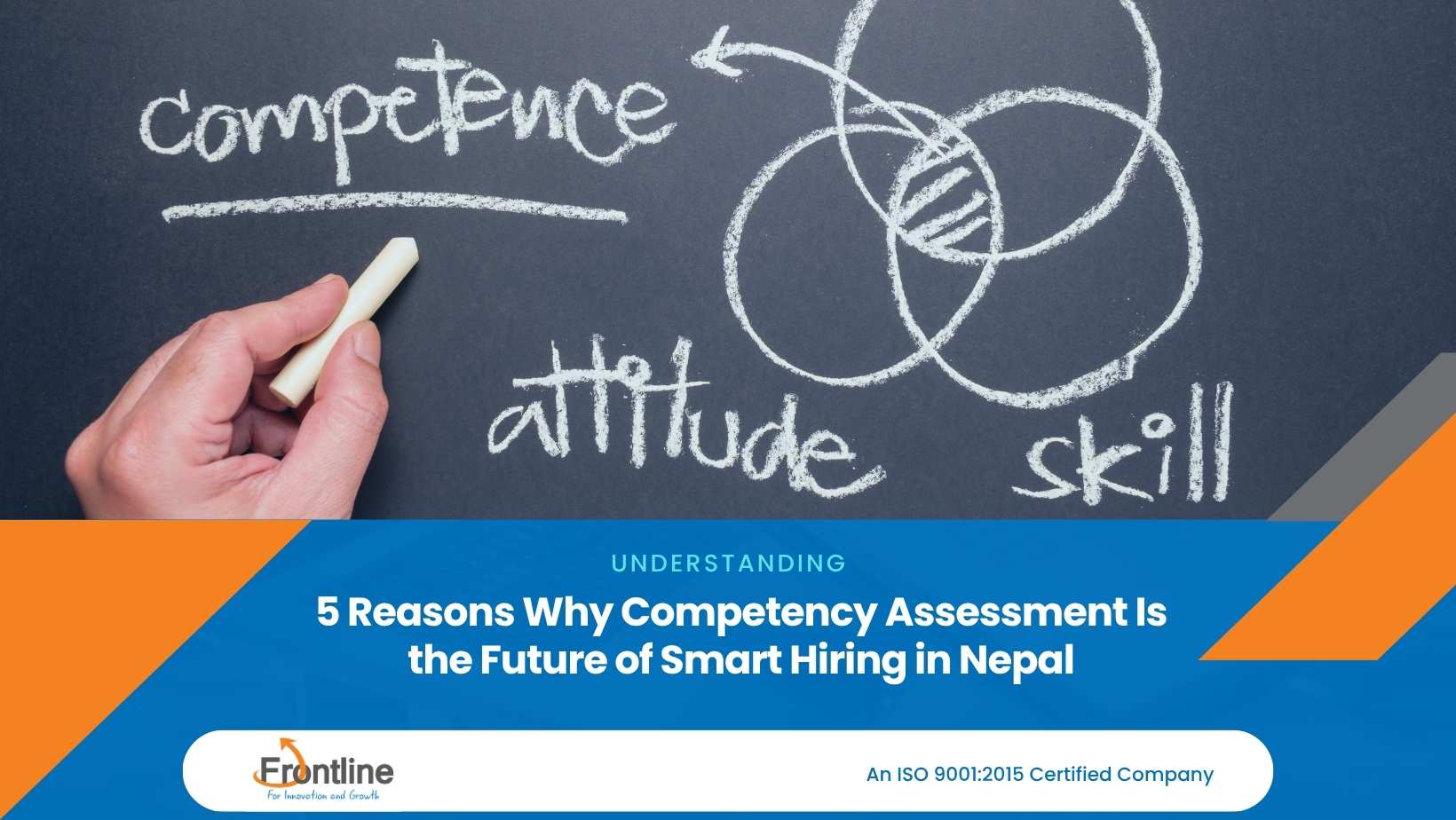
Nepal’s job market is evolving fast. Organizations across banking, IT, healthcare, and retail are growing rapidly — yet many still rely on resumes and gut instinct to make their most important decisions: who to hire and who to promote.
The cost of a bad hire isn’t just financial. It disrupts team culture, delays projects, and wastes months of onboarding investment. Research consistently shows that traditional interview-based hiring gets it right less than 50% of the time.
There is a better way — one that global organizations have used for decades and that forward-thinking employers in Nepal are now adopting: Competency Assessment, delivered through structured Assessment and Development Centers (ADCs). Here are five compelling reasons why it is reshaping the future of smart hiring.
Table of Contents
REASON 01 | OBJECTIVITY & FAIRNESS
It Eliminates Gut-Feel Hiring with Objective, Data-Driven Insights
Traditional hiring often relies heavily on a candidate’s confidence in the room, how they look on paper, or simply how comfortable they make an interviewer feel. This approach is riddled with unconscious bias; from affinity bias (favouring candidates similar to the interviewer) to halo effects (letting one impressive trait overshadow everything else).
Competency assessments replace subjective impressions with scientifically validated, evidence-based data. Tools such as psychometric personality tests, cognitive aptitude evaluations, and structured behavioural simulations measure what a candidate can actually do — not just what they claim. Each candidate is evaluated against the same set of defined competencies, ensuring a fair, consistent process regardless of where they studied or who they know.
| “Removing bias from the hiring process isn’t just an ethical choice — it’s a business one. Companies that hire objectively build stronger, more diverse teams that consistently outperform.” |
- Psychometric Testing — personality, aptitude, and cognitive ability
- Structured Evaluation — consistent, bias-free scoring across all candidates
- Validated Frameworks — backed by global assessment science
REASON 02 | POTENTIAL OVER CREDENTIALS
It Reveals Real Potential, Not Just Qualifications on Paper
In Nepal’s competitive job market, many candidates have comparable degrees and similar-looking CVs. The question that truly matters: can this person perform, grow, and lead? — cannot be answered by a certificate alone.
Competency-based Assessment and Development Centers use immersive, real-world simulation tools, including role-plays, case studies, leadership drills, and group exercises to reveal how a candidate thinks and behaves under pressure. This goes far beyond what any written exam or polished interview can show.
For high-potential (HiPo) identification and leadership pipeline development, this approach is particularly powerful. It surfaces candidates who may not have the most impressive resume but possess the cognitive agility, emotional intelligence, and collaborative instincts that truly drive performance.
| “A candidate who aces a formal interview may struggle in real situations. Behavioural simulations show you how they actually perform — not how they rehearsed.” |
- Behavioural Simulations — role-plays, case studies, leadership drills
- HiPo Identification — scientifically surface high-potential employees
- Beyond Credentials — evaluate capability, not just qualifications
REASON 03 | RISK MITIGATION
It Dramatically Reduces the Cost of Hiring Mistakes
Every bad hire is expensive. Factor in the time spent on recruitment, onboarding, training, and then the disruption to the team when someone doesn’t work out, and the true cost of a wrong hiring decision can be several times the employee’s annual salary.
In Nepal, where talent markets are still maturing and organizational budgets are tightly managed, this risk is especially acute. The pressure to fill positions quickly often leads to shortcuts that compound the problem: a cycle that competency assessment decisively breaks.
By screening candidates through validated tools from technical and communication skill tests to 360-degree feedback frameworks, organizations dramatically increase the predictive validity of their hiring decisions. They know, before an offer is made, how a candidate is likely to perform in the role.
| “The ROI of getting hiring right the first time dwarfs any upfront investment in assessment. Prevention is always more affordable than correction.” |
- Pre-Employment Screening — role-specific technical and communication tests
- Reduced Attrition — validated assessments dramatically lower early turnover
- Higher ROI on Recruitment — every hire becomes a confident, evidence-backed decision
REASON 04 | LEADERSHIP PIPELINE
It Builds a Resilient Leadership Pipeline from Within
Smart hiring doesn’t stop at the front door. One of the most strategic and underutilised applications of competency assessment is internal talent development and succession planning.
Nepal’s best organizations are beginning to realize that promoting from within is far more cost-effective and culturally coherent than constant external hiring. But to do it right, you need an objective way to identify who is ready to lead and who needs more development first.
Through structured competency frameworks paired with Individual Development Plans (IDPs) and targeted training modules covering emotional intelligence, strategic thinking, and communication, organizations can groom their next generation of leaders with precision. They stop guessing and start planning, using data to map their talent bench and fill critical roles before they become vacancies.
| “Succession planning without a competency framework is just wishful thinking. With one, it becomes a strategic advantage.” |
- Succession Planning — identify critical-role successors using competency frameworks
- Individual Development Plans — bridge gaps with targeted, personalized training
- 360° Feedback — holistic multi-rater insights to drive growth
REASON 05 | STRATEGIC ALIGNMENT
It Aligns Talent Strategy Directly with Business Goals
Hiring has traditionally been treated as an HR function operating in isolation from business strategy. Competency-based assessment changes this entirely by connecting every talent decision to the organization’s larger objectives.
When you define the competencies your business needs to succeed whether that’s analytical thinking in a finance team, customer empathy in a sales function, or innovation in an IT department and then measure every candidate against those specific benchmarks, every hire becomes a deliberate strategic investment.
With multi-rater 360-degree feedback systems and detailed performance insights spanning peers, managers, and self-evaluations, organizations can continuously calibrate their talent strategy in real time making hiring, promotion, and development decisions that are always informed by business reality.
| “The organizations that will dominate Nepal’s next decade of growth are the ones building talent strategies today that are aligned with where they want to be — not where they have been.” |
- Business-Aligned Competency Frameworks — tie every hire to strategic goals
- Multi-Rater Feedback — real-time performance calibration across the organization
- Scalable Solutions — from SMEs to large enterprises, virtual or on-ground
The Future Is Already Here, Is Your Organization Ready?
For years, the prevailing wisdom in Nepal’s hiring landscape has been: if the candidate seems right, hire them. That era is ending. The organizations investing in competency-based assessment today are building workforces that are not just skilled: they are aligned, resilient, and future-ready.
Whether you are screening for entry-level talent, identifying your next generation of leaders, or designing a succession strategy for critical roles, the right assessment methodology transforms every talent decision from a guess into a strategic, evidence-backed choice.
Nepal’s most ambitious organizations are making this transition now. The question is not whether competency assessment is the future of hiring — it already is. The question is: will your organization lead that change, or follow it?
| START YOUR TALENT TRANSFORMATION Ready to Hire Smarter and Develop Better? Frontline Consult’s Talent Assessment & Development Center combines globally validated tools with deep local expertise to help your organization find, develop, and retain the talent that drives growth. |
176 views