
Introduction to Staffing Services in Nepal
Hiring in Nepal sounds straightforward until you are actually doing it.
You post a role, receive a flood of applications, spend weeks screening and interviewing, finally settle on someone, and then realise you have no clear idea how the employment contract should be structured, what your Social Security Fund obligations are, or whether your onboarding process holds up under the Labour Act. That is before you account for all the actual work that sat untouched through the process.
This is the side of Nepal’s talent market that rarely gets mentioned. The country has a large, capable, and increasingly global workforce. But reaching that workforce in a way that is fast, structured, and legally sound is a different challenge altogether. That is what staffing services are built for, and that is what this guide walks through.
Table of Contents
The State of Nepal’s Workforce
To understand why staffing services matter here, you first need to understand the employment landscape.
According to the World Bank, Nepal’s total labour force reached 8.43 million people in 2024. On paper, that is a significant pool of available talent. In practice, the market is far more layered. Data from the Rastriya Shramik Mahasangh Nepal shows that youth unemployment currently stands at 20.82%, and an estimated 84.6% of all employment in the country still takes place in the informal sector, meaning most workers lack formal contracts, social protection, or clearly defined legal rights.
That informal majority is important context. It means a large portion of Nepal’s workforce has never operated under a structured employment arrangement. Candidates may not know what to expect from formal onboarding. Employers may not know how to bring workers into compliance. And without a structured recruitment process, businesses often end up with mismatches they spend months trying to correct.
Professional staffing services exist precisely to close that gap.
What Staffing Services Actually Cover
Staffing services are not just about filling vacancies faster. At their core, they are an end-to-end hiring and workforce management solution. A staffing partner typically handles candidate sourcing, screening, skills assessment, reference checks, contract preparation, onboarding, and in many cases, ongoing payroll processing and HR compliance.
For businesses, this means the burden of recruitment shifts away from internal teams that often lack the bandwidth or specialist knowledge to run it well. For workers, it means access to structured employment that comes with proper contracts, legal benefits, and a clear professional relationship.
The scope of what staffing agencies in Nepal offer has grown considerably over the past decade, moving well beyond traditional manpower placement into specialised services that cater to both local and international hiring needs.
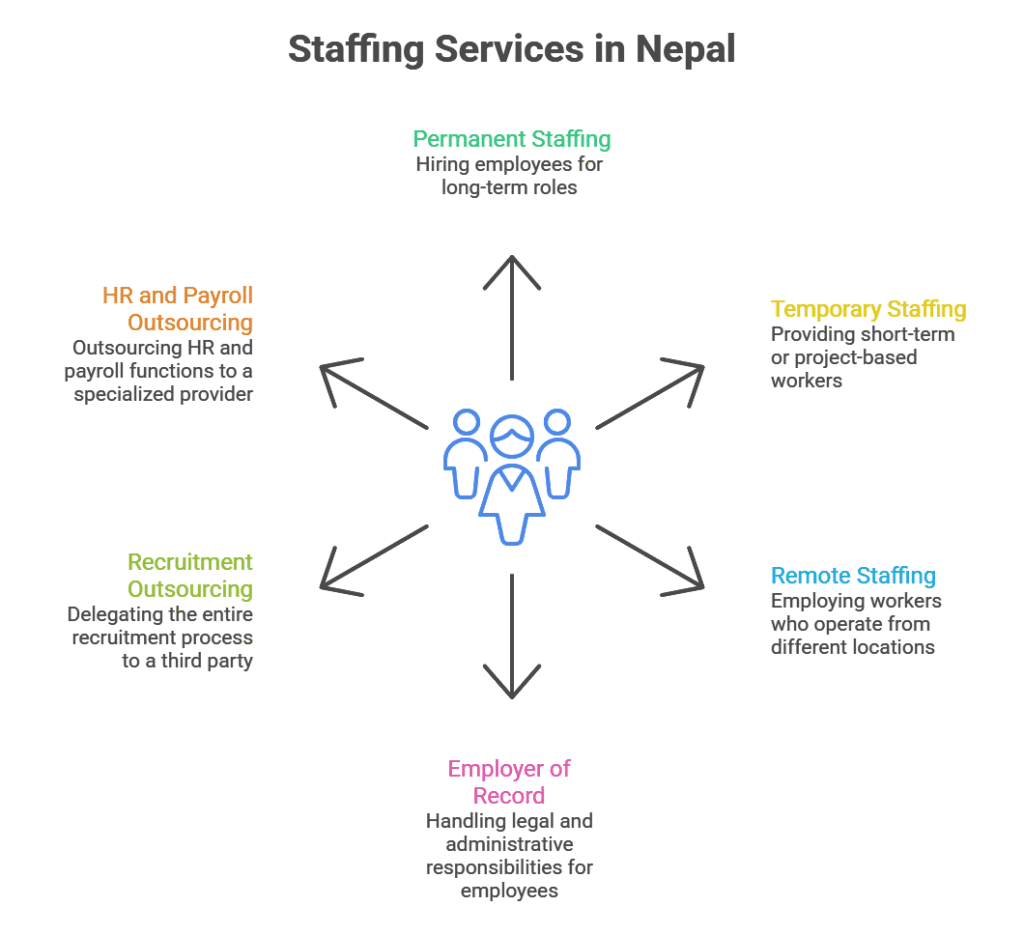
Types of Staffing Services Available in Nepal
Permanent Staffing
This is the most common arrangement. A staffing agency sources, vets, and places candidates into full-time roles on behalf of a client business. The employee joins the client’s organisation directly, and the agency’s involvement typically ends after a successful placement. This model works well for companies building core teams or filling specialist roles where long-term retention and cultural fit matter most.
Temporary and Contract Staffing
Not every business need is permanent. For project-based work, seasonal spikes in demand, or coverage during a key team member’s absence, contract staffing offers a practical alternative. Workers are placed for a defined period, and the arrangement can be extended or concluded cleanly without the obligations that come with permanent employment. It gives businesses staffing flexibility that is genuinely difficult to achieve through direct hiring alone.
Remote Staffing
This has become one of the fastest-growing staffing categories in Nepal, particularly for international employers. Nepali professionals working in IT, software development, digital marketing, customer support, accounting, and design are increasingly being engaged by companies across Australia, the United States, Europe, and the Gulf. A local staffing partner handles the compliance and payroll side of things, while the employer manages the day-to-day work. Remote staffing allows global businesses to access skilled talent at competitive rates without navigating Nepal’s regulatory framework on their own.
Employer of Record (EOR) Services
For international companies that want to hire in Nepal but are not yet ready to set up a local legal entity, Employer of Record services offer a clean solution. The staffing firm acts as the official employer on paper, managing contracts, payroll, tax filings, and all statutory contributions, while actual direction of the worker remains with the international client. It removes the legal complexity of cross-border hiring without sacrificing operational control.
Recruitment Process Outsourcing (RPO)
RPO is for businesses that need to scale hiring significantly and quickly. Rather than placing individual candidates, the agency takes over the entire recruitment function, from writing job descriptions and posting roles to managing applicant pipelines and coordinating final selections. This is particularly useful for companies undergoing rapid expansion, launching new departments, or entering the Nepal market for the first time.
HR and Payroll Outsourcing
Some staffing partners go beyond recruitment and take on ongoing HR functions entirely, including payroll processing, leave management, performance tracking, and statutory compliance reporting. For smaller businesses or international employers without a local HR team, this is often significantly more cost-effective than building that capability in-house.
Nepal’s Employment Legal Framework: What Businesses Need to Know
This is the section that matters most for any business planning to hire in Nepal, independently or through a partner. Nepal’s employment laws are specific and well-defined, and the consequences of getting them wrong include fines, legal disputes, and in some cases, criminal liability.
The Labour Act 2074 (2017)
The Labour Act 2074 is the primary legislation governing employment in Nepal. It replaced the older 1992 Act and introduced a significantly more comprehensive framework. One of its most important changes is its scope: unlike the previous law, which applied only to businesses with ten or more employees, the Labour Act 2074 applies to every registered entity in Nepal, regardless of size or sector. That includes companies, cooperatives, NGOs, partnerships, and foreign entities operating in the country.
Key provisions every employer needs to understand:
Written contracts are mandatory. Every employee, except casual workers engaged for fewer than seven days a month, must have a formal written employment agreement. This agreement must specify the role, salary, working hours, leave entitlements, and terms of termination.
Working hours are capped. The standard working week under the Act is 48 hours across six days, or eight hours per day. Overtime is permitted up to 24 additional hours per week and must be compensated at 1.5 times the employee’s regular wage rate.
Minimum wage is set by law. As of the 2025 Minimum Remuneration Notice, the monthly minimum wage in Nepal is NPR 19,550, which includes a basic wage of NPR 12,170 and a dearness allowance of NPR 7,380. No employer can lawfully pay below this, including for contract or part-time workers.
Termination must follow a defined process. Permanent employees are entitled to at least one month’s written notice before termination, or equivalent pay in lieu. Arbitrary dismissal without documented justification can result in legal penalties and mandatory compensation.
Five types of employment are recognised. The Act defines regular, time-based, work-based, part-time, and casual employment. Each carries different rights and obligations, and getting the classification right from the point of hiring is important.
The Social Security Fund (SSF)
Employers in Nepal are required to contribute to the Social Security Fund on behalf of all employees from their first day of employment. The SSF covers provident fund, gratuity, medical treatment, and accident insurance. Failure to register employees or make contributions can result in significant financial penalties.
The Foreign Employment Act 2064 (2007)
This Act governs the overseas deployment of Nepali workers and places strict obligations on any agency involved in international recruitment. Agencies must hold a valid licence from the Department of Foreign Employment, follow government-approved processes for documentation and worker deployment, and adhere to ethical recruitment standards that protect workers from exploitation. If you are working with a staffing partner to place Nepali workers abroad, verifying their licensing status under this Act is non-negotiable.
Why Businesses Choose Staffing Services Over Direct Hiring
The honest answer is that direct hiring in Nepal is manageable, but it is rarely efficient unless you already have a well-resourced internal HR function. Most growing businesses do not.
Staffing agencies bring pre-built talent networks, established screening systems, and compliance expertise that would take years and significant investment to replicate in-house. They also carry some of the risk of a poor hire more formally, with many offering replacement guarantees if a placed candidate does not work out within an agreed window.
For international businesses, the case is even clearer. Setting up a legal entity in Nepal to employ one or two remote professionals is expensive, slow, and administratively burdensome. Working through a staffing partner means you can have compliant employees active in a fraction of the time and cost.
Nepal is also genuinely competitive as a talent market. The country produces a growing number of technically skilled graduates, many of whom speak excellent English and have real experience working with international clients. Compensation expectations, while rising, remain considerably lower than equivalent talent in Western markets. That combination makes Nepal an attractive destination for both offshore and nearshore hiring, and staffing agencies are the practical entry point into that market.
What to Look for When Choosing a Staffing Partner
Choosing the right agency is worth taking seriously. Not all of them operate at the same standard. Here is what genuinely matters:
A track record in your industry. A generalist agency can fill entry-level roles, but if you need specialist talent in finance, engineering, IT, or healthcare, you want a partner with demonstrated experience in that space. Ask for specific placement examples, not just a list of sectors they claim to cover.
Process transparency. You should be able to understand exactly how the agency sources candidates, what their screening looks like, and how they manage shortlisting. Vague answers here usually reflect vague processes on the ground.
Compliance knowledge. Your staffing partner should understand Nepal’s Labour Act, SSF obligations, and tax requirements in real detail, not just in broad terms. If they cannot walk you through how a compliant employment contract is structured, that is a problem worth taking seriously.
Ethical recruitment standards. In Nepal’s context, this matters particularly for international placements. Agencies should never be charging candidates placement fees, and they must operate under proper government licensing. These are not nice-to-haves; they are legal and ethical requirements.
A written replacement policy. Placements do not always work out. Make sure the agency has a clearly defined, written policy for what happens if a candidate leaves or underperforms within a set period. Verbal assurances carry no weight when things go wrong.
Where Nepal’s Staffing Industry Is Heading
Nepal’s staffing industry has moved well beyond its origins in overseas manpower placement. Today it encompasses local permanent hiring, remote team building for international employers, executive search, HR outsourcing, and compliance-driven EOR solutions. The agencies doing this well are increasingly operating with the systems, certifications, and professional standards you would expect from a serious HR partner.
Remote work has opened up a new chapter for Nepal’s professionals. More Nepali graduates are entering fields like software engineering, UX design, financial analysis, and content strategy, roles that are easily delivered remotely and increasingly in demand from employers who cannot find affordable talent in their home markets. This is creating a two-way opportunity: Nepal gets formal, well-paying employment for its skilled graduates, and international businesses get reliable professionals without the overhead of hiring locally.
The businesses that are already doing this well are the ones that engaged proper staffing support from the start, rather than learning Nepal’s employment requirements the hard way.
Ready to Build Your Team in Nepal?
Frontline Consult Pvt. Ltd. has been working in Nepal’s HR and business consulting space since 2012. As an ISO 9001:2015 certified firm, Frontline Consult provides staffing services, talent acquisition, payroll management, HR outsourcing, and end-to-end business consulting, all backed by genuine expertise in Nepal’s regulatory and employment environment.
If you are looking to hire in Nepal and want
240 views