
Introduction to BPO
Running a business in Nepal means wearing too many hats. One week you’re reviewing sales strategy. The next, you’re chasing payroll errors, managing compliance paperwork, and sorting out attendance disputes. None of that is why you started your business.
That’s where BPO comes in, and more Nepal businesses are discovering it every year.This guide explains what Business Process Outsourcing actually is, how it works in the Nepali context, which functions you can outsource, and how to know if it’s the right move for your organisation.
Table of Contents
What is BPO (Business Process Outsourcing)?
Business Process Outsourcing or BPO is when a company hands over specific business functions to an external service provider, rather than managing those functions in-house.
Instead of hiring, training, and managing a team for payroll, HR administration, data entry, or customer support, you contract a specialised BPO firm to handle those processes on your behalf.
The BPO provider takes full responsibility for the process: the people, the systems, the quality, and the compliance. You get the output. Your team gets their time back.
BPO is not a new concept globally, but it is rapidly growing in Nepal as businesses realise that focusing on core competencies — rather than administrative overhead — is the fastest path to growth.
The Two Main Categories of BPO
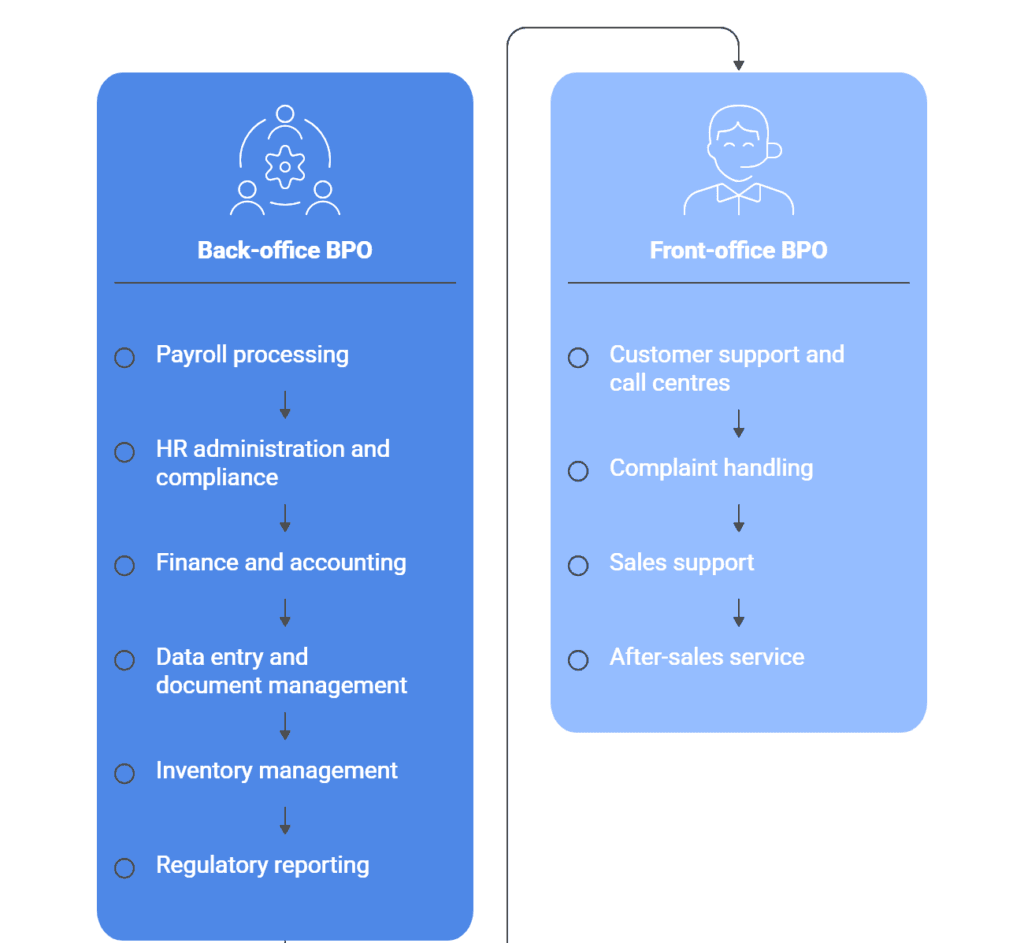
1. Back-office BPO
This covers internal business functions that don’t involve direct customer contact. Examples include:
- Payroll processing
- HR administration and compliance
- Finance and accounting
- Data entry and document management
- Inventory management
- Regulatory reporting
2. Front-office BPO
This covers customer-facing functions such as:
- Customer support and call centres
- Complaint handling
- Sales support
- After-sales service
Most Nepal businesses starting with BPO begin with back-office functions — particularly HR and payroll — before expanding into other areas.
What is HR BPO?
HR BPO (Human Resources Business Process Outsourcing) is one of the most in-demand BPO services in Nepal. It means outsourcing all or part of your HR function to a specialised provider.
This typically includes:
Payroll management Monthly payroll calculations, tax deductions, PF/CIT contributions, and salary disbursement done accurately and on time, every month.
Employee records management Maintaining employee files, attendance records, leave balances, and employment history in a structured, accessible way.
HR compliance Ensuring your business complies with Nepal’s Labour Act, Social Security Fund (SSF) requirements, and other regulatory obligations. One missed deadline can result in penalties. An HR BPO provider monitors this for you continuously.
Recruitment support Job posting, screening, shortlisting, and onboarding coordination so your HR team (if you have one) can focus on culture and retention rather than paperwork.
Performance management support Structuring appraisal cycles, collecting performance data, and managing documentation for promotion or disciplinary processes.
At Frontline Consult, HR BPO is at the core of what we do — built on over 12 years of HR consulting experience across Nepal’s industries.
Why Are Nepal Businesses Turning to BPO?
1. The cost of in-house HR is higher than most businesses realise
Hiring one in-house HR officer in Kathmandu typically costs NPR 40,000–80,000 per month in salary alone. Add ESIC, PF contributions, training, HR software subscriptions, compliance consultant fees, and the hidden cost of HR errors; and the real cost is significantly higher.
A BPO arrangement bundles all of this into a predictable monthly fee, with no recruitment risk, no training cost, and no compliance gaps.
2. Compliance complexity is increasing
Nepal’s labour law landscape has evolved significantly. The Labour Act 2017, Social Security Fund regulations, and evolving CIT and PAN requirements mean that staying compliant is a full-time job. Most businesses, especially SMEs don’t have the in-house expertise to manage this without risk.
BPO providers like Frontline Consult maintain dedicated compliance teams whose entire focus is keeping your business on the right side of the law.
3. Talent is scarce
Finding qualified HR professionals in Nepal is genuinely difficult, particularly outside Kathmandu. Even when you find the right person, turnover is high and every departure creates a knowledge gap in your most sensitive function.
Outsourcing eliminates that dependency. The BPO provider’s team becomes your team, with no single point of failure.
4. Growth requires focus
Every hour a founder, CEO, or operations manager spends on HR administration is an hour not spent on customers, products, or strategy. BPO reclaims that time.
What BPO Services Are Available in Nepal?
A comprehensive BPO provider in Nepal should be able to handle:
| BPO Service | What it covers |
|---|---|
| HR & Payroll Management | Salary, deductions, PF, CIT, records, leave |
| Administrative Services | Data entry, scheduling, document management |
| Finance & Accounting | Bookkeeping, billing, financial reporting |
| Customer Support | Call centre, complaint handling, response management |
| Compliance & Regulatory Reporting | Labour Act, SSF, tax filings |
| Inventory Management | Stock tracking, reorder management, reporting |
| Data Entry & Document Management | Digitisation, filing, retrieval systems |
| Back-Office Support | General administrative support across departments |
| Mystery Auditing | Undercover assessment of service quality and staff performance |
At Frontline Consult, we offer all of the above under one roof which means no coordination gap between your outsourced functions.
What is Mystery Auditing? (And Why It Belongs in BPO)
Mystery auditing is a specialised BPO service that many Nepal businesses don’t know exists but is quietly one of the most valuable.
A mystery auditor poses as a regular customer or visitor and evaluates your business from the outside in: how staff greet customers, how complaints are handled, how processes actually work in the real world versus how they’re supposed to work on paper.
The result is an unfiltered, objective assessment of your operational reality.
This is particularly valuable for:
- Retail chains and consumer-facing businesses
- Banks, financial institutions, and cooperatives
- Hotels, restaurants, and hospitality businesses
- Healthcare providers
- Any business with service quality standards to uphold
Internal audits tell you what your team reports. Mystery audits tell you what your customers experience. The gap between those two is often where growth is lost.
How Does BPO Work in Practice?
Here is what the typical BPO engagement process looks like at Frontline Consult:
Step 1 — Discovery consultation We meet with you to understand your current processes, pain points, volume of work, and compliance status. No assumptions — we map your actual situation.
Step 2 — Scope and proposal We define exactly which functions we’ll manage, how we’ll manage them, what the reporting structure looks like, and what the monthly fee is. Everything is transparent before you sign anything.
Step 3 — Transition We take over the process carefully. Your data is migrated, your workflows are documented, and your team is briefed on how to interact with the BPO team going forward. The transition is designed to be invisible to your employees and customers.
Step 4 — Ongoing management We manage the function on a day-to-day basis with regular reporting, proactive compliance monitoring, and escalation protocols for anything that needs your decision.
Step 5 — Review and scale We review performance monthly and quarterly. As your business grows, the scope adjusts more employees, more locations, more complex requirements without disruption.
Why Choose Frontline Consult for BPO in Nepal?
Frontline Consult is one of Nepal’s longest-standing HR and business consulting firms. Established in 2012 and ISO 9001:2015 certified, we bring a level of process maturity and industry experience that is genuinely difficult to find in the Nepali BPO market.
What sets us apart:
Consulting-backed BPO. We don’t just execute processes we understand why they exist, what they need to deliver, and how to improve them. Our consulting background means your BPO engagement is strategic, not just transactional.
Nepal-specific expertise. Our team is deeply familiar with Nepal’s Labour Act, SSF, PAN/CIT requirements, and the practical realities of doing business in Nepal’s regulatory environment.
Scalable across industries. We work with banks, manufacturing companies, agro-businesses, FMCG, retail, and more adapting our BPO model to the specific requirements of each sector.
One partner for everything. HR consulting, payroll outsourcing, BPO, staffing, training, and EOR/PEO services, all under one roof. You don’t need to manage multiple vendors for interconnected functions.
Ready to Explore BPO for Your Business?
The best way to know whether BPO is right for your organisation is a conversation.
Book a free consultation with Frontline Consult. We’ll review your current processes, identify the highest-value outsourcing opportunities, and give you an honest assessment of whether BPO makes financial sense for you at this stage.
Call us: +977 1 5707271 | +977 980-1898004
Email: info@frontline.com.np
Visit: 4th Floor, Gravity Center, Anamnagar, Kathmandu
Or fill in the contact form at frontline.com.np/bpo-service-in-nepal
Frequently Asked Questions
Is my data safe with a BPO provider? At Frontline Consult, data security and confidentiality are non-negotiable. We operate under strict information security protocols, and all engagements are backed by formal confidentiality agreements. Our ISO 9001:2015 certification reflects our commitment to process quality and risk management.
Can I outsource just one function, or does it have to be everything? You can outsource a single function; for example, just payroll, or a full suite. Most clients start with one area and expand as trust builds and the value becomes clear.
What happens to my in-house HR team if I outsource? This depends on your situation. Some clients have no HR team and are outsourcing from scratch. Others have a small HR team that is overwhelmed and BPO takes the transactional work off their plate so they can focus on strategic HR. We work with you to design the right operating model.
How long does the transition take? Typically two to four weeks for a payroll or HR administration handover. More complex engagements may take longer. We don’t rush transitions, we do them properly.
290 views