

Staffing Agency Nepal
Choosing a staffing agency in Nepal involves more than finding candidates for vacant positions. Businesses must also consider employment arrangements, payroll administration, employee documentation, workplace responsibilities, and labour compliance. A staffing arrangement that addresses only recruitment may leave important operational responsibilities with the employer.
For organisations managing workforce expansion, seasonal demand, multiple locations, or recurring administrative workloads, staffing services can provide a structured way to manage these requirements. The value depends on the scope of services, the clarity of responsibilities, and the provider’s ability to manage the workforce throughout the agreed engagement.
Understanding how a staffing agency operates helps businesses decide which responsibilities to retain internally and which to assign to an external provider.
Table of Contents
What Is a Staffing Agency and How Does It Work?
A staffing agency is an organisation that helps businesses meet workforce requirements by sourcing personnel, coordinating recruitment, or providing agreed employee management services. The scope varies according to the staffing arrangement.
Some agencies concentrate on candidate sourcing and placement. Others provide a broader service that includes employment administration, payroll processing, employee documentation, attendance management, and ongoing workforce support.
A typical staffing arrangement involves 5 stages:
- Workforce requirement assessment: The business identifies the roles, number of employees, required skills, work location, expected duration, and budget.
- Candidate sourcing and screening: The provider identifies potential candidates, reviews applications, and prepares a shortlist against the agreed criteria.
- Selection and engagement: Interviews take place, suitable candidates are selected, and the applicable employment arrangements are documented.
- Onboarding and administration: Depending on the contract, responsibilities may include employment documentation, orientation, attendance procedures, payroll setup, and statutory administration.
- Ongoing workforce management: The provider and client coordinate payroll, employee queries, attendance records, reporting, performance-related matters, and staffing changes according to their agreement.
The important distinction is that recruitment is only one part of staffing. A business seeking continued administrative support needs to establish what happens after a candidate starts work.
What Should Businesses Evaluate When Choosing a Staffing Agency in Nepal?
Businesses comparing staffing providers should examine the operational responsibilities the provider can manage, not simply the number of candidates it can supply.
1. Define the Actual Workforce Requirement
The first step is to determine the nature of the staffing requirement.
A company filling one specialist vacancy has different needs from a business that requires employees across several branches. Similarly, a temporary increase in workload may call for a different arrangement from a long-term workforce requirement.
Before approaching a staffing agency, document:
- Job roles, responsibilities, and required competencies
- Number of employees and work locations
- Expected start dates and duration of the engagement
- Salary ranges, allowances, and working schedules
- Required screening, verification, and selection procedures
- Expected responsibilities for payroll and employee administration
This information allows the provider to recommend a suitable service scope and prepare a more accurate commercial proposal.
2. Establish Who Is Responsible for Each HR Function
One of the most important decisions concerns the division of responsibilities between the client and the staffing provider.
A staffing agreement should specify who will handle recruitment, employment documentation, payroll, attendance records, employee queries, leave administration, workplace safety coordination, and employee separation procedures.
It should also establish who approves salary changes, overtime, leave, and other employment-related decisions.
Without this clarity, routine tasks can be delayed because each party assumes the other is responsible.
A responsibility matrix is useful for this purpose. For example, the provider may process monthly payroll, while the client supplies approved attendance records and authorised overtime details. The contract should identify the person responsible for checking and approving the final payroll information.
3. Assess Payroll and Employment Documentation Capabilities
Payroll management requires accurate employee records, approved compensation details, attendance information, applicable deductions, and timely processing.
A staffing provider offering payroll administration should explain how it manages:
- Monthly salary calculations and payment schedules
- Overtime, allowances, leave, and attendance adjustments
- Income tax calculations and tax deduction at source, where applicable
- Social Security Fund calculations and submissions, where applicable
- Payslips, payroll reports, and employee records
- Reconciliation and correction of payroll discrepancies
Businesses should also ask how employee information is stored, who can access it, and how changes are authorised.
A clear monthly payroll calendar, documented approval process, and reliable reporting system can reduce errors and improve accountability.
4. Examine Labour Compliance and Employment Arrangements
Staffing arrangements in Nepal require careful consideration of the Labour Act, 2074, applicable rules, employment terms, and relevant social security and tax obligations.
The legal responsibilities depend on the actual employment relationship, the nature of the work, and the specific staffing arrangement. A contract with a staffing provider does not automatically remove every responsibility from the client organisation.
For labour supply arrangements, the Labour Act contains specific provisions governing the supply of workers, permitted work categories, licensing, and employment obligations. Businesses should therefore verify that the proposed arrangement is appropriate for the work involved.
Before signing an agreement, review:
- The legal identity and applicable authorisations of the provider
- The proposed employment and contractual structure
- Responsibility for wages, benefits, and statutory contributions
- Employee health and safety arrangements
- Recordkeeping and compliance reporting procedures
- Procedures for complaints, disputes, and contract termination
Businesses should seek qualified legal advice when the proposed arrangement raises questions about employment classification or statutory obligations.
The relevant legislation can be reviewed through the Nepal Law Commission’s Labour Act, 2074 resource.
5. Evaluate the Provider’s Reporting and Workforce Monitoring
A staffing arrangement needs ongoing oversight after employees begin working.
Useful reporting may include headcount, attendance, payroll status, employee turnover, open staffing requirements, onboarding progress, and unresolved employee issues. The exact reporting requirements should reflect the nature of the engagement.
6. Compare the Total Cost of the Arrangement
The lowest quoted staffing fee does not necessarily represent the lowest overall cost.
Businesses should compare the complete service scope, including recruitment fees, recurring management charges, payroll administration, statutory costs, replacement provisions, and any additional charges specified in the agreement.
They should also consider the internal time spent on candidate screening, documentation, payroll corrections, employee queries, and compliance administration.
A useful comparison examines both the provider’s fees and the internal resources required to manage the arrangement.
The right choice is a service model that meets the organisation’s workforce requirements at a clearly defined and sustainable cost.
What Are the Two Main Types of Staffing?
Staffing can be classified in several ways, but two common categories are permanent staffing and temporary or contract staffing.
Permanent Staffing
Permanent staffing focuses on filling ongoing positions within an organisation. The employee is generally hired directly by the organisation under its applicable employment arrangements.
This model is suitable for businesses building long-term teams, filling continuing vacancies, and developing internal capabilities.
A staffing agency may assist with sourcing, screening, interviewing, and selection. The organisation typically retains responsibility for the employee’s ongoing management under a direct-hire arrangement.
Temporary or Contract Staffing
Temporary or contract staffing addresses workforce requirements for a defined period, project, assignment, or other agreed purpose.
Depending on the arrangement, employees may be engaged directly by the client or supplied through an authorised staffing provider. These structures should not be treated as legally interchangeable.
This category can be useful for short-term operational requirements, seasonal workloads, project support, and additional workforce capacity.
The appropriate arrangement depends on the duration of the requirement, the nature of the work, and the applicable legal framework.
Is Staffing Part of HR?
Yes. Staffing is a core human resource management function because it concerns the identification, acquisition, placement, and deployment of people required by an organisation.
However, staffing is not the entirety of HR.
Human resource management also covers employee relations, compensation, learning and development, performance management, workforce planning, organisational development, and other activities across the employee lifecycle.
Staffing establishes the workforce needed to carry out business activities. Other HR functions support employees after they join, help maintain performance, and address changing organisational requirements.
A business may manage staffing internally through its HR department or assign selected activities to an external provider. The decision depends on internal capability, workload, cost, and the level of support required.
What Is the Purpose of Staffing?

The purpose of staffing is to ensure that an organisation has the people it needs, with suitable competencies and availability, to meet its operational objectives.
Effective staffing connects workforce requirements with business planning. It helps organisations determine how many employees are needed, which skills are missing, when additional personnel must be available, and how workforce requirements should be managed over time.
Staffing also supports continuity. If a department experiences increased demand, employee turnover, or a new project requirement, a defined staffing process helps the organisation respond systematically instead of making unplanned hiring decisions.
For businesses using an external staffing agency, the purpose extends to establishing a clear process for sourcing personnel and managing the administrative responsibilities included in the agreement.
What Is the Role of HR in Staffing?
The HR department translates business requirements into practical workforce decisions.
Its responsibilities commonly include:
- Conducting workforce planning and identifying staffing gaps
- Preparing job descriptions and competency requirements
- Coordinating recruitment and selection
- Maintaining fair and consistent selection procedures
- Supporting employment documentation and onboarding
- Coordinating compensation and benefits administration
- Monitoring staffing outcomes and workforce requirements
HR also works with department heads to understand operational needs. A manager may request additional employees, but HR helps determine the skills required, the appropriate hiring process, and the employment arrangements needed to support the request.
When an external staffing agency is involved, HR generally acts as the internal coordinator, clarifying requirements, reviewing candidates, agreeing on responsibilities, and monitoring service delivery.
The precise division of work depends on the agreement between the organisation and the provider.
Who Is Responsible for Staffing?
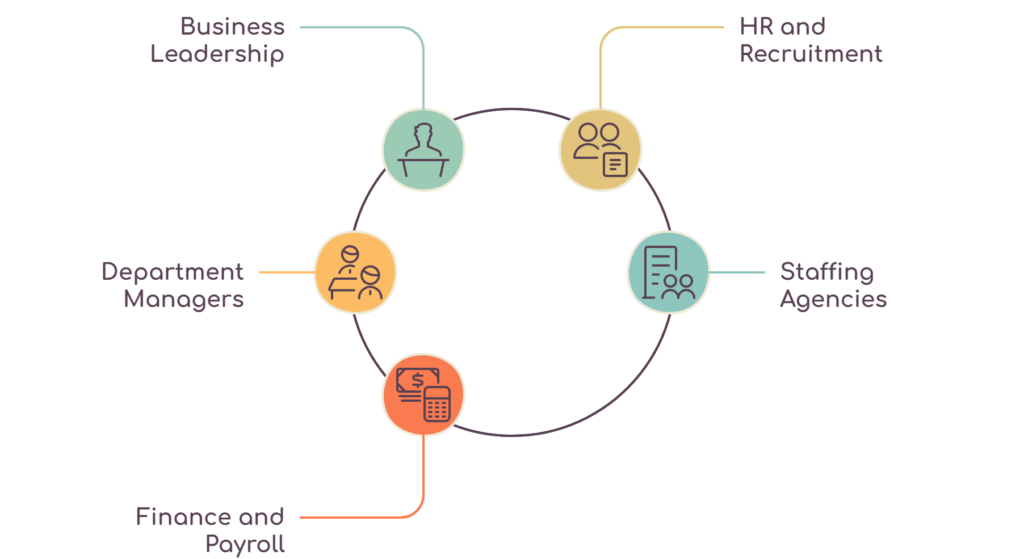
Responsibility for staffing is shared across the organisation, although specific duties may be assigned to different people.
Business leadership determines workforce priorities, approves headcount and budgets, and ensures that staffing supports organisational objectives.
HR and recruitment teams coordinate workforce planning, job specifications, candidate assessment, selection procedures, and employment documentation.
Department managers identify operational requirements, define role-specific expectations, participate in interviews, and assess whether candidates meet the needs of their teams.
Staffing agencies carry out the services assigned to them, which may include candidate sourcing, screening, onboarding coordination, payroll administration, or workforce management.
Finance and payroll teams support budget control, salary approvals, payroll reconciliation, and financial reporting according to the organisation’s internal structure.
The employer and other legally responsible parties must continue to meet their applicable obligations. Outsourcing selected staffing activities does not automatically transfer every legal responsibility to the provider.
What Are the 7 Important Functions of Staffing?
The following seven functions describe a commonly used HR management framework. They are related activities rather than a universal legal or operational checklist.
1. Human Resource Planning
HR identifies the number and type of employees required to meet business objectives. This includes assessing current workforce capacity, anticipated demand, skill gaps, and future staffing needs.
2. Recruitment
Recruitment involves attracting suitable candidates through job advertisements, professional networks, databases, referrals, and other appropriate sourcing channels.
3. Selection
Selection involves evaluating applicants against the role’s requirements through application reviews, interviews, skills assessments, reference checks, and other relevant methods.
4. Placement and Onboarding
Placement assigns the selected employee to the appropriate role. Onboarding introduces the employee to the organisation’s policies, responsibilities, reporting structure, and work procedures.
5. Training and Development
Training helps employees acquire the knowledge and skills required for their current responsibilities. Development prepares employees for broader responsibilities and future organisational needs.
6. Performance Appraisal
Performance appraisal evaluates employee contributions against agreed responsibilities, objectives, and performance standards. The findings can inform development plans and other employment decisions.
7. Compensation and Career Progression
This function concerns salary structures, benefits, incentives, and appropriate career progression arrangements. These decisions should reflect organisational policy, employee performance, market conditions, and applicable legal requirements.
In practice, many organisations also treat employee retention, succession planning, workforce analytics, and employee relations as important connected functions.
Which Tasks Are Part of Staffing?
The tasks included in staffing depend on the service model.
| Staffing activity | Typical tasks |
|---|---|
| Workforce planning | Headcount estimates, skill requirements, hiring priorities |
| Recruitment | Job postings, candidate sourcing, application management |
| Selection | CV screening, interviews, assessments, reference checks |
| Placement | Role allocation, offer coordination, joining arrangements |
| Onboarding | Employment documents, orientation, employee records |
| Employee administration | Attendance, leave records, documentation, employee queries |
| Payroll administration | Salary processing, deductions, payslips, reporting |
| Workforce monitoring | Headcount reports, attendance reviews, issue escalation |
A recruitment-only agency may perform the first three activities and coordinate placement. A broader staffing provider may also manage employee administration, payroll, and ongoing workforce support.
Businesses should confirm which tasks are included, which require additional fees, and which remain their own responsibility.
What Does Staffing Not Include?
Staffing does not automatically include every HR, management, or business operation.
For example, a standard recruitment assignment does not necessarily include payroll processing, employee relations management, statutory reporting, training delivery, performance management, or ongoing employee administration.
Likewise, providing employees does not automatically mean that an agency manages the client’s entire HR department.
Other activities, such as business strategy, financial planning, sales management, and general operational decision-making, are outside the normal scope of staffing unless they form part of a separate agreement.
The distinction matters because businesses often use the terms staffing, recruitment, outsourcing, and HR outsourcing interchangeably, even though they describe different scopes of work.
Before entering an agreement, organisations should request a written service description that identifies included activities, exclusions, responsibilities, reporting requirements, and additional charges.
What Are the Seven Steps of the Staffing Process?
A practical staffing process can be organised into seven stages.
Step 1: Identify the Staffing Requirement
The department identifies a vacancy, workload increase, skills gap, or other workforce requirement. The request should explain why additional personnel are needed and what the role must achieve.
Step 2: Conduct Workforce and Job Analysis
The organisation determines the required qualifications, experience, competencies, reporting relationships, working arrangements, and compensation range.
This stage helps prevent unsuitable hiring decisions caused by unclear job specifications.
Step 3: Develop the Staffing Plan
HR or the responsible manager determines the number of employees required, the expected timeline, the recruitment approach, the budget, and the resources available for selection and onboarding.
If an external provider is involved, the organisation also agrees on the scope of services and the responsibilities of each party.
Step 4: Source Candidates
Potential candidates are identified through suitable recruitment channels. These may include job portals, professional networks, candidate databases, referrals, and staffing agencies.
The sourcing strategy should reflect the position’s seniority, skill requirements, location, and expected availability.
Step 5: Screen and Select Candidates
Applications are reviewed against predefined criteria. Suitable candidates proceed through interviews, relevant assessments, and appropriate verification procedures.
The decision should be based on the role’s requirements and a consistent evaluation process.
Step 6: Complete Employment Formalities and Onboarding
Once a candidate is selected, the responsible parties coordinate the offer, applicable employment documentation, joining arrangements, and orientation.
For outsourced staffing, this stage should also establish the employee’s reporting line, attendance process, payroll arrangements, and escalation contacts.
Step 7: Monitor Staffing Outcomes
After deployment, the organisation evaluates whether the staffing arrangement meets operational requirements.
Useful indicators include time to fill, attendance, retention, payroll accuracy, employee feedback, service delivery, and unresolved administrative issues.
The findings can inform future workforce planning and help identify improvements in the staffing process.
Is a Staffing Agency Worth It?
A staffing agency can be worthwhile when the cost and administrative effort of managing workforce requirements internally exceed the cost of obtaining suitable external support.
The decision should be based on the organisation’s actual workload, the scope of the service, and the quality of the proposed arrangement.
An external provider may be particularly useful when a business:
- Needs additional employees within a defined timeframe
- Has recurring recruitment or workforce administration requirements
- Wants support with payroll processing and employee documentation
- Needs more consistent processes across multiple locations
- Has limited internal HR capacity
- Wants clearly defined responsibility for selected staffing activities
A business with a capable internal recruitment team and a small, predictable hiring requirement may prefer to manage recruitment independently. An organisation with recurring staffing, payroll, and administration needs may gain more value from a broader service arrangement.
To assess the financial case, compare the provider’s fees with internal recruitment costs, HR staff time, administrative expenses, payroll correction costs, and the resources required to maintain appropriate records.
The decision should also account for service quality, compliance processes, response times, and the level of control the organisation wishes to retain.
What Is Another Name for Staffing?
The term used for staffing depends on the activity being described.
Common related terms include workforce planning, personnel management, recruitment, talent acquisition, manpower planning, and workforce resourcing.
These terms are not exact synonyms. Recruitment and talent acquisition primarily concern finding and attracting candidates, while workforce planning focuses on determining future personnel requirements. Staffing can encompass a broader process of securing and placing the people needed by an organisation.
The term manpower supply is also used in some contexts, particularly for labour supply arrangements. Businesses should distinguish the commercial terminology from the specific legal structure of an engagement.
What Is an Example of Staffing?
Consider a company opening a new customer service department in Kathmandu.
The company estimates that it needs 15 customer service representatives, one team supervisor, and administrative support. Its HR department prepares the job requirements and determines the expected hiring timeline.
A staffing provider may then source candidates, screen applications, coordinate interviews, and help the company select suitable personnel.
If the agreement covers broader staffing services, the provider may also coordinate employment documentation, onboarding, payroll administration, attendance records, and employee queries.
The company’s managers remain responsible for defining service standards, allocating work, monitoring customer service quality, and making operational decisions.
This example demonstrates how staffing can extend beyond recruitment when the organisation selects a service model that includes ongoing workforce administration.
How Can Businesses Choose the Right Staffing Service in Nepal?
The right staffing arrangement depends on the workforce problem the business needs to solve.
An organisation that only needs candidate sourcing may require recruitment support. A company managing recurring employee administration may need a broader service covering employment documentation, attendance, payroll, and workforce monitoring.
Before making a decision, businesses should establish the following:
- Service scope: Confirm which recruitment, HR, payroll, and administration tasks are included.
- Legal and employment arrangements: Understand how employees will be engaged and which obligations apply.
- Cost structure: Review service fees, statutory costs, additional charges, and payment terms.
- Reporting: Agree on the information the provider will supply and how frequently it will be delivered.
- Accountability: Identify the responsible contacts for payroll queries, employee issues, approvals, and escalations.
- Performance measures: Define suitable indicators for service quality, timeliness, accuracy, and workforce continuity.
- Contract exit procedures: Establish arrangements for employee records, outstanding payments, handovers, and service termination.
These checks help organisations compare providers based on their ability to meet operational needs rather than relying solely on quoted fees or general service claims.
Staffing Agency Nepal: Workforce Support for Growing Businesses
Staffing decisions influence recruitment, employee administration, payroll accuracy, workforce continuity, and the consistency of HR processes. For businesses in Nepal, choosing the right service arrangement requires a clear understanding of the work involved and the responsibilities that must remain with the employer.
An effective staffing arrangement begins with a defined workforce requirement and continues through clear employment procedures, reliable administration, and regular monitoring. Businesses that establish these requirements before engaging a provider are better positioned to assess service quality and manage their workforce effectively.
Staffing Services from Frontline Consult
Frontline Consult provides staffing and outsourcing support for organisations seeking assistance with talent sourcing, employment administration, payroll management, and workforce monitoring. Its service scope includes recruitment support, employment documentation, attendance and leave administration, payroll processing, SSF-related administration, and workforce coordination.
Businesses looking for staffing support can review the Staffing Services in Nepal offered by Frontline Consult to understand the available services and discuss their workforce requirements.
Contact Frontline Consult
- Website: https://frontline.com.np/services/staffing-service/
- Phone: +977 1 5707271
- Additional contact numbers: 980-1898004 / 980-1898003
- Location: 4th Floor, Gravity Center, Anamnagar, Kathmandu, Nepal
Frequently Asked Questions About Staffing Agencies in Nepal
1. What is a staffing agency?
A staffing agency helps businesses meet workforce requirements through candidate sourcing, recruitment, selection, placement, or other agreed employee management services.
2. Is staffing part of HR?
Yes. Staffing is a core HR function concerned with workforce planning, recruitment, selection, placement, and ensuring that the organisation has the people required for its operations.
3. What are the two main types of staffing?
Two common categories are permanent staffing and temporary or contract staffing. The appropriate arrangement depends on the nature and duration of the workforce requirement.
4. Who is responsible for staffing?
Responsibility is generally shared by business leadership, HR, department managers, and any external staffing provider. Each party’s duties depend on the organisation’s structure and the service agreement.
5. What are the seven steps of the staffing process?
The seven stages outlined in this article are identifying the requirement, conducting job analysis, developing a staffing plan, sourcing candidates, screening and selection, completing employment formalities and onboarding, and monitoring staffing outcomes.
6. Is a staffing agency worth it?
A staffing agency may be worthwhile when it provides value through recruitment support, reduced administrative workload, consistent processes, or workforce management capabilities that would otherwise require significant internal resources.
7. What is another name for staffing?
Related terms include workforce resourcing, personnel management, manpower planning, and recruitment. Their precise meanings differ depending on the activities involved.
8. What does staffing not include?
Staffing does not automatically cover all HR functions, business strategy, financial management, or operational decision-making. The actual scope depends on the service agreement.
9. What should a business look for in a staffing agency in Nepal?
Businesses should evaluate service scope, recruitment capability, employment documentation, payroll processes, compliance knowledge, reporting, transparent fees, and clearly assigned responsibilities.
10. What is the difference between recruitment and staffing?
Recruitment primarily concerns attracting, screening, and selecting candidates. Staffing can include recruitment and placement, along with broader workforce administration when those services are part of the agreement.
10 views