
Business Process Improvement
Business process improvement is not simply about making employees work faster or introducing new software. It is the systematic examination of how work is performed, where resources are being lost, why delays and errors occur, and how processes can be redesigned to produce better business results.
For organizations in Nepal, Business Process Improvement (BPI) can become particularly important as businesses expand, add new departments, increase transaction volumes, introduce new services, or move from founder-led operations to structured management systems. Processes that were effective at an earlier stage of growth can become difficult to manage as the organization becomes more complex.
A proper business process improvement exercise therefore begins with the business itself, not with technology.
At Frontline Consult, business transformation is approached through strategic planning, measurable objectives, performance management, KPIs, and structured execution. This creates an important connection between process improvement and the wider question of how an organization intends to perform and grow.
Table of Contents
What Business Process Improvement Actually Examines
A business process is a sequence of activities through which an organization converts inputs into a specific output.
For example:
Customer enquiry → Lead qualification → Proposal → Approval → Contract → Service delivery → Invoice → Payment
Looking at each activity individually may not reveal a serious problem. The problem often exists between activities.
A proposal may wait three days for an approval because responsibility is unclear. Sales may collect information that finance later requests again. Operations may not receive complete information from sales. An invoice may be delayed because supporting documents are submitted through different channels.
These are process problems.
Business Process Improvement examines the entire flow rather than treating every issue as an individual employee or departmental problem.
A proper review typically examines:
- Process ownership
- Sequence of activities
- Decision points
- Approval requirements
- Information movement
- Handoffs between departments
- Duplicate activities
- Manual data entry
- Rework
- Waiting time
- Error points
- Documentation requirements
- Technology usage
- Accountability
- Performance indicators
- Customer impact
This distinction is important. A process can contain highly capable employees and still perform poorly if its structure creates unnecessary delays.
The Difference Between a Process Problem and a People Problem
One of the most important principles in business process improvement is to avoid immediately assigning responsibility for poor performance to individuals.
Suppose an organization takes 7 working days to approve a purchase request.
A superficial assessment may conclude that the approving manager is slow.
A process assessment asks different questions:
- How many approvals are actually required?
- Is every approval necessary?
- Does the manager receive complete information?
- How long does the request remain unattended?
- Is there a defined approval timeline?
- Are requests submitted through one standard channel?
- Can some categories be approved at a lower organizational level?
- Is the approval process documented?
- Can the status of a request be tracked?
- What happens when the responsible person is unavailable?
The problem may not be the manager. The process itself may be producing the delay.
This is one reason process improvement should be based on evidence, process mapping, and performance data rather than assumptions.
Start With the Current-State Process
Before redesigning a process, an organization needs to understand how the process actually operates.
This is known as current-state analysis.
The documented procedure and the actual process are often different.
A company may have an SOP stating that a request goes from Department A to Department B and then to Department C. In practice, employees may send documents through email, messaging applications, spreadsheets, verbal instructions, and physical files.
The formal process may therefore appear efficient while the actual process contains several additional steps.
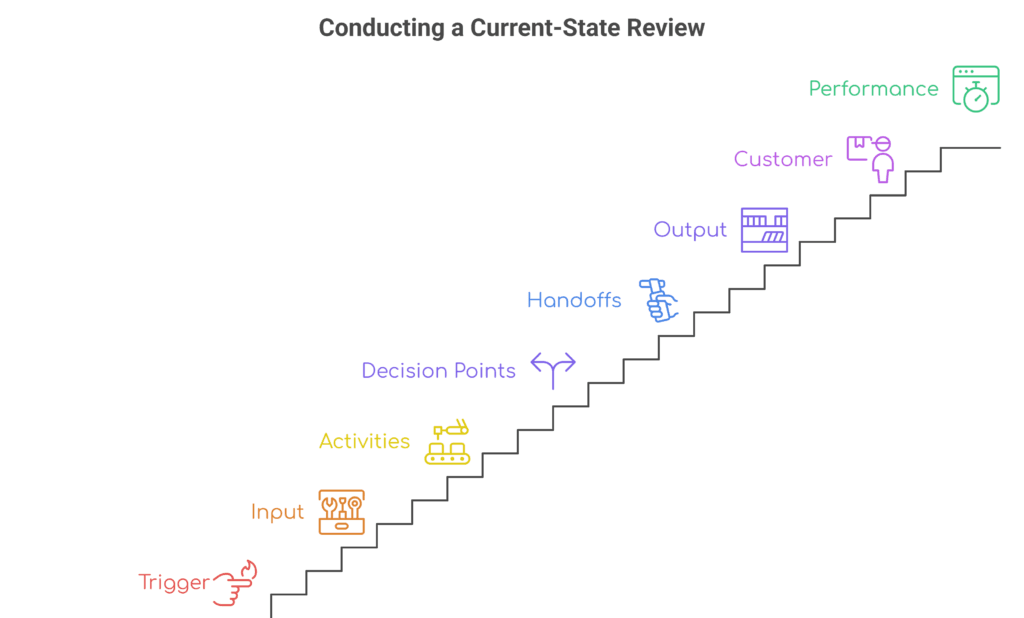
Process Mapping: Finding Where Time Is Actually Lost
Consider a simplified employee recruitment process:
Manpower request → Approval → Job description → Vacancy publication → CV screening → Interview → Selection → Offer → Joining
At first glance, the process appears straightforward.
However, a detailed process map might reveal:
- The manpower request requires approvals.
- The job description is rewritten by another department.
- CVs are received through several channels.
- Shortlisting is performed manually.
- Interview feedback is not submitted using a standard format.
- Offer approval requires another round of documentation.
- Joining documents are collected separately by HR and finance.
The issue is not necessarily that any single activity is inefficient. The accumulated waiting time, duplication, and handoffs create the larger problem.
This is why process mapping is one of the most useful tools in Business Process Improvement in Nepal. It provides management with a visual representation of how work moves through the organization.
Measure the Process Before Changing It
Improvement requires a baseline.
Without a baseline, an organization may implement a change and still be unable to determine its actual effect.
Useful process performance measures include:
| Process Measure | What It Shows |
|---|---|
| Cycle time | Total time required to complete the process |
| Processing time | Time employees actively spend working on it |
| Waiting time | Time the process spends waiting between activities |
| Error rate | Frequency of incorrect or incomplete outputs |
| Rework rate | How often work must be repeated |
| Cost per transaction | Resources consumed by each transaction |
| First-time-right rate | Percentage completed correctly without rework |
| Approval time | Time required for decisions |
| Volume | Number of transactions processed |
| SLA compliance | Percentage completed within the required timeframe |
One particularly useful comparison is:
Total Cycle Time = Processing Time + Waiting Time
A process may require only two hours of actual work but take five days to complete.
That means the primary improvement opportunity may not be employee productivity. It may be waiting, approvals, handoffs, or poor information flow.
Root Cause Analysis Is More Important Than Quick Fixes
An organization may observe that invoices are frequently delayed.
A quick solution could be to instruct employees to submit invoices faster.
A root-cause investigation could reveal something deeper:
Delayed invoices
↓
Supporting documents frequently missing
↓
Departments use different documentation formats
↓
There is no standard submission checklist
↓
Responsibility for document verification is unclear
The sustainable solution is therefore not simply “submit invoices faster.”
The solution may involve:
- A standardized document checklist
- Defined ownership
- A single submission process
- Clear approval responsibilities
- A documented turnaround time
- Monitoring through a KPI
This illustrates an important principle of process improvement:
Fix the cause, not only the visible symptom.
Identify the Type of Process Waste
A useful process assessment also examines activities that consume resources without creating sufficient value.
Common examples include:
Unnecessary approvals
Multiple approval levels may have developed over time without being reviewed against current organizational needs.
Duplicate data entry
The same information may be entered into several spreadsheets or systems.
Rework
Incomplete information or unclear requirements can cause employees to repeat tasks.
Waiting
Work may remain idle while waiting for information, authorization, signatures, or decisions.
Excessive handoffs
Every additional transfer of responsibility can create opportunities for delay and communication errors.
Unclear ownership
A process may have several participants but no clearly accountable process owner.
Manual activities
Repetitive tasks performed manually may consume significant employee time and introduce avoidable errors.
Unnecessary documentation
Organizations sometimes retain forms and reports that no longer contribute to decision-making, compliance, or operational control.
The purpose of identifying these issues is not to remove activities indiscriminately. Each activity should be assessed according to its purpose and contribution to the desired outcome.
Standardization Should Follow Process Redesign
Once an improved process has been established, it should be documented.
This may include:
- Standard Operating Procedures
- Process flowcharts
- Responsibility matrices
- Approval matrices
- Checklists
- Templates
- Service standards
- Escalation procedures
- Process KPIs
Standardization is particularly important when organizations depend heavily on individual employees who understand processes through experience rather than documented systems.
A documented process makes organizational knowledge easier to transfer and reduces dependence on informal instructions.
Clarify Process Ownership With RACI
A process can still perform poorly after redesign if responsibility remains unclear.
A RACI framework can help establish accountability:
R = Responsible
Person who performs the activity.
A = Accountable
Person ultimately accountable for the result.
C = Consulted
Person whose input is required.
I = Informed
Person who needs to be kept informed.
For example, in a procurement process, procurement may be responsible for sourcing, the department head may be accountable for the business requirement, finance may be consulted on budget availability, and senior management may be informed about significant purchases.
The exact structure depends on the organization, but the principle remains the same: every important activity should have clear ownership.
Prioritize Processes Instead of Trying to Improve Everything
Organizations often identify dozens of inefficient processes.
Trying to redesign all of them simultaneously can create unnecessary disruption.
A better approach is to prioritize processes using four dimensions:
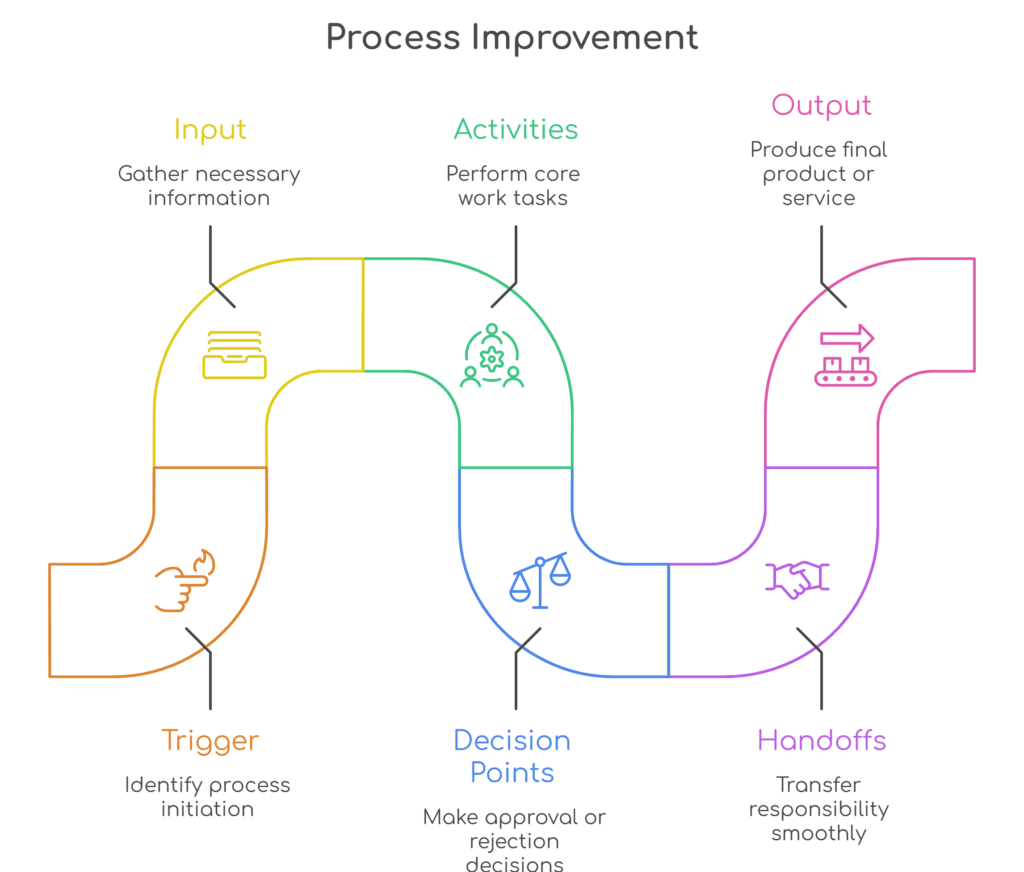
Connect Process Improvement With Business Strategy
This is where process improvement becomes more than an operational exercise.
A process should not be improved simply because it can be improved.
The more important question is:
What business objective should the improved process support?
If the objective is improved profitability, procurement, inventory, service delivery, billing, and resource utilization may become priorities.
If the objective is improved customer experience, enquiry handling, complaint resolution, service delivery, and after-sales processes may deserve greater attention.
This connection between strategy, execution, KPIs, and performance is central to Frontline Consult‘s approach to strategy and business transformation. Frontline Consult supports organizations in defining strategic goals, designing KPIs and Balanced Scorecards, integrating strategic priorities with performance management systems, and establishing performance monitoring mechanisms.
For organizations looking at process improvement as part of a broader transformation initiative, see Frontline Consult’s Strategy & Business Transformation service.
Establish a Continuous Improvement Cycle
Business Process Improvement should not end when a redesigned SOP is approved.
After implementation, management should monitor:
Baseline → Improvement → Measurement → Review → Adjustment → Standardization
If performance improves, the new process becomes the operating standard.
If performance does not improve, management should investigate why.
Possible reasons include:
- The root cause was incorrectly identified.
- Employees were not adequately trained.
- Responsibilities remain unclear.
- The new process is too complicated.
- The required technology is not available.
- Performance targets are unrealistic.
- Management is not reviewing the KPI.
- Employees have returned to the previous method.
Continuous monitoring turns process improvement from a one-time project into an ongoing management practice.
Business Process Improvement in Nepal: Where Organizations Can Begin
For organizations in Nepal considering a process improvement initiative, the first step does not need to be a company-wide transformation.
Begin with one process that has a clear business impact.
Suitable starting points may include:
- Sales and lead conversion
- Customer onboarding
- Procurement
- Inventory management
- Recruitment
- Employee onboarding
- Payroll administration
- Expense approval
- Invoice processing
- Customer complaints
- Service delivery
- Management reporting
- Performance review processes
Select one process, document the current state, establish baseline measurements, identify root causes, redesign the workflow, define ownership, implement the changes, and measure the outcome.
The results from that process can then inform broader organizational improvement.
A Practical Business Process Improvement Framework
A structured BPI initiative can therefore follow this sequence:
1. Select
Identify the process with the strongest business case for improvement.
2. Map
Document how the process actually operates today.
3. Measure
Establish cycle time, cost, quality, volume, error, and other relevant baselines.
4. Diagnose
Identify bottlenecks, duplication, waiting, rework, unclear ownership, and root causes.
5. Prioritize
Determine which issues will have the greatest effect on business performance.
6. Redesign
Develop a simpler and more effective future-state process.
7. Standardize
Document procedures, responsibilities, approval rules, and performance expectations.
8. Enable
Introduce appropriate technology or automation where it supports the redesigned process.
9. Implement
Put the new process into operation with clear ownership and communication.
10. Monitor
Track KPIs and compare actual performance against the baseline.
11. Improve again
Use performance data to identify the next improvement opportunity.
This framework keeps business process improvement connected to measurable organizational outcomes rather than treating it as an isolated operational exercise.
Frequently Asked Questions About Business Process Improvement in Nepal
Building Better Business Processes
Business Process Improvement in Nepal should not be approached as a search for isolated operational shortcuts. The stronger approach is to understand how work moves through the organization, measure what is happening, identify the causes of poor performance, redesign the process around business objectives, and establish the accountability required to sustain the improvement.
The most effective process is not necessarily the one with the most technology or the fewest steps. It is the process that consistently produces the required business outcome with appropriate cost, time, quality, control, and accountability.
For organizations seeking to connect process improvement with broader strategy, performance management, and business transformation, Frontline Consult provides consulting support focused on strategic planning, measurable objectives, KPI design, performance management integration, and strategy execution.
Learn more about Frontline Consult’s Strategy & Business Transformation services:
Strategy & Business Transformation
136 views