
Why a 3-Year Strategy Matters for Nepali Businesses
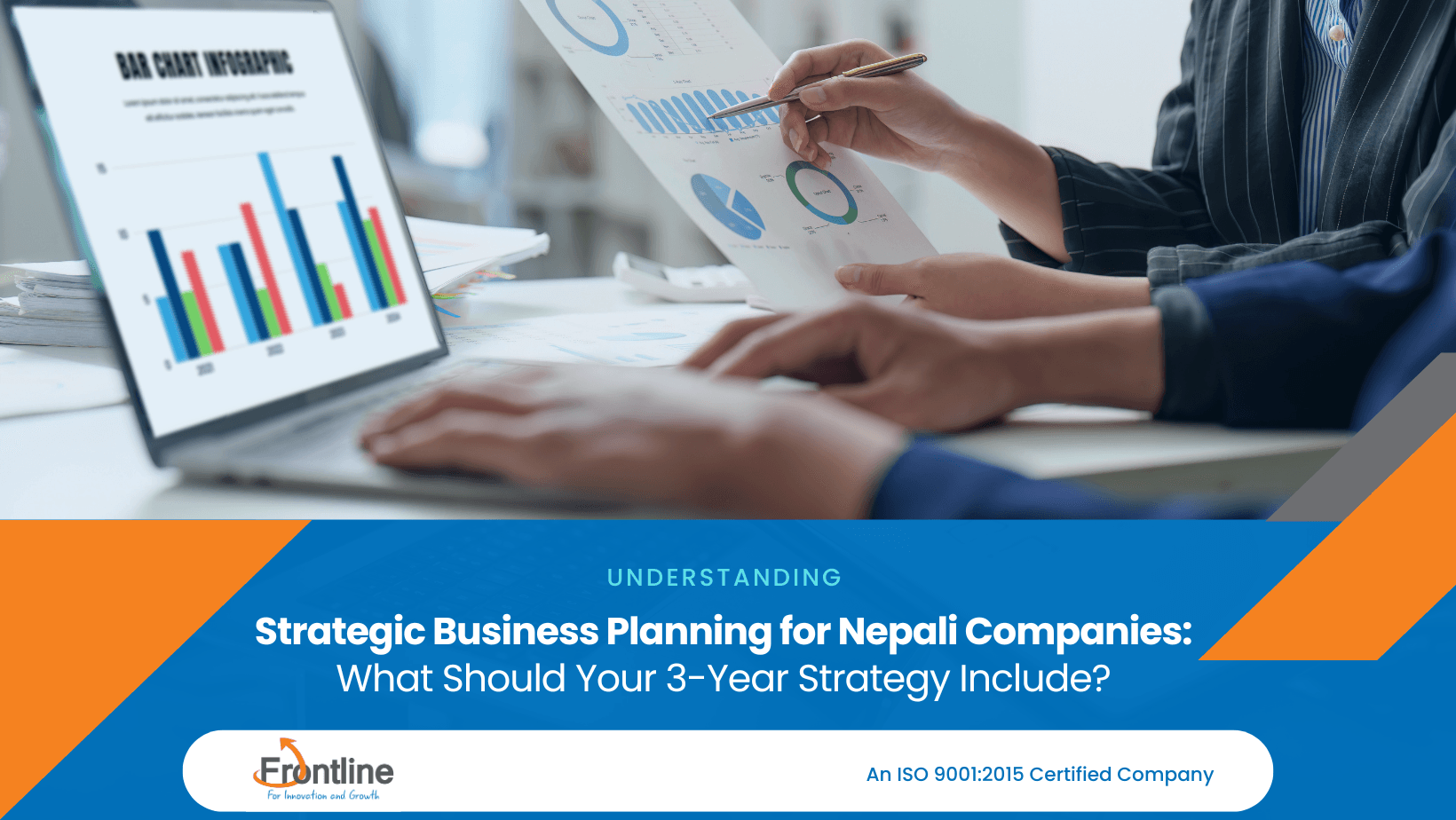
A 3-year strategy gives a company something more useful than a list of ambitions. It creates a clear direction for where the business wants to go, what it needs to achieve along the way, and how different teams will contribute to those priorities.
For Nepali companies, strategic planning can be particularly valuable when the business is growing, entering new markets, expanding its team, adding new products or services, or moving from founder-led decision-making toward a more structured management approach.
A good 3-year strategy should answer a few fundamental questions:
Where are we now? Where do we want to be 3 years from now? What needs to happen to get there? Who will be responsible for making it happen? And how will we measure progress?
This is where strategic business planning becomes more than an annual management meeting. It becomes a practical framework for making business decisions.
What Is a 3-Year Business Strategy?
A 3-year business strategy is a structured roadmap that defines an organization’s medium-term direction and priorities.
It connects the company’s broader vision with specific strategic goals, initiatives, performance measures, responsibilities and timelines.
Rather than attempting to predict every detail 3 years into the future, the purpose is to establish a clear direction while allowing enough flexibility to respond to changes in the business environment.
A well-developed strategy typically connects:
- Business vision and long-term direction
- Current organizational capabilities
- Market and industry conditions
- Strategic priorities
- Financial and growth objectives
- Key initiatives
- Departmental priorities
- KPIs and performance measures
- Risks and assumptions
- Governance and review mechanisms
The goal is to create a plan that management can actually use when making decisions.
Why Should Companies Develop a 3-Year Strategy?
Many organizations have annual targets, budgets and operational plans. These are important, but they do not always provide a clear picture of the bigger direction.
A 3-year strategy helps management step back from day-to-day activities and examine the business more broadly.
For example, a company may want to increase revenue. That is an important objective, but it does not explain how the organization intends to achieve it.
A strategic plan could break that objective into priorities such as:
- Expanding into selected geographic markets
- Strengthening distribution channels
- Developing new products
- Improving customer retention
- Building sales capabilities
- Investing in technology
- Improving operational efficiency
- Developing future leaders
This gives management a clearer basis for deciding where resources, people and investment should be directed.
What Should a 3-Year Business Strategy Include?
A useful strategy should not become a long document filled with statements that are difficult to act upon. It should contain the elements that management needs to make decisions and monitor progress.
1. A Clear Strategic Direction
The starting point is understanding what the organization wants to become over the next 3 years.
This should go beyond a general statement such as “become a leading company.”
A stronger strategic direction describes the position the organization wants to achieve and the value it intends to create.
Management should consider questions such as:
- What should the company be known for 3 years from now?
- Which customers or markets should it serve?
- What should its competitive position look like?
- What capabilities will the organization need?
- What kind of growth is realistic?
This creates a foundation for the rest of the strategy.
2. An Assessment of the Current Business
Before deciding where the company should go, leadership needs a clear understanding of where it currently stands.
A strategic assessment can examine areas such as:
Internal capabilities
- People and leadership
- Financial capacity
- Operations
- Technology
- Sales and marketing
- Customer relationships
- Organizational structure
External factors
- Customer expectations
- Market developments
- Industry trends
- Regulatory considerations
- Competitor activity
- Emerging opportunities
- Potential business risks
This assessment helps management make strategic decisions based on evidence rather than assumptions.
3. Strategic Goals That Can Be Measured
A strategy becomes much more useful when its goals can be measured.
For example:
Broad objective:
Improve business growth.
Strategic goal:
Increase annual revenue by a defined percentage within 3 years through expansion into selected markets and development of targeted customer segments.
The second version provides a clearer basis for action and measurement.
Strategic goals should ideally follow SMART principles: specific, measurable, achievable, relevant and time-bound.
The goal is not simply to create more numbers. It is to make strategic priorities clear enough that teams understand what success looks like.
4. Strategic Priorities
Not every opportunity can become a priority.
One of the most important parts of strategic planning is deciding what the organization will focus on.
A company may identify ten possible areas for improvement, but attempting to pursue all ten at once can spread resources too thin.
A 3-year strategy might therefore identify four or five major strategic priorities, such as:
- Revenue growth
- Market expansion
- Operational improvement
- Customer experience
- Leadership and organizational capability
Each priority can then have specific strategic initiatives attached to it.
This creates a hierarchy from broad direction to practical action.
5. A Strategy Map
A strategy map helps management understand how different strategic objectives connect with one another.
For example:
People & Capability → Better Processes → Better Customer Experience → Business Growth
This helps show that financial outcomes rarely happen in isolation.
If a company wants stronger revenue growth, it may first need to develop its sales team, improve processes, strengthen customer service and invest in the capabilities required to support expansion.
A strategy map makes these relationships easier to understand across the organization.
6. Strategic Initiatives and Action Plans
Strategic goals explain what the company wants to achieve. Strategic initiatives explain what it will actually do.
For example:
Strategic Goal:
Increase presence in new markets.
Possible Strategic Initiatives:
- Conduct market feasibility studies
- Develop a market entry plan
- Establish distribution partnerships
- Adapt products or services for target segments
- Develop a regional sales structure
Each initiative should have an owner, timeline, required resources and relevant performance measures.
This is where a strategic plan starts becoming an execution framework rather than simply a management document.
7. Departmental Alignment
A company-wide strategy should not remain with the board or senior management team.
Its priorities need to flow into departments.
For example, if one strategic priority is improving customer retention:
Sales may focus on account management and relationship development.
Customer service may focus on response time and issue resolution.
Marketing may focus on customer communication and retention campaigns.
HR may focus on developing the capabilities required for customer-facing teams.
This connection between corporate strategy and departmental priorities is essential for execution.
Frontline’s strategic planning methodology specifically emphasizes a cascade-ready structure where strategic goals can flow into departmental and individual KPIs.
8. KPIs and Performance Measures
A 3-year strategy needs a way to track whether the organization is moving in the intended direction.
Depending on the organization’s objectives, KPIs may cover:
- Revenue growth
- Profitability
- Market expansion
- Customer retention
- Sales productivity
- Operational efficiency
- Employee capability
- Customer satisfaction
- Project completion
- Cost management
The important point is that KPIs should connect directly to strategic priorities.
A KPI should not exist simply because it is easy to measure. It should tell management something meaningful about strategic progress.
9. Risk and Assumption Management
Every strategy is based on assumptions.
For example, management may assume that:
- A particular market will continue to grow
- Required talent will be available
- A planned investment will generate expected returns
- Customer demand will develop as anticipated
- Operational capacity can support expansion
These assumptions should be identified and reviewed.
A strategic plan can also include a risk and assumption register covering the major factors that could influence strategic initiatives.
This gives management a structured way to monitor issues rather than discovering them only after they affect execution.
10. Governance and Review
A strategy should not be created once and then forgotten.
Management needs a defined process for reviewing progress.
A practical governance structure may include:
- Monthly operational reviews
- Quarterly strategic reviews
- KPI dashboards
- Initiative progress tracking
- Responsibility matrices
- Periodic review of strategic assumptions
- Annual strategy refresh
The purpose is not to constantly change the strategy. It is to make sure the organization remains focused on its priorities and can make informed adjustments when necessary.
A Simple 3-Year Strategic Planning Structure
A company can structure its strategy around 3 horizons:
Year 1: Build the Foundation
The first year can focus on establishing the capabilities, systems and resources required for future growth.
This may include:
- Strengthening leadership
- Improving processes
- Building organizational capabilities
- Developing new systems
- Establishing performance measures
Year 2: Scale the Strategy
Once the foundation is stronger, the organization can focus on expanding successful initiatives.
This may include:
- Market expansion
- Product or service development
- Sales growth
- Operational scaling
- Technology investment
Year 3: Consolidate and Grow
The third year can focus on strengthening the organization’s position and preparing for the next strategic cycle.
This may include:
- Consolidating market presence
- Improving profitability
- Strengthening customer relationships
- Developing future growth opportunities
- Reviewing the next 3-year direction
The exact structure will vary according to the company’s industry, size, objectives and organizational maturity.
Why Strategic Planning Facilitation Can Add Value
Strategic planning can become difficult when the same leadership team is responsible for both contributing to the discussion and facilitating it.
Important issues can be overlooked, conversations can become focused on operational matters, and different departments may leave with different interpretations of the final priorities.
A professional facilitator provides structure to the process.
The focus is not simply on conducting a workshop. It is on helping leadership teams move through the right discussions, examine relevant information, define strategic priorities, establish measurable goals and connect those goals with execution.
Frontline Consult’s strategic business planning facilitation approach includes an environmental and capability scan, strategic goal framework, strategy map, initiative portfolio, risk and assumption register, and performance governance blueprint.
The methodology is also designed to adapt to an organization’s culture, capacity, sector and level of strategic maturity.
What Makes a 3-Year Strategy Useful?
The length of the strategy document is not what determines its value.
A useful strategy should make it easier for leadership and teams to answer:
What are we trying to achieve?
Why does it matter?
What are our most important priorities?
What initiatives will get us there?
Who owns each initiative?
How will we measure progress?
When will we review our progress?
If these questions have clear answers, the strategy becomes much easier to translate into everyday business decisions.
Final Thoughts
For Nepali companies, a 3-year business strategy can provide a practical bridge between long-term ambition and annual execution.
It gives leadership a structured way to assess the current business, define priorities, allocate resources, establish measurable goals and align departments around a common direction.
The most useful strategic plans are not created simply to be presented at an annual meeting. They are built to guide decisions throughout the year.
For organizations looking to develop a structured, measurable and execution-ready strategic plan, professional facilitation can help bring the right people, questions, data and decisions into the planning process.
Frontline Consult provides Strategic Business Planning Facilitation for organizations looking to develop a clear 3 to 5 year strategic plan, establish measurable strategic goals and create a direct connection between strategy and execution.
Build Your 3-Year Business Strategy
If your leadership team is preparing for the next stage of growth, Frontline Consult can facilitate a structured strategic planning process based on your organization’s goals, capabilities and business context.
Learn more about Strategic Business Planning Facilitation:
Strategic Business Planning Facilitation | Frontline Consult
Contact Frontline Consult: +977 1 5707271
150 views