
Business Planning Services
Business planning is often treated as a document preparation exercise. A company sets out its vision, mission, objectives, financial projections and action points, then considers the planning process complete.
A useful business plan requires much more than documentation.
For an established organization, business planning should answer a more important set of questions: Where is the organization now? Where does it need to go? Which priorities deserve investment? What capabilities are required? How will management measure progress? Who is responsible for delivering each strategic priority?
This distinction is particularly important for organizations operating in Nepal, where businesses may be dealing with changing customer expectations, evolving technology, workforce constraints, regulatory considerations, cost pressures and increasingly complex operating models.
Effective business planning connects these realities with specific strategic choices and measurable execution.
Table of Contents
What Business Planning Actually Involves
A business plan and a strategic plan are related, but they are not identical.
A conventional business plan often focuses on the business model, market, operations, financial projections and commercial viability. Strategic business planning goes further by determining the organization’s direction, priorities, resource allocation and mechanisms for execution.
A practical planning process should establish five things:
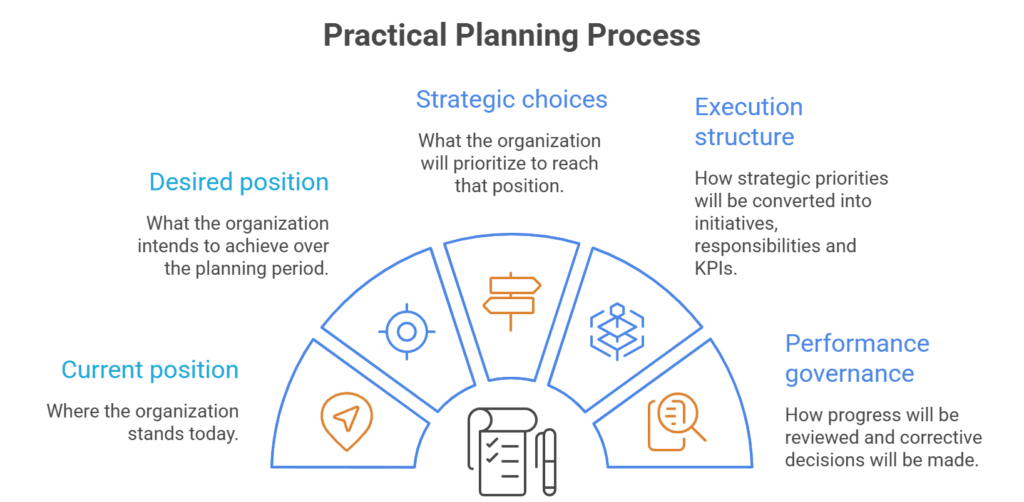
Without these connections, a strategic plan can become a collection of intentions rather than a management tool.
The Business Planning Process in Nepal
A strong business planning process normally begins before strategic objectives are written.
The first task is to establish a realistic picture of the organization and its operating environment.
1. Assess the Current Business Position
Planning should begin with evidence.
Management needs to understand the organization’s current performance, capabilities, market position and internal constraints before deciding where it should go.
The assessment can cover:
- Revenue and profitability trends
- Customer segments and customer concentration
- Products and service performance
- Market position
- Operational capacity
- Workforce capability
- Technology and systems
- Organizational structure
- Cost structure
- Sales and distribution channels
- Leadership and management capability
- Existing risks
- Available financial and operational resources
Financial performance alone does not provide a complete picture.
For example, a company may be generating strong revenue while depending heavily on a small number of customers. Another organization may have strong demand but insufficient operational capacity to support expansion.
These differences matter when establishing strategic priorities.
2. Examine the External Environment
The next stage is to understand the conditions affecting the organization from outside.
This can include:
- Customer behaviour
- Market demand
- Industry developments
- Regulatory changes
- Technology adoption
- Economic conditions
- Supply-side changes
- Talent availability
- Emerging business models
- Changes in purchasing patterns
The objective is not to produce a lengthy market analysis for its own sake.
The objective is to identify external factors that should influence strategic decisions.
For instance, if customer expectations are moving toward digital service delivery, the strategic response may involve technology investment, process redesign, workforce development or a combination of all three.
The planning process should make that connection visible.
3. Define Strategic Priorities Instead of Listing Every Goal
One of the most important parts of business planning is deciding what the organization will focus on.
Companies often have many legitimate goals:
- Increase revenue
- Improve customer retention
- Enter new markets
- Improve productivity
- Develop employees
- Introduce technology
- Reduce operating costs
- Strengthen management systems
- Launch new products
- Improve service quality
The problem is not the number of possible objectives. The problem is attempting to pursue all of them with equal priority.
Strategic planning requires choices.
A useful approach is to group priorities into a manageable number of strategic areas and establish a clear outcome for each.
For example:
| Strategic Area | Strategic Objective | Possible Measure |
|---|---|---|
| Revenue Growth | Increase revenue from priority segments | Revenue growth rate |
| Customer | Improve customer retention | Retention rate |
| Operations | Improve operational productivity | Cost per output |
| People | Strengthen critical capabilities | Capability or productivity indicators |
| Technology | Improve digital processes | Digital adoption rate |
| Finance | Improve profitability | Operating margin |
This creates a stronger connection between strategy and measurement.
4. Convert Strategic Goals Into Measurable Outcomes
A strategic goal should describe an outcome rather than simply an activity.
“Improve marketing” is an activity-oriented statement.
“Increase qualified leads from priority market segments” describes an outcome.
Similarly:
“Train employees” describes an activity.
“Build required sales capability and improve sales conversion” describes the intended business outcome.
This distinction is important because strategic planning should eventually connect with departmental KPIs and individual responsibilities.
A useful objective should clarify:
- What needs to change?
- By how much?
- Within what period?
- Who owns the outcome?
- Which indicators will demonstrate progress?
SMART criteria can provide a useful structure for defining these objectives.
5. Build a Strategy Map
Once strategic priorities are established, the organization needs to understand how those priorities relate to each other.
A strategy map helps create this connection.
For example:
People capability
↓
Better operational processes
↓
Improved customer experience
↓
Higher retention and revenue
↓
Improved profitability
This type of relationship is valuable because it prevents departments from operating around disconnected targets.
Human resources may focus on capability development.
Operations may focus on productivity.
Sales may focus on revenue.
Customer service may focus on retention.
A strategy map provides a common view of how these areas contribute to the organization’s larger objectives.
6. Prioritize Strategic Initiatives
Objectives alone do not produce results.
Each major objective needs initiatives that move the organization toward the intended outcome.
Suppose an organization has identified operational efficiency as a strategic priority.
Possible initiatives could include:
- Process redesign
- Technology implementation
- Procurement improvement
- Workforce restructuring
- Standard operating procedures
- Performance management improvements
- Management reporting systems
At this stage, the organization should assess each initiative based on factors such as:
- Strategic importance
- Expected business impact
- Cost
- Resource requirements
- Implementation complexity
- Risk
- Time required
- Organizational readiness
This helps management distinguish between initiatives that are strategically important and initiatives that are simply desirable.
7. Connect the Business Plan With Resource Allocation
A strategic plan should influence where the organization puts its money, people and management attention.
If a strategic priority requires new technology, the required investment should appear in financial planning.
If expansion requires additional employees, workforce planning should reflect that requirement.
If a new market requires distribution capability, the operational plan needs to account for it.
This creates an important relationship:
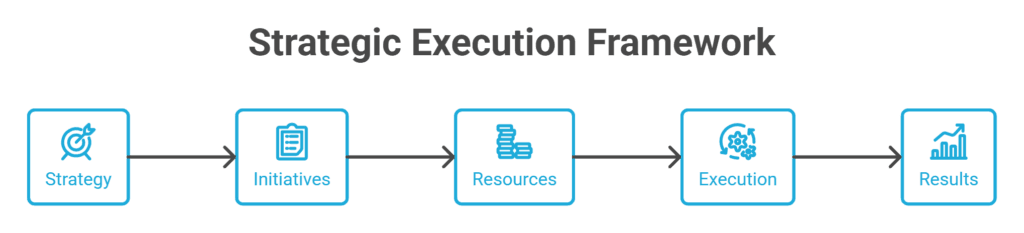
When these elements are developed separately, the organization can end up with a strategic plan that cannot be implemented within its available resources.
8. Include Risks and Strategic Assumptions
Business planning should not be based only on expected outcomes.
Every major strategic decision contains assumptions.
For example:
- Customer demand will increase.
- Required talent will be available.
- A planned technology investment will produce expected efficiency.
- Expansion into a new segment will generate sufficient demand.
- Operating costs will remain within projected levels.
These assumptions should be documented and monitored.
A strategic risk register can identify:
| Risk | Potential Impact | Probability | Mitigation | Owner |
|---|---|---|---|---|
| Talent shortage | Delayed expansion | Medium | Workforce pipeline | HR |
| Cost increase | Margin pressure | Medium | Cost controls | Finance |
| Technology delay | Implementation delay | Medium | Alternative vendors | Operations |
| Demand variation | Revenue gap | Medium | Scenario planning | Commercial Team |
This makes risk management part of strategic management rather than an isolated compliance activity.
9. Develop Scenarios Instead of Relying on One Forecast
A 3-year or 5-year plan should provide direction, but it should not assume that the future will follow one exact path.
Scenario planning can help management prepare for different operating conditions.
Each scenario can be assessed against:
- Revenue
- Costs
- Workforce requirements
- Cash requirements
- Capacity
- Investment
- Strategic priorities
This allows leadership to establish trigger points for strategic decisions.
For example, if demand exceeds a certain threshold, additional capacity may be approved. If demand falls below another threshold, the organization may delay selected investments.
This makes the business plan more useful as a management tool.
10. Cascade the Strategic Plan Into Departmental KPIs
A strategic plan becomes operational when it reaches departments and teams.
Consider a strategic objective such as:
Improve customer retention.
That objective may translate into different departmental responsibilities.
Sales
- Repeat customer rate
- Account retention
- Customer acquisition cost
Customer Service
- Resolution time
- Customer satisfaction
- Complaint recurrence
Operations
- Service delivery accuracy
- Turnaround time
- Error rate
HR
- Training completion
- Capability development
- Employee performance indicators
This process is often called strategy cascading.
It creates a line of sight between organizational objectives and the work performed by individual departments.
The result is a stronger connection between business planning, performance management and accountability.
11. Establish a Performance Review System
A business plan should not be reviewed only at the end of the year.
Strategic performance needs a defined review structure.
A practical governance cycle may include:
Monthly: Operational and KPI monitoring
Quarterly: Strategic performance review
Biannually: Strategic initiative and resource review
Annually: Full strategy review and planning update
The review should examine more than whether targets were achieved.
Management should ask:
- What changed?
- Why did performance change?
- Which assumptions remain valid?
- Which initiatives are progressing?
- Which initiatives require intervention?
- Are resources being used appropriately?
- Have new risks emerged?
- Does the strategy still reflect the organization’s current environment?
Business Planning for Different Stages of an Organization
The depth of planning should reflect the organization’s stage and complexity.
Startups and New Businesses
Planning may focus on:
- Business model
- Target customers
- Market opportunity
- Revenue model
- Cost structure
- Initial investment
- Operational requirements
- Financial sustainability
- Go-to-market priorities
The main requirement is clarity around how the business will operate and generate sustainable revenue.
Growing Businesses
Growing organizations often need to move beyond founder-led decision-making.
Planning may focus on:
- Expansion priorities
- Organizational structure
- Leadership capability
- Process standardization
- Technology
- Workforce planning
- Customer segmentation
- Financial controls
- Management KPIs
At this stage, planning helps ensure that growth is supported by the required organizational capacity.
Established Organizations
For mature organizations, strategic planning may involve:
- Portfolio decisions
- Market expansion
- Business transformation
- Cost optimization
- Organizational redesign
- Digital transformation
- Leadership succession
- Performance governance
- Long-term investment priorities
The emphasis shifts from establishing the business model to managing strategic choices and organizational performance.
When Should a Company Review Its Business Plan?
Business planning should not be limited to the beginning of a financial year.
A strategic review can become necessary when there is a significant change in:
- Revenue performance
- Market conditions
- Customer behaviour
- Leadership
- Organizational structure
- Technology
- Regulation
- Workforce requirements
- Business model
- Investment priorities
A company can also review its plan when the existing strategy is no longer providing clear guidance for decision-making.
A useful planning cycle therefore combines annual strategic planning with periodic performance reviews.
What Should a Business Planning Document Contain?
A practical strategic business plan may include the following sections:
- Executive direction
- Current-state assessment
- Market and external environment analysis
- Organizational capability assessment
- Strategic priorities
- Strategic objectives
- Strategy map
- Key performance indicators
- Strategic initiatives
- Resource requirements
- Risk and assumption register
- Implementation roadmap
- Governance and accountability structure
- Performance review framework
- Annual action plan
The exact structure should depend on the organization’s size, sector, objectives and planning horizon.
The purpose is not to produce a longer document. The purpose is to produce a plan that management can actually use.
Turning Business Planning Into an Execution Framework
The real value of business planning is visible after the plan has been approved.
A useful strategic planning framework should allow an organization to move from:
Where we are
↓
Where we want to go
↓
What strategic choices we will make
↓
What initiatives we will implement
↓
Who is responsible
↓
How resources will be allocated
↓
How performance will be measured
↓
How management will review and adjust the strategy
This is the difference between a plan that sits in a document and a plan that becomes part of management practice.
Get Professional Support for Strategic Business Planning in Nepal
For organizations that need a structured approach to developing a practical, measurable and execution-focused strategy, Frontline Consult provides strategic business planning facilitation designed around organizational context, strategic priorities, measurable goals, initiative planning, KPI alignment and performance governance.
You can learn more about the service here: Strategic Business Planning Facilitation by Frontline Consult.
The engagement is designed to help leadership teams develop a strategic plan that can be translated into departmental priorities, KPIs and implementation actions rather than remaining only as a planning document.
Strategic Business Planning Facilitation
Frequently Asked Questions About Business Planning Services in Nepal
Conclusion
Business planning is most useful when it connects strategic decisions with execution.
For organizations in Nepal, this means going beyond a document containing vision statements, financial projections and broad objectives. A practical planning process should examine the current business position, identify strategic priorities, define measurable outcomes, establish initiatives, allocate resources, address risks and connect organizational strategy with departmental performance.
The final objective is a clear management framework that helps leadership make decisions, allocate resources and monitor progress over time.
That is what makes business planning a continuing strategic management process rather than an annual documentation exercise.
116 views