
EOR Services
Hiring talent in a new country used to mean months of paperwork before a single employee could start work. A company would need to register a local entity, open a corporate bank account, get tax registrations sorted, and understand a labor law system it had never dealt with before. For most businesses, that process alone could take three to six months, and cost far more than the hiring itself was worth.
An Employer of Record (EOR) removes that barrier entirely. It lets a company hire an employee in another country the same week they find the right candidate, without setting up a local branch or subsidiary.
This article explains what an EOR does, how the model works in practice, and why it has become the preferred route for companies hiring in Nepal.
What Is an Employer of Record (EOR)?
An Employer of Record is a local company that legally employs a worker on behalf of another business. The EOR becomes the registered employer for tax, payroll, and labor law purposes, while the hiring company continues to direct the employee’s day-to-day work, projects, and performance.
In simple terms, the Employer of Record handles the legal and administrative side of employment. The client company handles the actual work relationship.
This structure matters because employment law does not allow a foreign company to simply pay someone in another country and call them an employee. Every country, including Nepal, requires a locally registered employer to issue contracts, deduct taxes, contribute to social security schemes, and follow labor regulations. Without a local entity or an EOR partner, a foreign company has no legal way to employ someone directly.
Why Companies Avoid Setting Up a Local Entity
Registering a company branch in a new country is a serious undertaking. It typically involves:
- Business registration with government authorities
- Opening and maintaining a local corporate bank account
- Ongoing tax filings and statutory audits
- Understanding and applying local labor law correctly
- Managing payroll, benefits, and social security contributions
- Handling work permits for foreign staff, where applicable
For a company that only wants to hire one or two people in a new market, this is a heavy commitment. It ties up capital, requires legal counsel, and creates ongoing compliance obligations that have nothing to do with the actual business goal, which is simply to hire good people and get work done.
An EOR removes all of this. The company gets access to talent in the new country immediately, while the EOR carries the legal employer responsibility.
How an EOR Works in Practice
The process is more straightforward than most companies expect. At Frontline Consult, the EOR journey typically follows six steps:
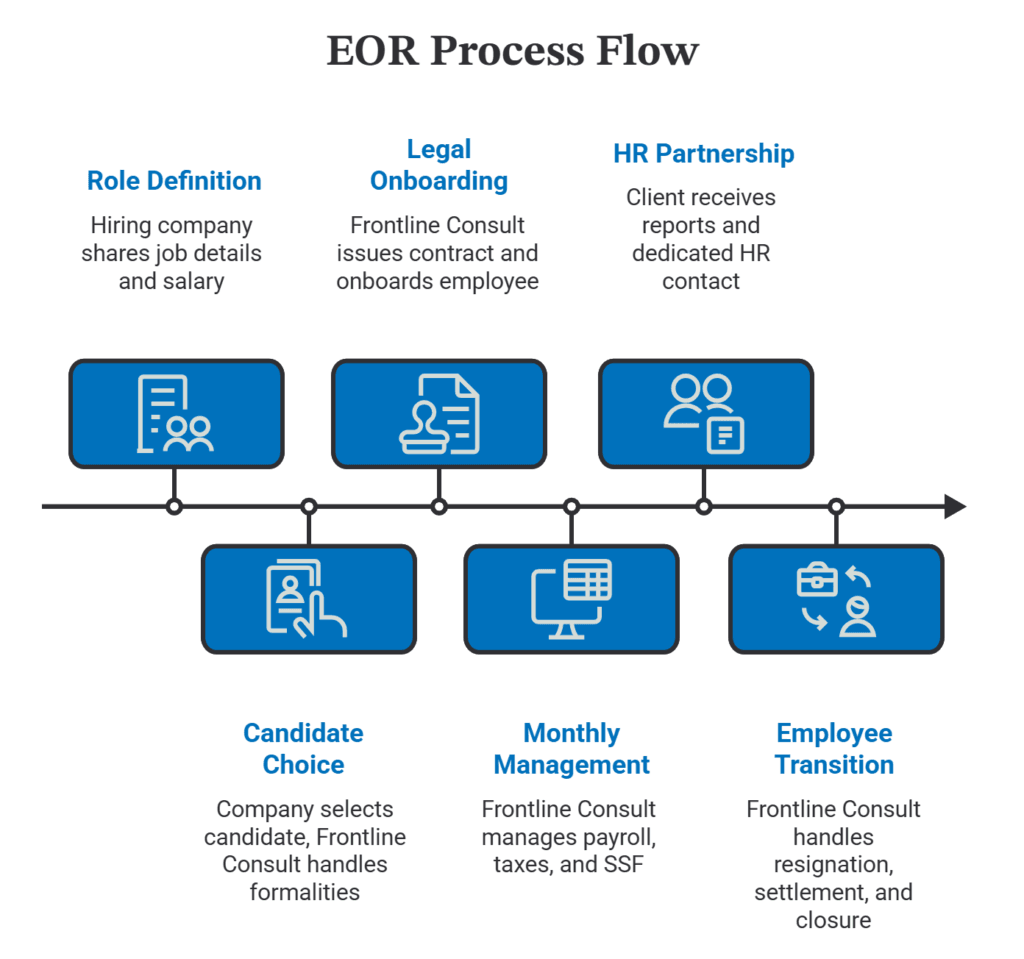
1. Talent requirement discussion. The hiring company shares the role, required skills, and salary range.
2. Hiring and selection. The company selects the candidate they want. Frontline Consult completes the formalities.
3. Employment contract signing. Frontline Consult issues a compliant employment contract and onboards the employee under Nepal’s labor law.
4. Payroll and HR operations begin. Frontline Consult runs monthly payroll, tax withholding, and Social Security Fund (SSF) contributions.
5. Ongoing support and reporting. The client receives monthly reports and has a dedicated HR contact for any employee-related matter.
6. Contract renewal or exit. If an employee moves on, Frontline Consult manages resignation handling, final settlement, and SSF and income tax closure.
The client never has to touch local paperwork. They interview, select, and manage the employee’s actual work. Frontline Consult manages everything that requires a registered legal employer in Nepal.
What an EOR Actually Covers
A proper EOR service goes well beyond issuing a contract. Frontline Consult’s Employer of Record service in Nepal covers:
Full HR and compliance administration, including employment contracts aligned with the Nepal Labor Act 2074, SSF enrolment and monthly contributions, payroll processing and tax filings, leave and attendance handling, and work permit assistance for foreign nationals.
Hiring and onboarding, including job posting, candidate screening, background checks where required, offer issuance, contract signing, and orientation on local rules and benefits.
Payroll and benefits administration, covering monthly salary processing, tax calculation, SSF contributions, statutory benefits, and salary transfers.
Ongoing employee support, acting as the local HR point of contact for issue resolution, leave management, and policy clarification.
Contract management and exit handling, including resignation processing, clearance, final settlement, and closure of SSF and income tax records.
This is what separates an EOR from simply “outsourcing payroll.” The EOR is the legal employer, carrying full responsibility for compliance, while the client keeps full control of the employee’s actual work.
EOR vs PEO: Knowing the Difference
Companies sometimes use “EOR” and “PEO” interchangeably, but they solve different problems.
| Feature | EOR | PEO |
|---|---|---|
| Legal employer | Frontline Consult | Shared responsibility |
| Local entity required | No | Yes |
| Employment contracts | Issued by Frontline Consult | Jointly managed |
| Payroll and compliance | Fully handled by Frontline Consult | Co-managed with the client |
| Best suited for | Companies with no Nepal entity | Companies that already have a Nepal entity |
If a business is expanding into Nepal without a registered office, EOR is the right structure. If the company already has a local entity and simply wants stronger HR and compliance support, PEO strengthens that existing setup.
Key Facts About Hiring in Nepal
Companies exploring Nepal as a hiring destination should know the basic labor framework Frontline Consult operates within:
- Work hours: 8 hours per day, 48 hours per week
- Weekly off: Saturday
- Minimum wage: NPR 19,550 per month, effective July 2025 (basic pay of NPR 12,170 plus a dearness allowance of NPR 7,380, with SSF calculated separately)
- Public holidays: A minimum of 13 per year
- Payroll cycle: Monthly
- Leave structure: Defined under the Nepal Labor Act 2074
- Foreign nationals: Require a work permit to be legally employed
Getting any of these details wrong can create compliance risk for the hiring company, which is exactly the exposure an EOR is designed to remove.
Who Should Use an EOR Service?
An Employer of Record model fits companies that:
- Want to hire in Nepal quickly, without waiting on entity registration
- Have no plans to open a local branch or subsidiary
- Need remote staff based in Nepal
- Want to reduce their administrative and legal workload
- Need guaranteed compliance with Nepal’s labor laws
- Prefer a local HR team managing their employees on the ground
This covers a wide range of situations: a startup testing the Nepal market before committing to a full office, a global company building a small remote team, or an organization that simply wants one specialist role filled without the overhead of local incorporation.
Why Companies Choose Frontline Consult in Nepal
Frontline Consult is a licensed HR company in Nepal, accredited under the Ministry of Labor, Employment and Social Security, and has spent over 10 years managing HR operations, payroll, and staffing for clients hiring in the country. The company is also an ISO 9001:2015 certified organization and a member of a global payroll association, which supports accuracy and consistency when coordinating payroll across borders.
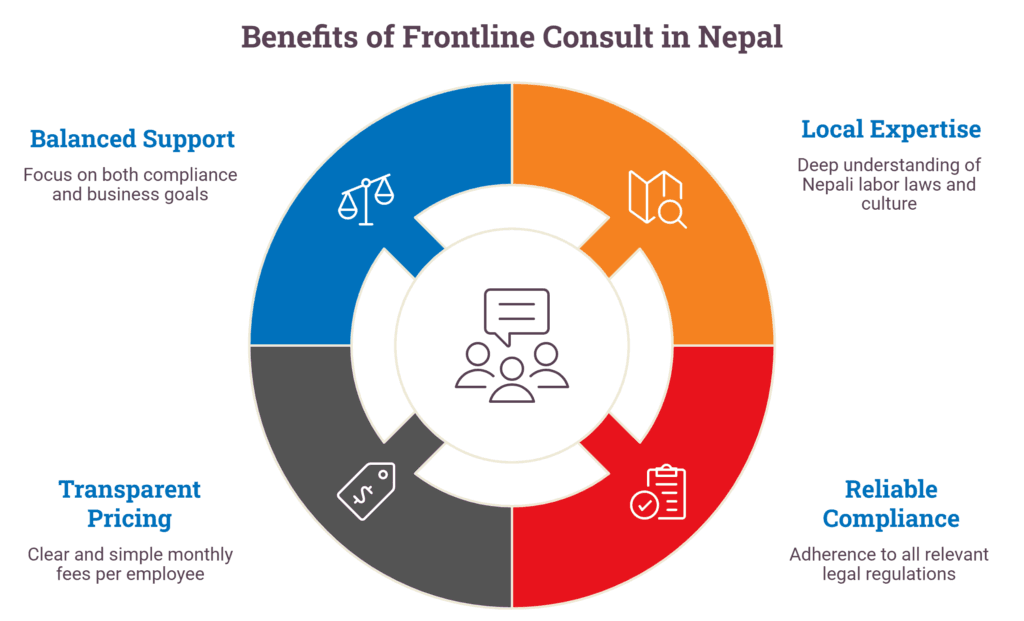
A few things set the service apart:
- Local expertise. The team understands Nepali labor law, culture, and market practices, not just the legal text.
- Reliable compliance. Every process follows the Nepal Labor Act 2074, the Income Tax Act, SSF regulations, and other applicable laws.
- Transparent pricing. A simple monthly cost per employee, with no hidden fees.
- Balanced support. Frontline Consult manages compliance and employee care while keeping the client’s business goals at the center of the arrangement.
For companies that want to hire in Nepal without the delay and cost of setting up a local entity, this combination of experience and compliance discipline is what makes the process low-risk.
Frequently Asked Questions
Does an EOR replace the need for a local company registration?
Yes. The EOR itself is the registered legal employer in Nepal, so the hiring company does not need to register its own entity to employ staff there.
Who manages the employee’s daily work under an EOR arrangement?
The client company. The EOR handles the legal employment relationship, payroll, and compliance, while the client directs the employee’s actual tasks and performance.
How long does it take to hire someone through an EOR in Nepal?
Once a candidate is selected, Frontline Consult can issue a compliant contract and begin onboarding within days, compared to the months typically needed to register a local entity first.
Can an EOR handle foreign employees who need work permits?
Yes. Frontline Consult provides work permit assistance for foreign nationals as part of its EOR service in Nepal.
What is the difference between choosing EOR and PEO?
EOR is for companies with no local entity in Nepal, where Frontline Consult is the legal employer. PEO is for companies that already have a Nepal entity and want shared HR and compliance support.
Ready to Hire in Nepal Without Opening a Local Entity?
Companies that want access to Nepali talent without the cost and delay of local incorporation can rely on Frontline Consult’s EOR and PEO services to handle contracts, payroll, and compliance from day one. Tell Frontline Consult the roles you want to fill, and the team will take care of everything from contract to payroll while you focus on the work itself.
121 views