
Introduction to Strategic HR Planning
Every organisation, big or small, faces the same challenge: having the right people, in the right roles, at the right time. That is exactly what workforce forecasting helps us achieve. It is not just a corporate buzzword. It is a practical, necessary process that separates organisations that grow with confidence from those that struggle to keep up.
In Nepal’s growing economy, where industries like hospitality, banking, IT, and development sectors are expanding rapidly, HR teams can no longer rely on gut feeling alone. Strategic workforce forecasting gives us the data and the direction we need to plan ahead.
Table of Contents
What Is Workforce Forecasting?

Workforce forecasting is the process of predicting an organisation’s future staffing needs based on business goals, employee trends, and market changes. It helps HR leaders answer questions like:
- How many people will we need next year?
- What skills are we going to be short on?
- Which departments are at risk of high turnover?
Unlike traditional strategic HR planning, which tends to be reactive, workforce forecasting is proactive. It prepares us before a crisis hits, not after.
Why It Matters More Than Ever

Dave Ulrich, widely regarded as the father of modern HR, has long argued that HR must move from being an administrative function to a strategic business partner. Workforce forecasting is one of the clearest ways HR can demonstrate that strategic value.
When HR teams bring data-driven workforce plans to leadership meetings, they are no longer just talking about headcount. They are talking about business continuity, growth readiness, and risk management. This shift in how HR is perceived within an organisation is significant.
The Link Between Forecasting and Strategic HR Planning
Strategic HR planning is the broader roadmap that connects people decisions to business direction. Workforce forecasting is one of its most important tools.
Think of it this way: if our organisation plans to open a new branch or launch a new product line, HR needs to know well in advance. How many people do we need to hire? What kind of training will existing staff need? How long will recruitment take?
Without forecasting, HR is always playing catch-up. With it, we are part of the conversation from the beginning.
The Society for Human Resource Management (SHRM) emphasises that strategic HR planning is incomplete without a reliable forecasting component. It is the bridge between where the business is today and where it wants to go.
Key Benefits of Workforce Forecasting
1. Reduces Hiring Gaps and Overstaffing
Both understaffing and overstaffing are costly in their own ways. Understaffing leads to burnout and missed targets. Overstaffing leads to unnecessary overhead and disengaged employees. Workforce forecasting finds the balance by giving us a clearer picture of what we actually need.
2. Supports Succession Planning
One of the most overlooked aspects of strategic HR planning in Nepali organisations is succession planning. Many companies lose institutional knowledge when senior staff retire or resign because no plan was in place. Michael Armstrong, in his widely used Handbook of Human Resource Management Practice, stresses that planning for talent pipelines is not optional for growing organisations. It is essential.
Workforce forecasting tells us where those gaps will appear and gives us time to prepare.
3. Helps Manage Workforce Demographics
In Nepal, we are seeing a growing trend of young graduates entering the workforce while experienced professionals migrate abroad for opportunities. This demographic shift creates skill gaps that HR teams must plan for. Forecasting helps us see these trends early and respond with targeted hiring, training, or retention strategies.
4. Improves Budgeting and Resource Allocation
When HR can present a well-researched workforce plan, Finance teams can allocate resources more accurately. Training budgets, recruitment costs, and compensation structures all become easier to plan when we have a roadmap. This is especially relevant in Nepal where many organisations operate with lean budgets and cannot afford reactive hiring.
5. Enhances Employee Retention
Research from Gallup’s State of the Global Workplace consistently shows that employees who feel their organisation is well-managed and has a clear direction are more likely to stay. Workforce forecasting contributes directly to that sense of organisational clarity.
When employees see that there are growth paths, training opportunities, and a stable workforce plan, their confidence in the organisation grows. That confidence reduces turnover.
Common Workforce Forecasting Methods We Use
There is no single perfect method. Experienced HR teams usually combine a few approaches depending on the organisation’s size and data availability.
Trend Analysis looks at historical data, such as hiring patterns, turnover rates, and seasonal staffing changes, to project future needs.
Workload Analysis ties staffing directly to expected business volume. For example, a hotel in Pokhara might forecast staffing needs around tourist seasons based on past booking data.
Managerial Judgement involves department heads sharing insights about upcoming projects, expected growth, or expected exits. This qualitative input is just as important as the numbers.
Skills Inventory audits what capabilities currently exist within our teams and where the gaps are likely to grow.
Using a combination of these ensures our forecasts are grounded in both data and real-world knowledge.
Challenges Organisations in Nepal Face With Workforce Forecasting
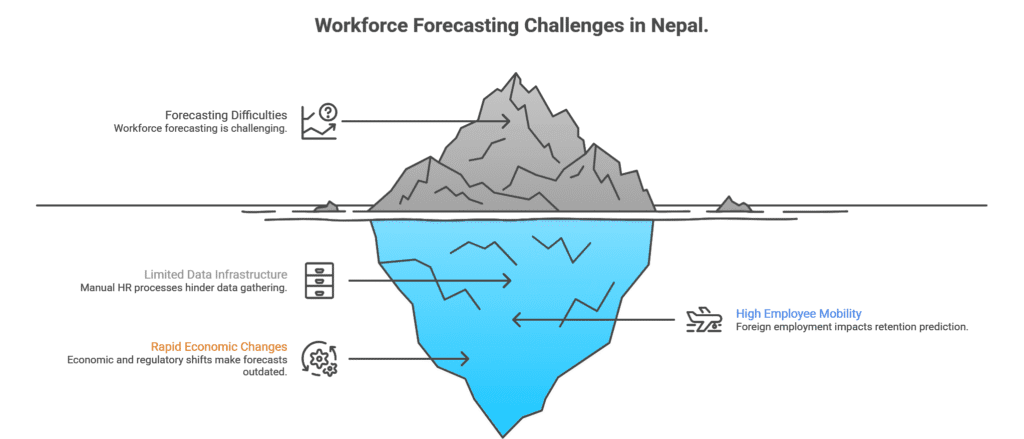
It is honest to acknowledge that workforce forecasting is not without its difficulties.
Limited data infrastructure is one of the most common barriers in Nepali organisations. Many companies still rely on manual HR processes, which makes it difficult to gather the historical data needed for accurate forecasting.
High employee mobility due to foreign employment trends also makes it harder to predict retention. Nepal’s workforce is significantly influenced by migration, and HR teams must factor this into any planning.
Rapid economic and regulatory changes, particularly in sectors like banking, cooperatives, and government services, can quickly make forecasts outdated. This is why we recommend revisiting forecasts at least twice a year rather than treating them as a once-a-year exercise.
How To Start Workforce Forecasting in Your Organisation
Starting does not require a large team or expensive software. It requires intention and a structured approach.
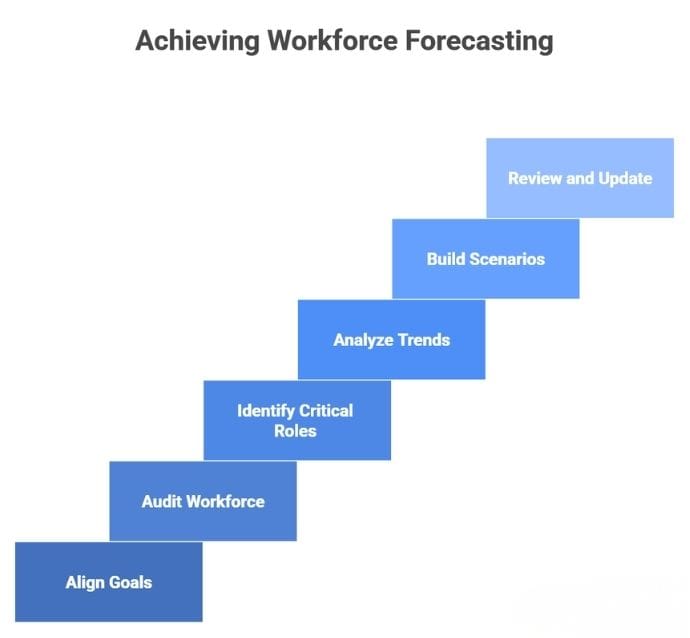
Step 1: Align with organisational goals. Talk to senior leadership about the one, three, and five-year direction of the business.
Step 2: Audit your current workforce. Know what you have before you plan for what you need.
Step 3: Identify critical roles. Not all positions carry equal strategic weight. Focus forecasting energy on roles that are hardest to fill or most important to operations.
Step 4: Analyse trends. Look at past turnover, retirement timelines, and hiring patterns.
Step 5: Build scenarios. Create a few different projections based on conservative, moderate, and optimistic business growth assumptions.
Step 6: Review and update regularly. The forecast is a living document, not a finished report.
The Human Element Behind the Numbers
It is easy to think of workforce forecasting as a purely numerical exercise. But at its core, it is about people. It is about making sure that the individual contributors within our organisation have the support, the development, and the environment they need to grow alongside the business.
Peter Drucker, one of the most influential management thinkers of the twentieth century, once said that the most important decisions in organisations are people decisions. Workforce forecasting gives those decisions the preparation they deserve.
Final Thoughts
For HR professionals in Nepal looking to elevate their function from operational to strategic, workforce forecasting is one of the most powerful tools available. It connects HR directly to business outcomes, builds credibility with leadership, and most importantly, ensures that our people are set up to succeed.
We are not just planning headcount. We are planning the future of our organisations.
204 views