
Table of Contents
Introduction to Continuous Performance Management
The annual performance review has been a workplace ritual for decades. Once a year, managers and employees sit across from each other, revisit goals set twelve months ago, and try to summarize an entire year of work into a rating or a score. For many employees, it is a stressful and often meaningless exercise. For many managers, it feels like a burden that takes time away from real work.
The truth is, the annual appraisal model is broken. And organizations that continue to rely on it are falling behind.
Why the Annual Appraisal Model Is Failing
Annual performance reviews were designed for a different era, one where workplaces were stable, roles were fixed, and goals rarely changed. Today, that world no longer exists.
Marcus Buckingham and Ashley Goodall, in their research published in Harvard Business Review, found that the traditional performance review system suffers from a fundamental flaw: it asks managers to evaluate employees against a standardized scale, yet what managers actually observe is filtered through their own subjective experience. The result is that reviews often say more about the reviewer than the person being reviewed. They called this “idiosyncratic rater effect,” and it is a serious problem in most organizations.
Beyond subjectivity, annual reviews are simply too infrequent. By the time a review happens, a project completed nine months ago is a distant memory. Feedback loses its value when it arrives too late to course-correct.
What Continuous Performance Management Actually Means
Continuous performance management is not about doing more paperwork more often. It is about creating a culture where feedback, goal-setting, and recognition happen as a natural part of everyday work.
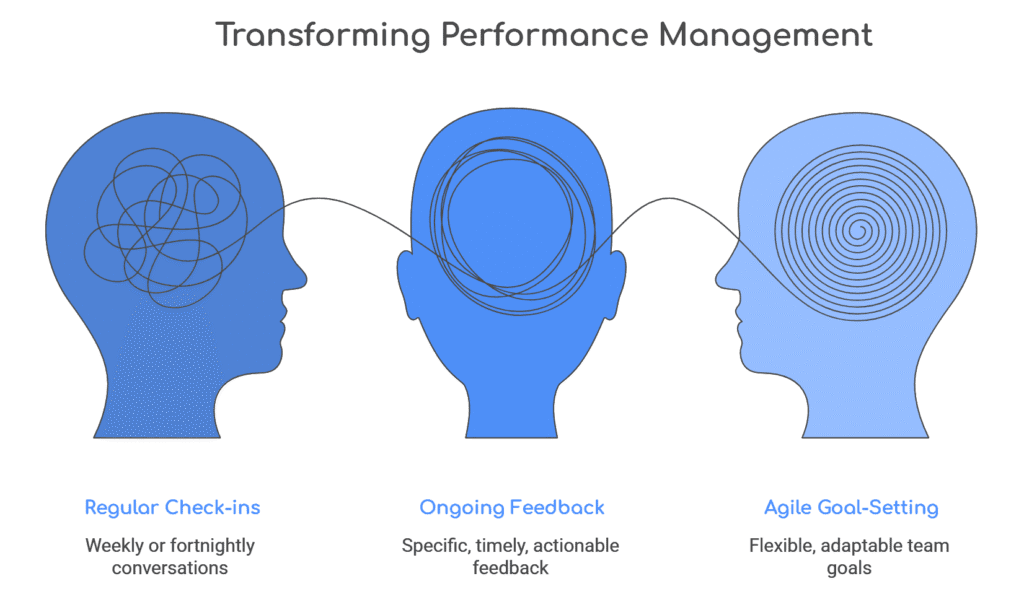
At its core, continuous performance management involves three things:
Regular check-ins between managers and employees, not once a year but weekly or fortnightly. These are short, focused conversations about progress, blockers, and support needed.
Ongoing feedback that is specific, timely, and actionable. Not “you did a good job last quarter” but “the way you handled that client situation last Tuesday was exactly what we needed, and here is why.”
Agile goal-setting that allows teams to update and realign goals as business priorities shift, rather than being locked into targets set in January that are irrelevant by June.
The Research That Changed How We Think About Performance
Deloitte’s Global Human Capital Trends report found that a large majority of executives rated their performance management process as neither driving employee engagement nor delivering high performance. That finding alone was enough to push many organizations to rethink their approach.
Peter Drucker, widely regarded as the father of modern management, said something that remains deeply relevant: “What gets measured gets managed.” But the real question is whether we are measuring the right things, and whether we are measuring them often enough to actually drive improvement.
When measurements only happen once a year, we are not really managing performance. We are documenting it after the fact.
How Leading Organizations Have Made the Shift

Some of the world’s most recognized companies have already moved away from annual reviews. Adobe, Deloitte, and Accenture are among those that publicly dismantled their traditional appraisal systems and replaced them with ongoing dialogue and development conversations.
Adobe introduced what they called “Check-in,” a system where managers and employees have regular, undocumented conversations focused on expectations, feedback, and growth. The result was not just a cultural shift. It changed how people experienced work day to day.
For organizations in Nepal and across South Asia, the cultural context matters. Hierarchical structures, where employees may feel reluctant to push back on a manager or voice dissatisfaction, can make annual reviews feel even more one-sided. Continuous conversations, when done with the right intent, can actually make it safer for employees to speak honestly, because the relationship is built over time rather than concentrated into a single high-stakes meeting.
The Manager’s Role Has to Change
One of the most important shifts in continuous performance management is what it demands of managers. In the annual review model, a manager’s job around appraisal time is largely administrative: fill out forms, assign ratings, deliver feedback. In the continuous model, the manager becomes a coach.
Gallup’s research on manager effectiveness consistently shows that the relationship between an employee and their direct manager is one of the strongest predictors of engagement and performance. Employees who receive regular, meaningful feedback from their manager are more likely to stay, perform better, and feel a sense of purpose in their work.
This does not happen through annual reviews. It happens through consistent, human connection over time.
Rethinking Goals: OKRs and Beyond
One of the most practical tools that supports continuous performance management is the OKR framework, which stands for Objectives and Key Results. Originally developed at Intel and popularized by Google, OKRs allow organizations to set ambitious goals and track measurable results across shorter cycles, typically quarterly.
John Doerr, in his book Measure What Matters, outlines how OKRs create alignment, focus, and accountability in a way that annual goals rarely achieve. When goals are reviewed and updated every quarter, they remain relevant. Employees understand how their daily work connects to the larger mission of the organization.
In a Nepalese organizational context, this kind of structured yet flexible goal-setting can be particularly powerful. Many businesses here are growing rapidly and dealing with frequent changes in market conditions, team sizes, and strategic direction. Locking goals into a twelve-month cycle simply does not make sense in that environment.
Feedback Culture: The Foundation of Everything
No system of continuous performance management works without a healthy feedback culture. And building that culture requires deliberate effort.
Kim Scott, author of Radical Candor, argues that the best managers care personally about the people they lead while also being willing to challenge them directly. She calls this “caring personally and challenging directly.” Neither half works without the other. A manager who only cares personally without challenging directly gives what Scott calls “ruinous empathy,” which feels kind but holds people back.
Feedback must become a two-way street. Employees should feel safe to give feedback to their managers as well. This kind of upward feedback is rare in hierarchical cultures, but it is one of the most powerful signals of a psychologically safe workplace.
Making the Transition: Where to Start
If your organization is still running on annual appraisals, the shift to continuous performance management does not happen overnight. But it can begin with a few deliberate steps.
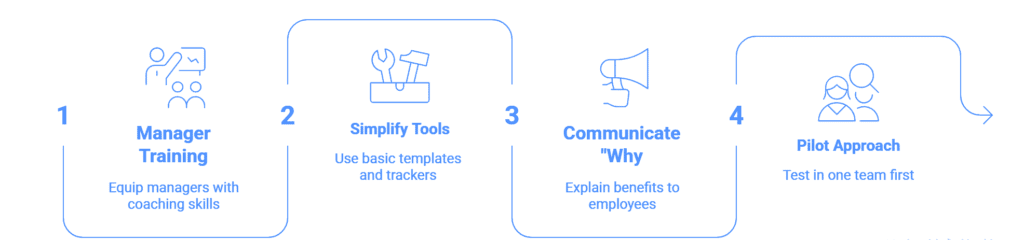
Start with manager training. The success of any continuous performance management system depends entirely on the quality of conversations happening between managers and their teams. Train managers to hold meaningful check-ins, give specific feedback, and coach rather than evaluate.
Simplify your tools. You do not need expensive software to begin. A structured weekly check-in template, a shared goal tracker, and a commitment to regular one-on-one conversations are enough to get started.
Communicate the “why” clearly. Employees need to understand that this shift is not about more surveillance or more accountability pressure. It is about better support, clearer expectations, and more meaningful recognition.
Pilot before scaling. Choose one team or department to test the new approach. Gather honest feedback. Learn what works in your specific cultural and organizational context. Then expand.
Continuous Performance Management Is Not Just a Trend
Some organizations dismiss continuous performance management as a Western concept that does not translate to their context. We would argue the opposite. The desire to feel seen, supported, and developed at work is universal. What changes is how organizations create the conditions for that to happen.
The shift from annual appraisals to continuous performance management is not about adopting a new HR system. It is about fundamentally changing the relationship between organizations and the people who make them work. It is a shift from control to trust, from evaluation to development, from looking backward to looking forward.
The organizations that make this shift thoughtfully and consistently will not just retain better talent. They will build the kind of workplaces where people genuinely want to contribute their best.
221 views